
03 Aug Ally Metzger – Ecology at RMBL – Week 4
Hi everyone! This will be my last post here, as Week 4 wraps up my time at RMBL, a biological research station situated in the historic mining town of Gothic, just outside of Crested Butte, CO. To give the rundown, one last time, I am working at RMBL in the Brosi Lab, specifically with Annie’s Team and my fantastic mentor PJ. This lab studies pollination ecology, which requires them to look at plant-pollinator interactions (which, if curious, I explained in my Week 1 post). The research that Annie’s Team does involves catching bugs in dedicated plots of land, and noting which flowers the pollinators they catch landed on. I will go into this process in more detail in a second, as this is what I mostly did this week. On the other hand, my mentor, PJ, is specifically studying the difference in the nutrients in pollen of different flower species and if that is a factor in why certain pollinators visit certain flowers.
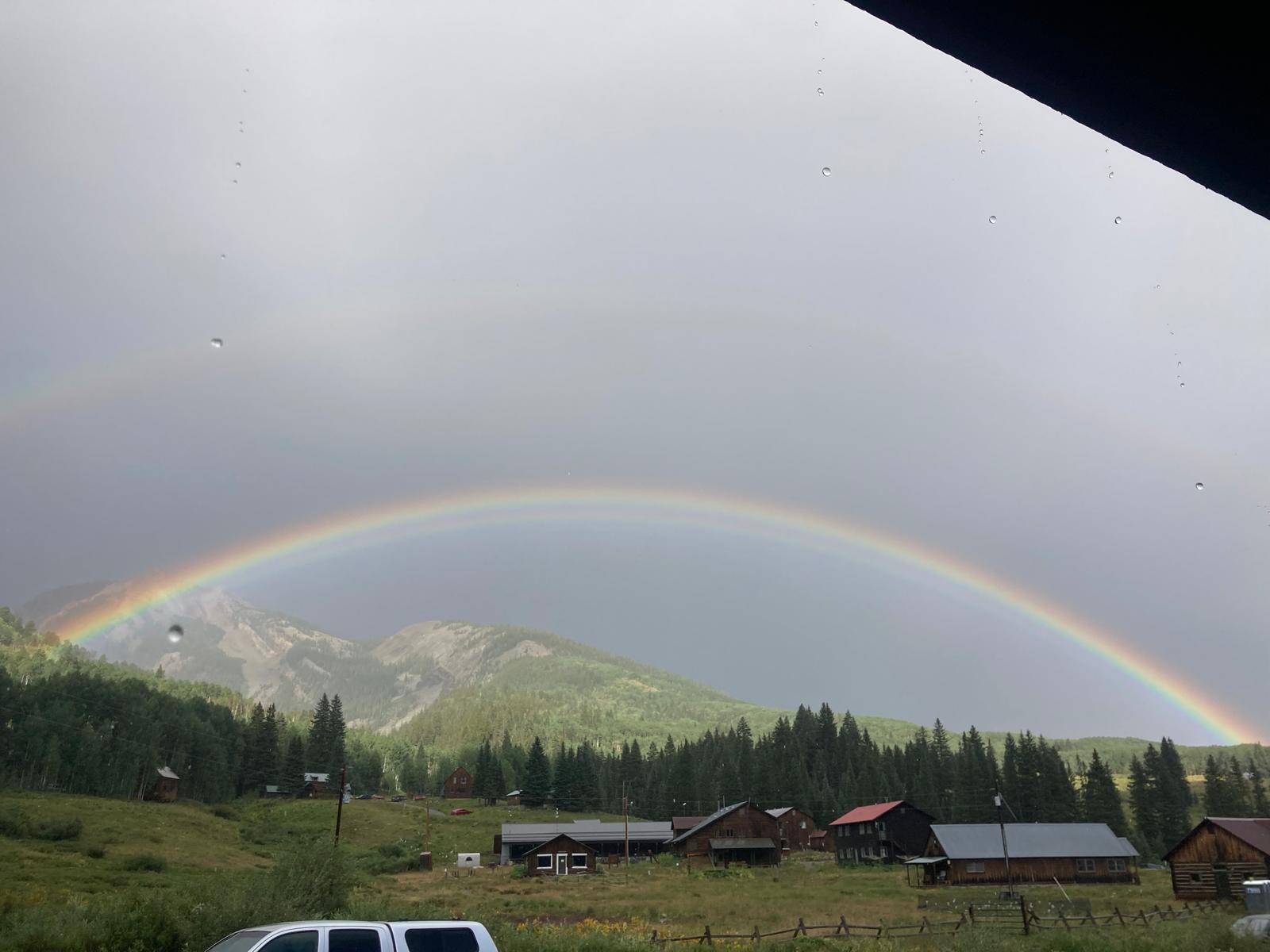
a crazy rainbow over Gothic and also a picture to showcase the bad weather the rest of the week
This week started off with most of Annie’s Team making the trek up to Virginia Basin, the high-site that I briefly mentioned back during Week 2. Monday had the best weather of the week, so if they were going to do it, it had to be that day. This meant that PJ and I had to go sample Gothic Town, the site right by RMBL in short driving distance. At this site in particular, there weren’t many flowers out, and we even got to remove one of the sections of land that we were supposed to observe because there were no flowers in it at all. This is a good time to mention that before we even start to catch bugs, we must first do a flower count. This is essentially noting the species of flowers in each section and how many of each of them there are. This allows us to not only keep track of what flowers and how many of them were present at this time, which means that over the years scientists can see how the environment has potentially changed, but this is also necessary to see what the pollinators can even choose from when we start to observe. Once the flower counts are done, then we can jump into sampling.
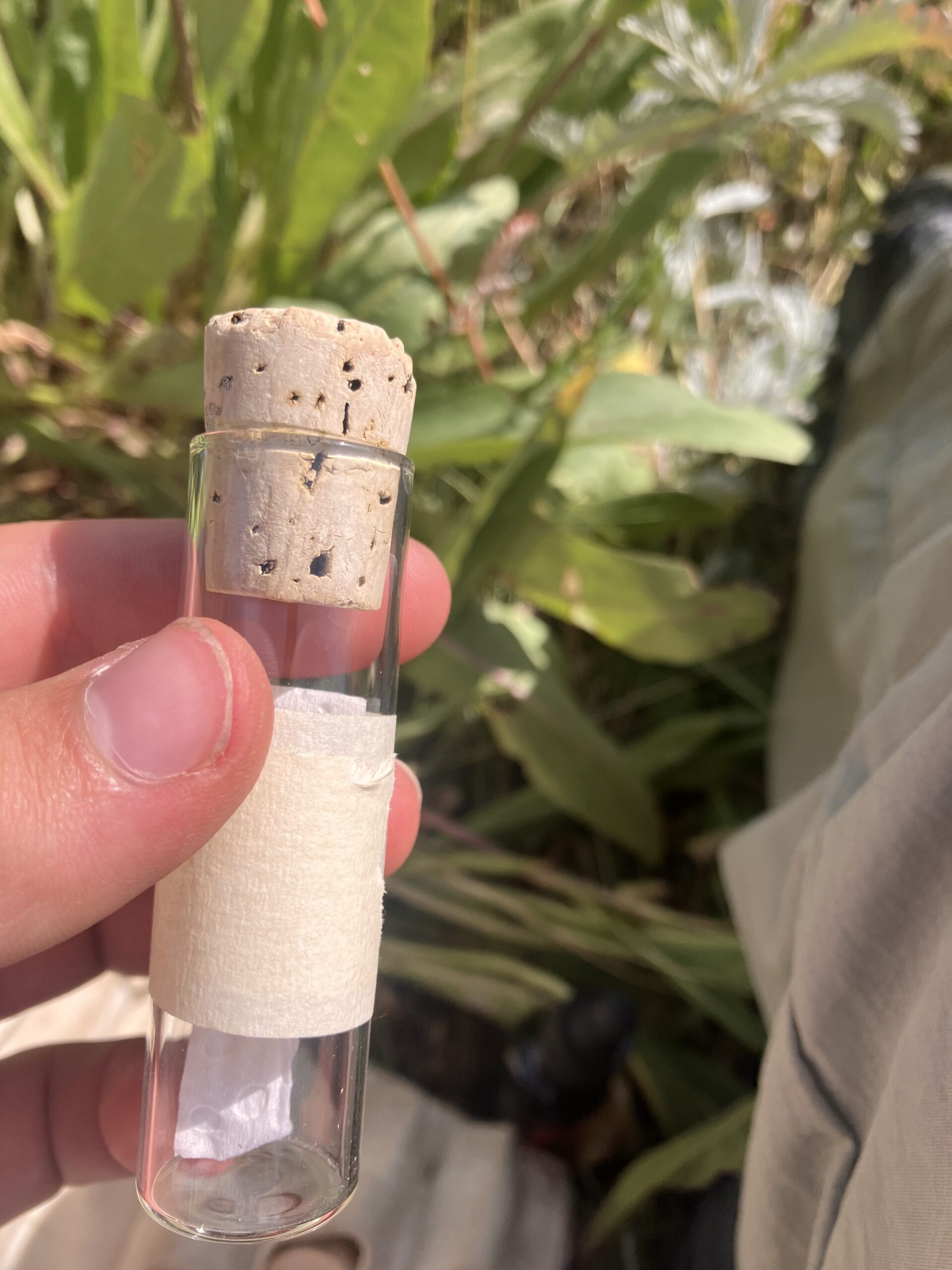
vial with a small paper towel for caught bugs
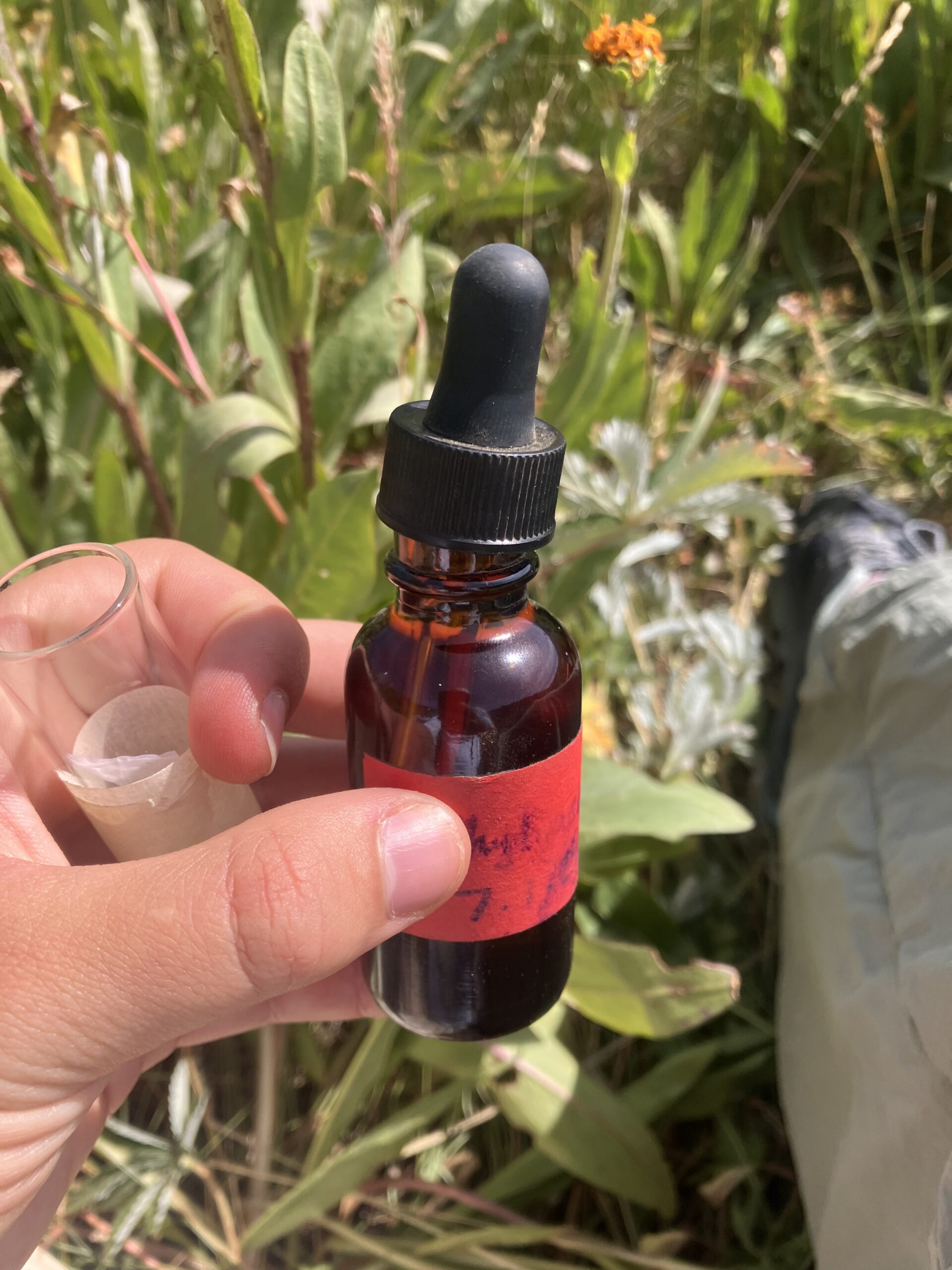
ethyl acetate for soaking the paper towel and to cause the bugs to asphyxiate
I explained this just a little while ago, but sampling requires us to observe sections of land for one and a half minutes on both sides for a total of three minutes. These sections of land are small, about two meters long and a meter wide. During this time we watch the plot of land for any pollinators to land on flowers and interact with the flower’s reproductive parts. If we see a bug, we pause the timer, catch it in the net, then, as long as it’s not something like a bumblebee or butterfly, we put it in a vial with a little paper towel soaked in ethyl acetate. This then causes the bug to asphyxiate and die. Once this is done, we write a couple of things on the vial, such as who caught it, what section it was in, etc., so we can keep track of the bugs that are caught. Each round consists of visiting all of the sections (split up by the amount of people helping during the round), catching bugs, then entering this data onto a paper. On this paper we record the same things recorded on the vial and we also include misses, things we saw but didn’t catch, including bumblebees and the other bugs we don’t kill.
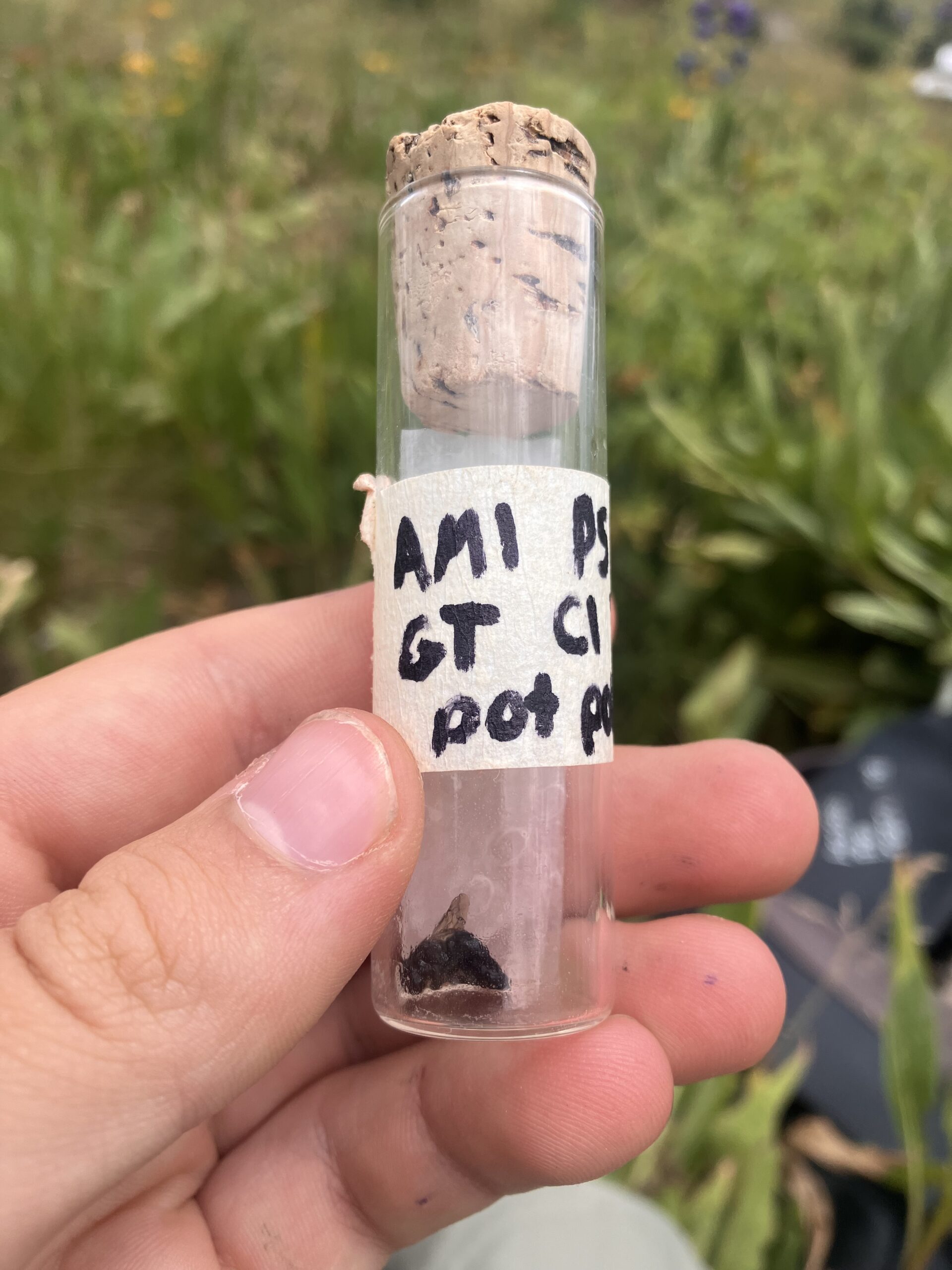
a bug that was caught and died, also a look at how we label the vials
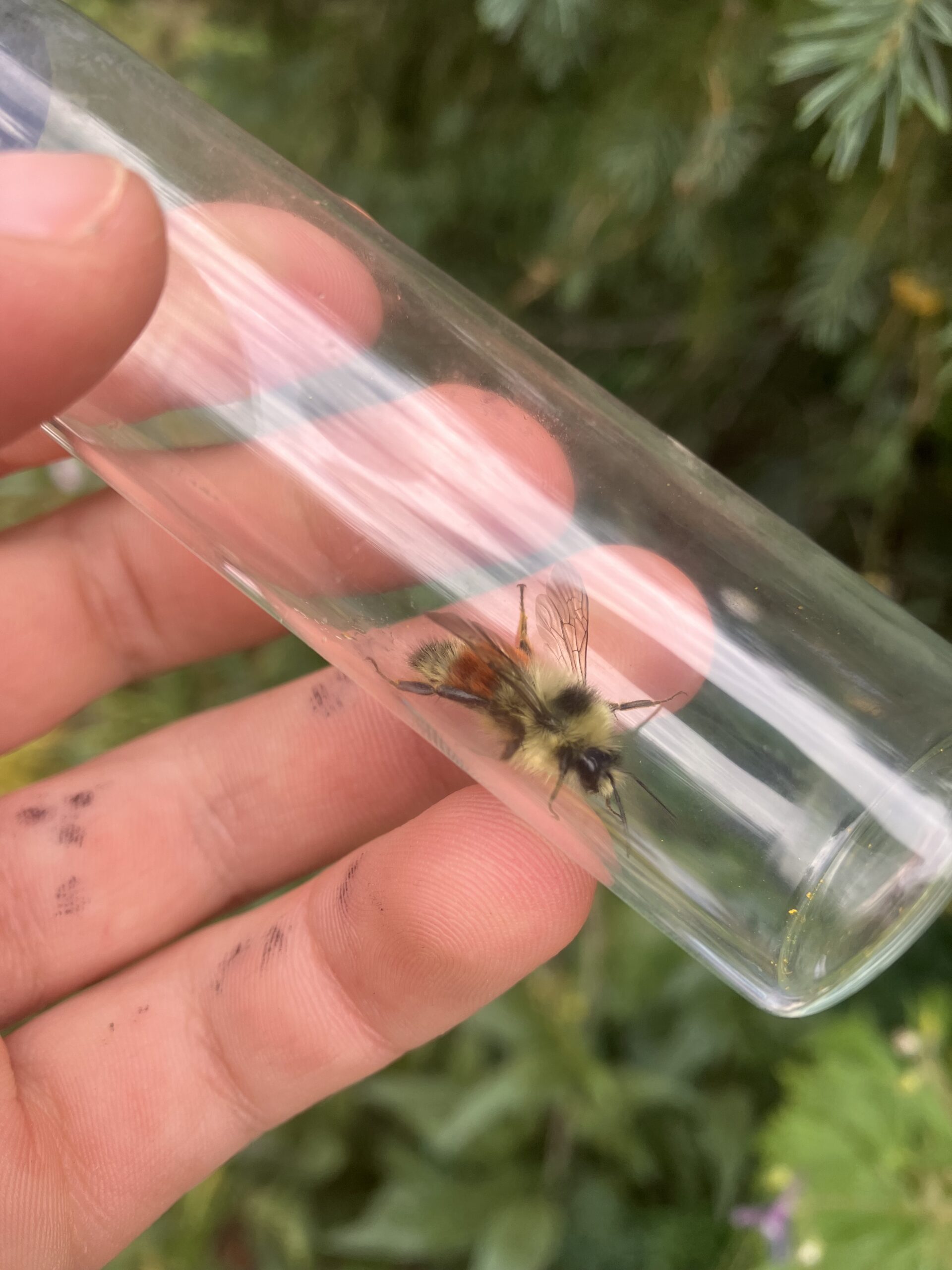
a male bumblebee that was caught to identify, then promptly released
Once we get back to the lab. There are two things that happen with the bugs we have collected. Any solitary bees and syrphids from one of the rounds are set aside to go through pollen processing. The rest of the bugs, however, just go through insect processing. Insect processing, at least to me, is the easier task. This involves taking microcentifuge tubes and transferring the dead bugs from the vials into those tubes. Finally, we fill the tubes halfway with ethanol, to preserve them. With pollen processing it’s a different story.
This process involves transferring the insects (solitary bees and sryphids) from the vials into microcentifuge tubes that will hold the pollen, and then filling the tubes with 1000 mL of soapy water using a pipette. We then vortex the tubes to release the pollen off of the insects and to encourage it to gather at the bottom of the tubes. Once this is done we carefully remove the bugs from the soapy water with tweezers, making sure to sterilize them for each tube so as to not contaminate the different pollen in the tubes. Then we carefully pipette up the 1000 mL of soapy water from the tubes so that only the pollen clump remains in the tube. This part is tricky as if the tip of the pipette gets too close to the pollen, then it can either break it up, allowing the pollen to disperse through the liquid which means it has to be vortexed again. On the flip side, if the pipette tip is too close to the pollen, there is the possibility of completely sucking up the pollen into the pipette. Once this step is done however, we fill each pollen tube with 200 mL of ethanol to once again preserve the pollen. With the discarded bugs, they go through insect processing and end up in new tubes with ethanol. These processes, particularly the pollen processing, were something I had never done before, which was very exciting. I’m also glad to have learned to use a pipette as it’s definitely a very transferable skill in any sort of lab.
In terms of PJ’s project this week, we continued the same work as every other week. We did not work on chamaenerion angustifolium this week like I originally had said we would. The pollen that we had somewhat separated from the anthers did not go bad over the weekend, and there was no good time to really work on separating more pollen from anthers. Moving past this, this week, in terms of flowers, was much worse than the previous weeks. This meant that we only really collected pollen from heliomeris multiflora, erigeron speciosus, and erigeron elatior, because they were really the only flowers out. Everything else was pretty much past. This is the reason that this internship is ending this week. The interesting thing about ecology and outside field work is that you aren’t running on your own timeline, you are running on nature’s timeline. This means that you can only do what you can do in the time that is allotted. Since there is not much to collect pollen now, my internship has reached its endpoint.
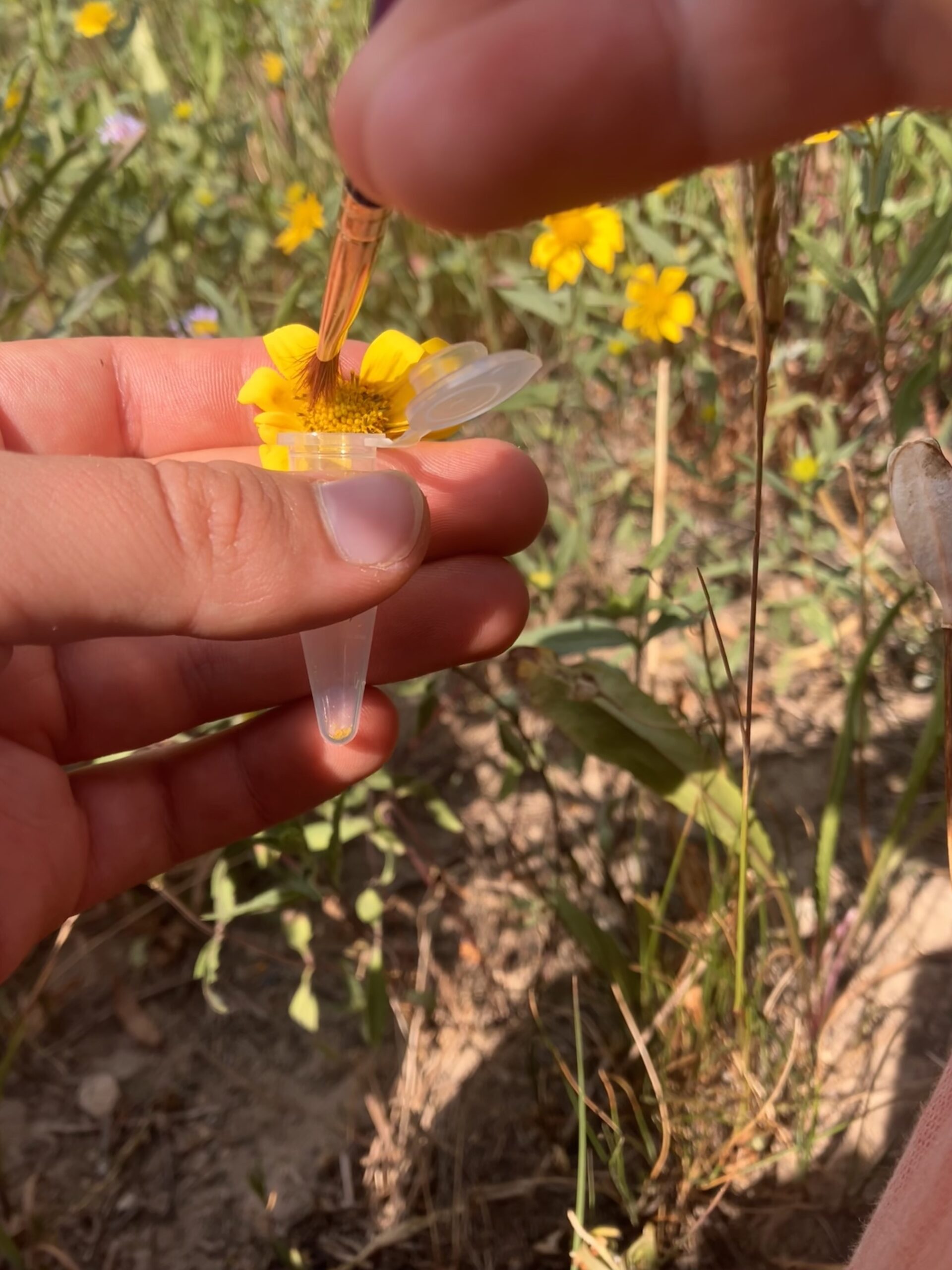
collecting pollen from heliomeris multiflora
Before I add my final remarks, I would also like to add that outside the internship this week, there was a team potluck Wednesday evening. The food was very yummy and we played a bunch of fun and hilarious games, it was a great time! Then on Friday, RMBL hosted the No Talent Talent Show. The acts were absolutely hilarious and my mentor, PJ,, was one of the hosts and she made it super fun! It was so great to spend time with this amazing team one last time before my time here is done.
I truly can’t even express how amazing this experience has been. Knowing the bare minimum when I came in, I don’t think I could have ever predicted the outcome. The research that I got to help out with truly gave me a feel for field work, and it felt really good to be apart of something that would grow to become important papers that would continue to further the ecology community. But, I think that the most amazing part of this internship was who I got to spend it with. I cannot stress this enough, these people are the most incredible individuals ever. They are not only smart and talented, conducting their own research and making important contributions to the science community, but they are funny, kind, crazy, and creative. They were simply a joy to be surrounded by everyday. And even though the work can be monotonous, they are what made each day truly unique and special. I don’t think I’ve ever laughed as hard as I have when I’ve been with these people. They were so welcoming and let me, a truly unqualified student in high school with no experience, help with what they were doing, not sheltering me from the trickier things, which I am truly grateful for. I feel so lucky to have gotten this experience, I have learned what it’s like to live on my own, I have learned so much more about field work (which I didn’t realize I would enjoy so much), but most of all I have made some amazing connections with some fantastic people. I don’t think I could ever forget this month of my summer, and I don’t want to.
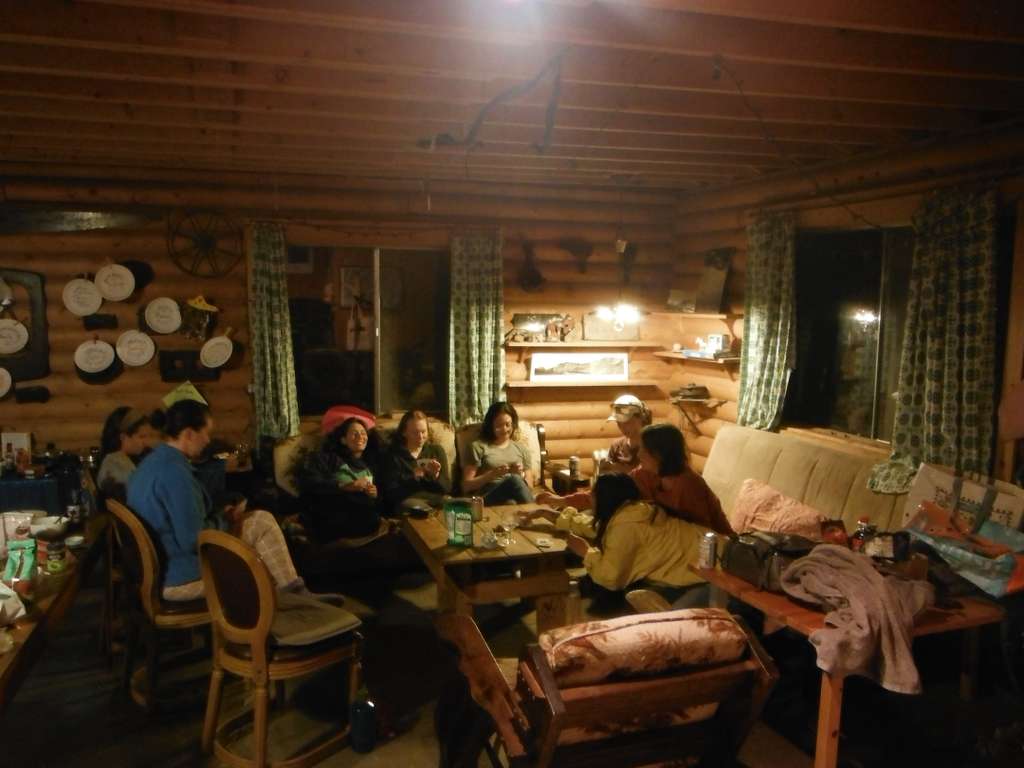
playing games with the team at the potluck Wednesday evening
Special thanks to Sarah Holbrooke and the rest of the Pinhead team. Without the work you all do to place kids all around the country in truly prestigious and amazing places, I never would have this adventure in the first place. I also send my love to the Brosi Lab. You all have already accomplished so much and I am fully confident that you will continue to do so. To know that I got to be a part of your amazing lives for truly only a second in the grand scheme of things, is so special to me. You all have made such an incredible impact on me and I won’t ever forget this summer. And finally, thank you to anyone who has kept up with my couple of blogs. I hope I explained things well enough and I hope that you have enjoyed my journey.
No Comments