It still hasn’t hit me that this was the last week I had in the George Lab, and it’s definitely been hard to say goodbye. As I’m writing my blog after my internship has finished, I just feel thankful for everything I went through, and everyone I went through it with. The learning I did in the lab, the bonds I’ve built, the adventures we went on, and even the many mistakes I’ve made- all of these lessons have truly cultivated one of the best summers of my life. Thank you to everyone who has made this experience become a reality, especially to Sarah Holbrooke, Trang Pham, and the Pinhead Institution- this would’ve never happened without you. My heart is filled with gratitude for my mentors, teachers, and friends at the George Lab, for they have become a part of who I am and have changed the trajectory of my journey in life. This whole experience wouldn’t have been nearly as memorable if I weren’t housed with the best housemates ever, and to you guys, I am thankful for the laughs we shared, the trust we’ve built, the cries we exhaled, and the many songs we sang. To the summer of 2025, thank you- I have so much love for you!
Mon. July 14, Day 36-
My last Monday here at the George Lab started off strong! This week was the week of surgeries for the new cocaine and oxycodone cohorts. These surgeries were different from the ones I did with Sonja; these surgeries involved placing catheters into the jugular vein of the rats. The catheters help with the self-administration of the drug to the rat. When the rat pushes the correct lever to receive its drug, the tube then administers the drug as it passes through the body. This surgery was a bit more intense than the virus injection, but it was interesting to watch. The surgeons consisted of Molly, Sonja, and Elizabeth. Joseph, Max, and I were in charge of pre-op and post-op tasks. The pre-op section was definitely a little more stressful than post-op work, but we were able to make it work. In pre-op, we needed to knock down the rat under anesthesia, and when the rat was still down, we had to shave them on their stomachs and on their backs so getting them open would be easier. Shaving was a lot harder than it looks because the rat needs to remain asleep the whole shaving process, but there were many times the rats woke up during it. If they woke up, then we had to keep track of how long they needed to stay back in the anesthesia chamber. I got to experience shaving a rat, but I don’t think I was a very good barber, so I stuck to writing surgery and recovery notes and also post-op procedures. In pre-op, the rats also had to get injected with flunixin which helps with inflammation and pain, so when they wake up, it’s not too bad. Before heading to the surgery tables, the rats’ weights also have to get taken for record on the surgery notes. These notes are quite important, as they hold what happened in the surgeries, how they went, and if anything went wrong. And they are also looked over by the Institutional Animal Care and Use Committee (IACUC) which is responsible for overseeing the animal care and use program in the lab, making sure it aligns with ethics and not abusing animal treatment. After the pre-op station, the rats head over to either Sonja, Elizabeth, or Molly based on what kind of drug the rat would be taking. Molly was in charge of the cocaine rats while Sonja and Elizabeth did the oxycodone rats. After surgery, then it was time for the rats to go through post-op. I wrote down any notes the surgeons had for the surgery, and then injected them with cefazolin, which helps with bacterial infections. Then, we placed them in their recovery chambers and wrote down notes on their recovery. We made sure each rat woke up, was alive, and didn’t have any excess bleeding. These surgeries lasted all morning to a little after noon, so we were all working and locked in for quite a while. After surgeries were finished, I asked Sonja to look over my slides before I presented tomorrow, to make sure I didn’t have any misconceptions on any topics. She helped a lot and gave me a bit more insight on some things I had trouble understanding, making my slides better than they were before. Once she checked over my slides, I was officially done with the start of my last week in the lab.
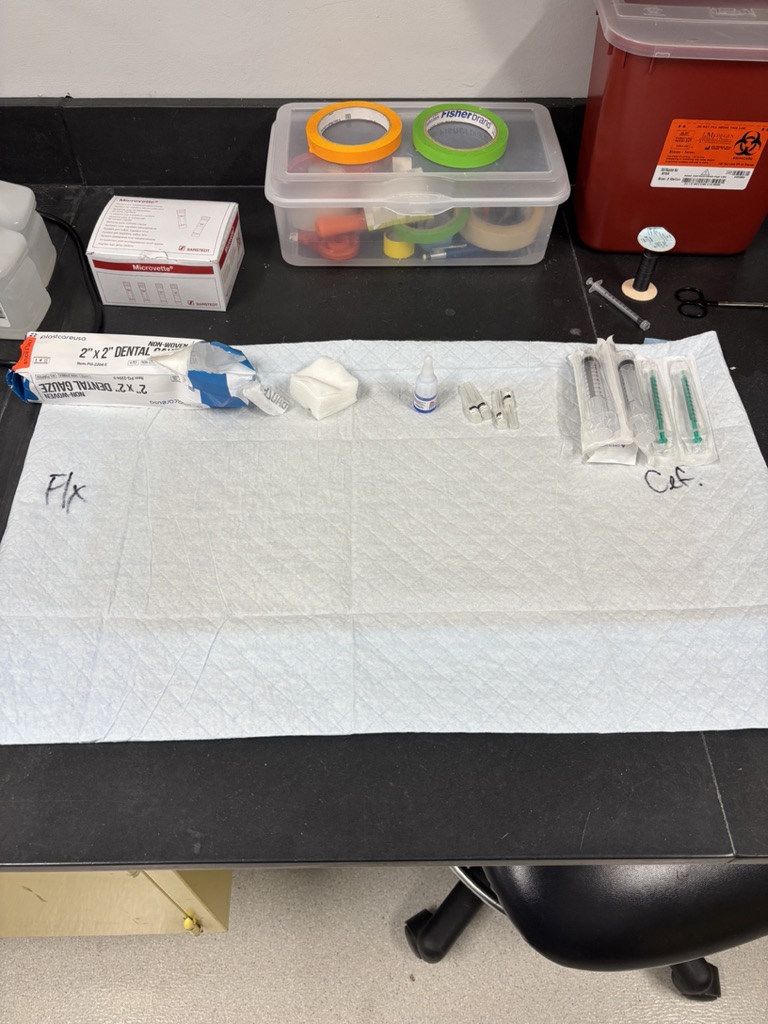
Pre-op/Post-op area
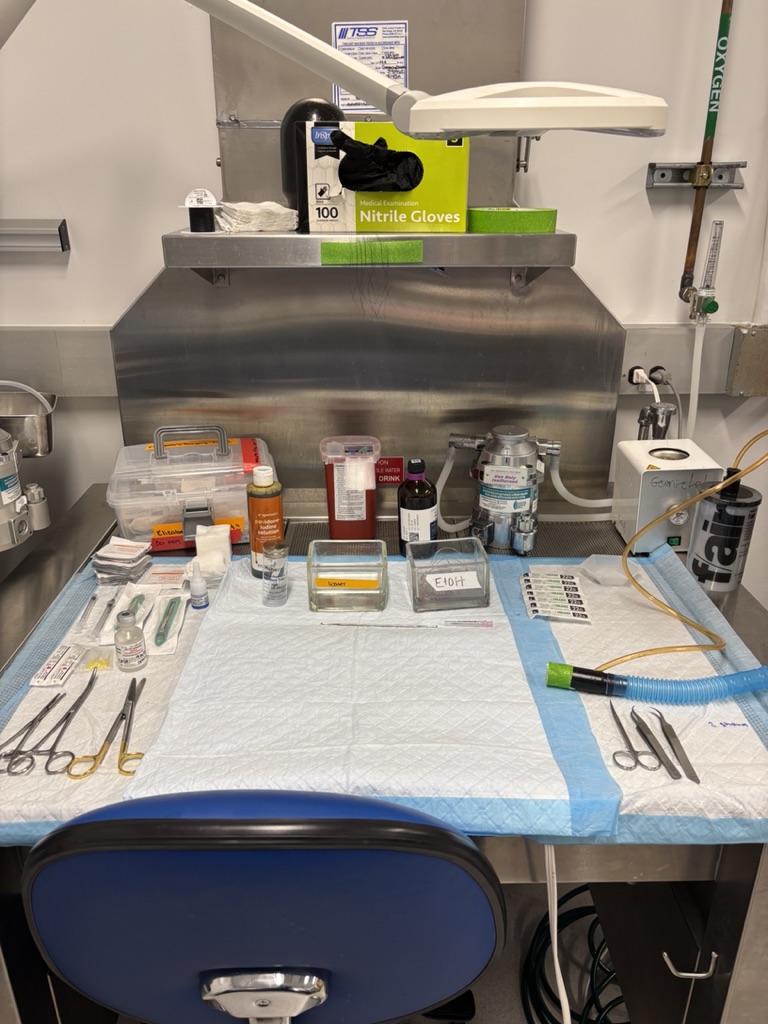
Surgery set-up
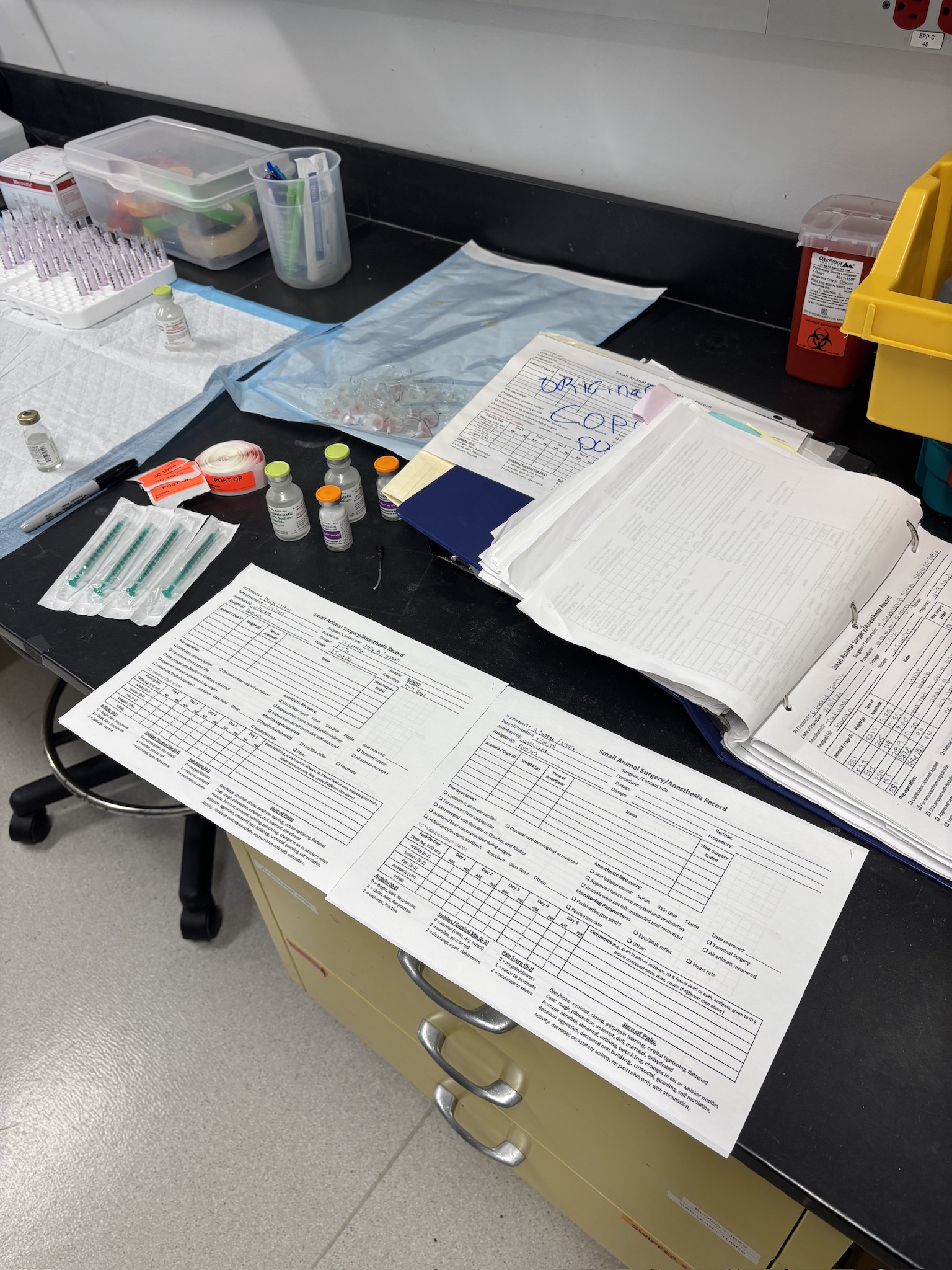
My little note-taking station!
Tues. July 15, Day 37-
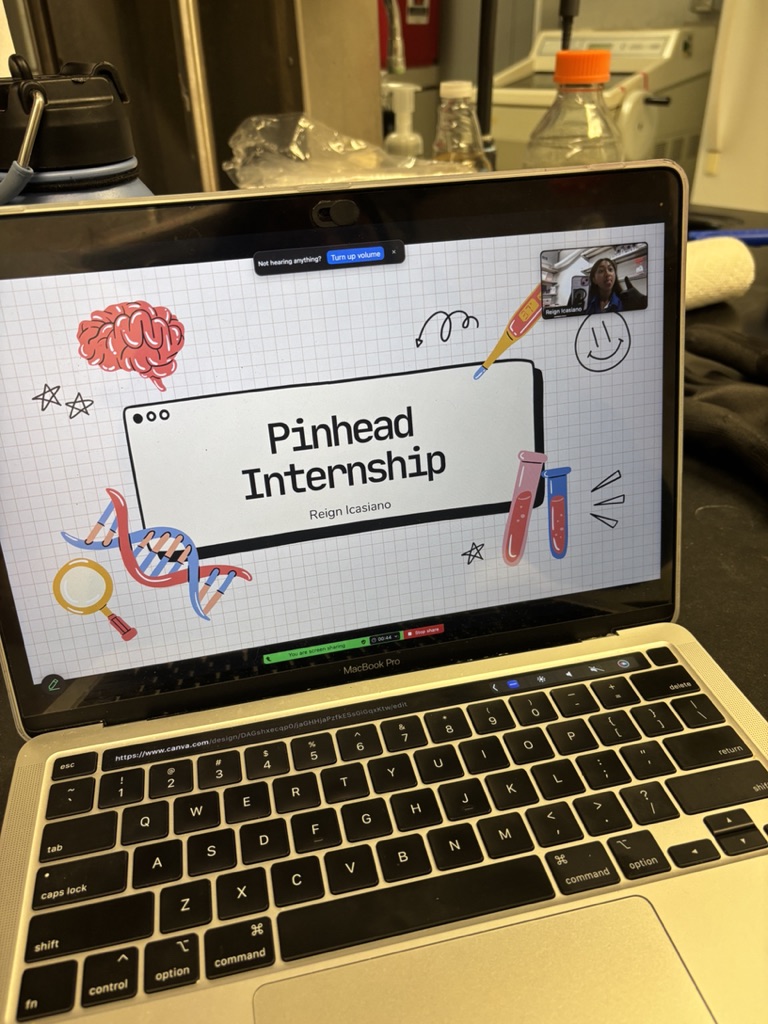
Presentation time on Zoom!
Today was another early morning of surgeries! This morning, we also had lab meeting on Zoom where I had to present about my internship in the lab. Before hopping on to the meeting, Molly wanted to start some of her rats, so she was able to get two of the ten rats she had to do today. I honestly wasn’t that nervous about my presentation until right before hopping on the meeting. Thankfully the presentation went really well, and Olivier, our Principal Investigator (PI), even said I was a natural speaker which was really nice to hear! He gave me some good critiques as well for the Pinhead Presentations which will for sure be implemented. After the meeting, I got to be with Selene in the MTF Wet Lab, and she taught me how to do bloods. During surgery, the surgeons have to poke behind the rats’s eye to get some blood that we then spin for it’s plasma. The plasma is used for all kinds of research, so it’s important to get a little from the rats. Fortunately, I did a similar procedure that we did for bloods at school, so I caught on pretty quick. Selene also taught me really well, so it was easy to comprehend. I also got to use this time to talk to Selene a bit because she’s been out of the lab most of the time I’ve been here, so it was nice getting to know someone new in the lab! Doing bloods was a pretty simple procedure, so I was able to do it without supervision. First, when I received the blood tubes, I recorded the time I got them at, I also wrote down what tubes I got. Then, these tubes went into the centrifuge,
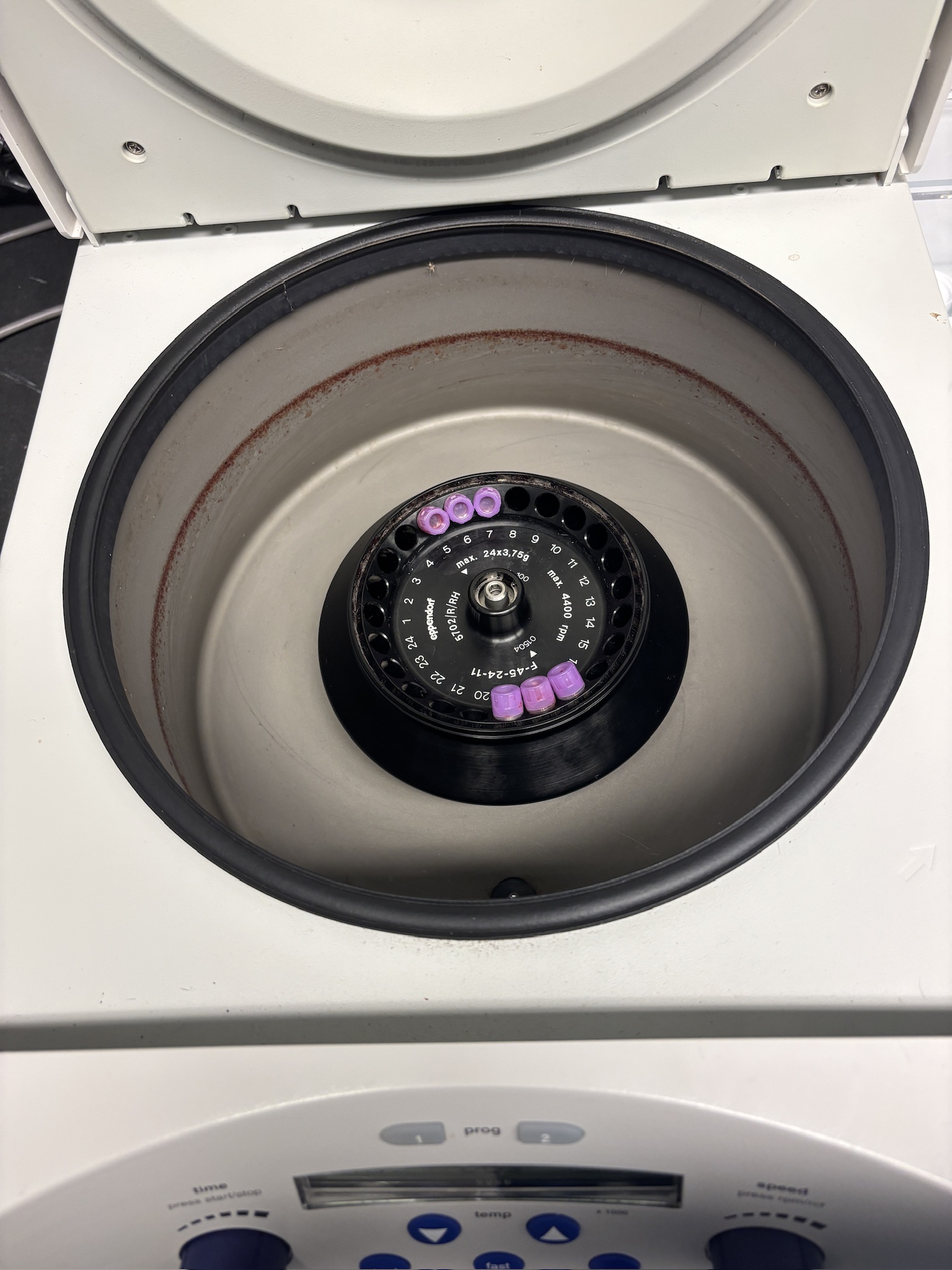
Tubes in the centrifuge
which spun the tubes for 10 minutes to separate the plasma from the other cells in the blood. The important thing of the centrifuge is that it’s very sensitive to weight, so if a tube is put on one side, another tube had to be placed directly across from it to balance the weight. If the amount of tubes were odd, Selene had “sham” tubes, which were essentially placeholders for the tubes that didn’t have a partner. During the 10 minutes the tubes were being spun, I had to label new plasma tubes so I could transfer the plasma from the full blood tube into the new plasma tube. Once the tubes were done, I took them out of the centrifuge and micropipetted the plasma from the old tube into the new tube. This part was definitely more difficult, especially since I had to make sure I didn’t get any of the excess stuff in the tip of the micropipette. If I messed up really bad, it was okay, just a little tedious because I had to respin the tube in the centrifuge for three minutes. After transferring the plasma into the new tube, I recorded about how many microliters of plasma I collected, as well as the score of the purity of the plasma. Scoring the plasma was a bit more opinionated, not really a correct answer. The score went from 0-5, 0 being clear, to 5 being so red it’s basically blood. The scores of all the bloods I did today were between 0 and 1, which was really good! I repeated these steps for every batch of blood I got, so I got the hang of everything pretty quick. I really enjoyed doing bloods, mainly because I was trusted enough to do them myself which was really cool!
Weds. July 16, Day 38-
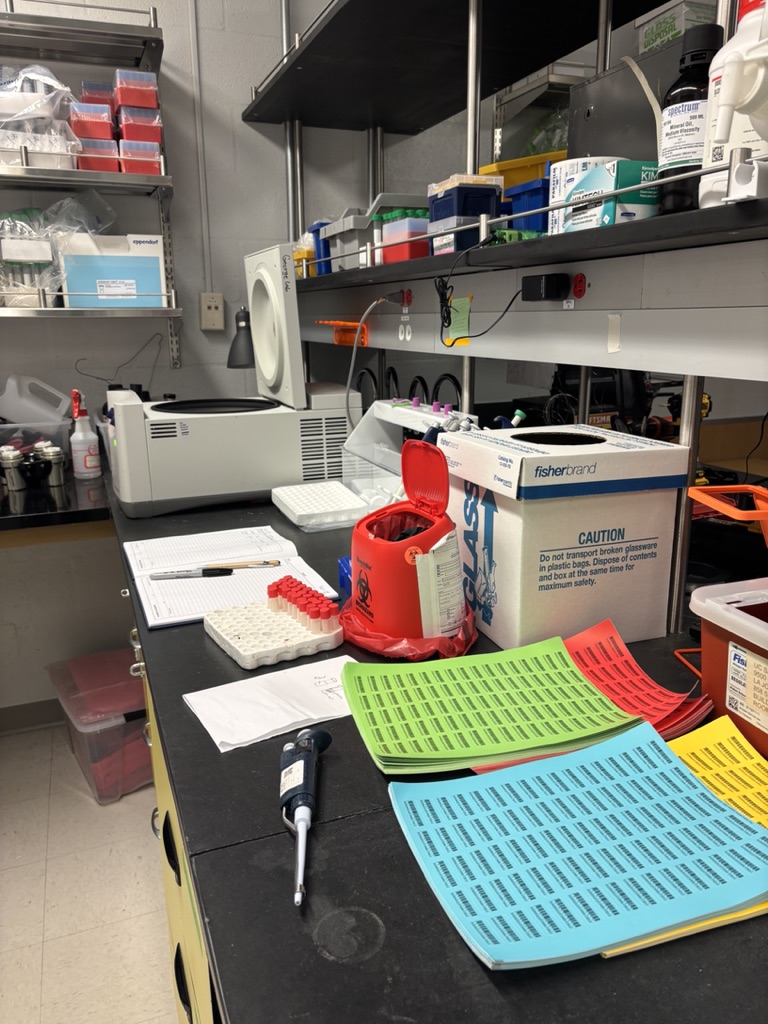
Blood protocol setup
This morning, we had our last day of surgeries! Everyone was a bit under the weather today, but we pushed through for the last day. Today, we also had Sara join us, which was really fun! It was nice to see her one last time before I left. In the surgery room, I was tasked to making what they call “hoodsies” for the catheters. They’re just little covers for the catheters so nothing goes into them to get the rats infected. Soon after, though, I was tasked to do bloods, which I was really excited to do. The whole surgery day I felt like a genuine part of the procedure, doing things on my own without supervision which truly boosted my lab confidence. Unfortunately, today was not my day doing bloods though, as I kept messing up and having to respin a bunch of bloods. None of the actual data was messed up, but it definitely got confusing trying to remember how much plasma I had collected before putting the tube back into the centrifuge and then re-collecting it. However, I brushed it off and got through the hardships, finishing with results I was happy with. Today was another early day for me, ending the halfway point of my last week in the lab.
Thurs. July 17, Day 39-
Sonja and I started the morning in MTF, saying hello to her new rats! For her CRF-cre project, she got a new batch of rats, so we headed over to them to handle them. Rats need to become acclimated to humans and the new environment they just got put in, so holding the rats and conversing with them for at least a minute everyday is very important to build trust between the animal and the handler. I watched Max handle rats by himself, but this time I got to hold the rats to help Sonja which was really fun. These six weeks have definitely changed my opinions on rats, and they’re one of the cutest animals ever honestly! Even if they did pee and poop on me while I was holding them in my arms, I forgive them because they’re so nice. After handling our rats, we said left MTF and headed to Skaggs. Sonja assigned me to use the cryostat and section two of her new brains for IHC next week. These brains were from the two rats we did stereotaxic brain surgery, the virus injection, about two weeks ago. It was really interesting to connect going from animal to lab, and seeing a lot of the timeline for research. Since I had already done some sectioning before, Sonja let me do it again by myself which was really exciting. I did ask her to help me setup the first brain and prep it properly before I started cutting, but for the second brain, I did the whole thing pretty much myself with guidance from Sonja. In between the two brains I was sectioning, I helped Sonja make some PFA. PFA is really really bad to inhale since it’s so toxic, so everyone in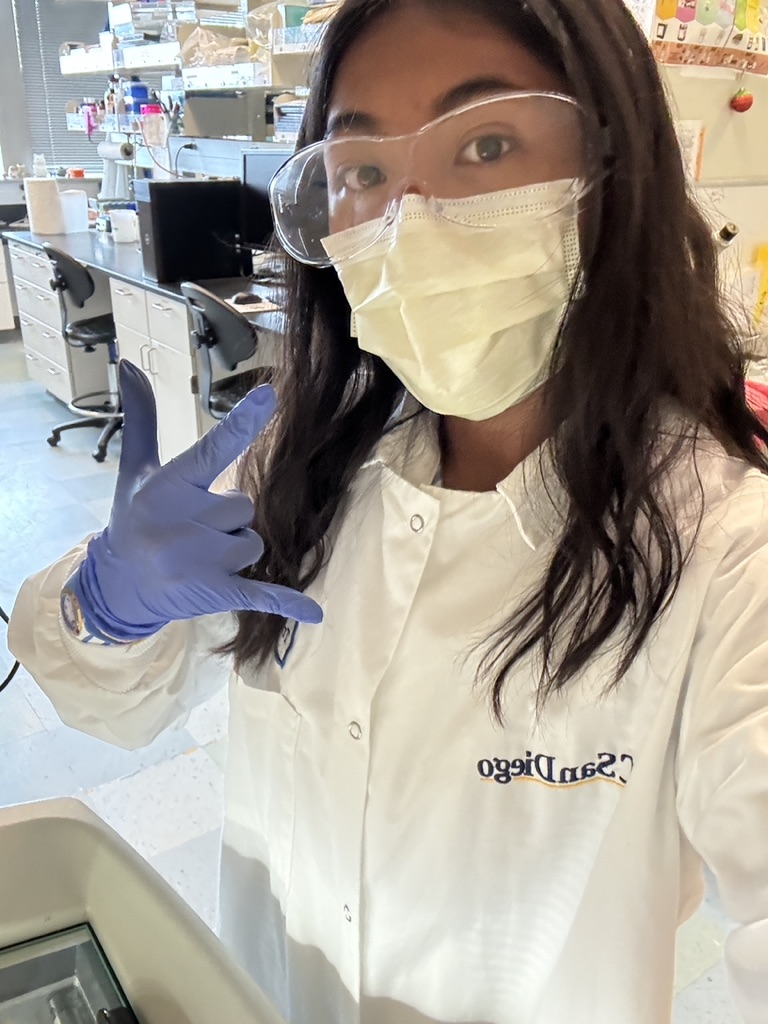 the lab was required to wear a mask. PFA is formaldehyde, which pretty much stiffens the body. PFA is used when doing perfusions, and we started to run out of it, so Sonja wanted to make some to just have some in stock. I wasn’t too involved in the PFA making since I was also on sectioning duty, but from time to time I would hop up from the chair to go and shadow Sonja.
Fri. July 18, Day 40-
Today was a packed day to fulfill my last hours here in the lab. The first thing we did was check to make sure the PFA Sonja was filtering yesterday was all good and in the fridge because Joseph was in charge of it last night. Sonja made 2 bottles with 2 liters of PFA in them, and we were going to do the same thing today. Since I wasn’t on the cryostat today, I got to help with actually making the PFA which was really fun. The first thing we did was pour 3 liters of PBS into a 4 liter beaker. We didn’t fill it all the way up to 4 liters because the PFA powder wasn’t added yet, adding the powder increases the volume of the solution, so if we added 4 liters of PBS to begin with, then adding the powder would make it so there’s a greater number than 4 liters which we don’t want. For 1 liter of PBS, you want 40 grams of PFA, so Sonja carefully measure out 80 grams onto a weigh boat, and then another 80 grams for precise measure. Before the PBS was added to the beaker, a stir bar was put into the solution to help dissolve the powder faster. A temperature probe was also placed onto the beaker to make sure the solution didn’t boil while on the hot plate. We kept an eye on the solution until it reached 65 degrees Celsius, and then took it off of the hot plate. Then we took the bottles that the PFA would reside in, and some extra PFA specific bottles, and started to funnel out the PFA to make sure that only PFA were going into these bottles. We used funnels and filter papers to filter the water out. Since the paper only let through so much water at a time, someone would need to repour the solution into the funnels to make the process go faster. By the time we finished, it was already time for the planned lab lunch that the George Lab planned as a little goodbye for my last day here. It was so nice, and I honestly didn’t expect it until Sonja messaged me earlier that week about it! We headed over to the Price Center on the UCSD campus and had some Panda Express which was really good, and it was fun to talk to Olivier, Elizabeth, Selene, Sonja, and Max over lunch! They also surprised me with a George Lab shirt which was super sweet, and I can’t wait to represent it back in Montrose!!! After lunch, Olivier and Selene parted from the group and headed back to Skaggs, while the rest of us went down to MTF. Sonja and I went back to her new CRF-cre rats to handle them, get their weight, and also mark their tails to identify who they were. After finishing, we went back to the MTF office where I said bye to Elizabeth, and then we were off back to Skaggs. Joseph and Natalie were able to watch over our PFA while we were gone, so it was good to see them before I left! While Natalie kept filtering out the PFA, Sonja and I got to pH the previously made PFA from yesterday. To my surprise, I did in fact apply what I learned in AP Chem to the real world, because Sonja was able to quiz me and I got all the answers correct! Yay! But basically, to pH, there’s this little stick with a glass orb inside that determines the pH of liquids. For it to work, you first need to calibrate the stem, by putting it in different pHs- 7, 10, and 4. You want the pH probe to get used to at least two of the pHs you need to be the closest to, and since PFA needs to be at a pH of 7.4, we calibrated the probe to 7 and 10. After calibrating the probe, you place the probe inside the solution to see if you need to add any NaOH(more basic) or HCl(more acidic) to lower or higher the pH. Typically, the PFA is a little above 7.4, so adding a bit of HCl will help lower it to 7.4. After fixing the pH of the solution, we’re able to put them back in their respective bottles and put them in the fridge for future use. We continued to filter out the second batch of PFA afterwards, and Natalie thought of a genius idea to filter the solution through a vacuum to speed up the filtration of the solution. So once the rest of the PFA was filtered, Natalie and I pH’d it, and put it in the fridge. That was pretty much the last thing Sonja had me do in the lab! Other than that, I got to take some stuff home, like the practice brains I plated, as well as my safety goggles. So once we were done in the lab, I had a very sweet goodbye with everyone there- Sonja, Natalie, Selene, and Joseph- and headed out.
Like I said, it still hasn’t hit me that I won’t be walking into the lab on Monday, or even the fact that I’m traveling home as I’m writing this, but this experience has been one of a lifetime. There are so many words I could say to describe how I feel, but none of them seem to truly express what I want to. So again, thank you 🙂
Thank you so much for reading my blog and keeping up with my adventures! It’s been an honor to work at the George Lab and even spend the summer in San Diego. I really hope, one day, science will open more eyes and help the world even more than it has. That, though, would start with this new generation, and I hope that I can be a part of that epiphany!
This has been Reign Icasiano, officially signing off from Pinhead: Team San Diego!
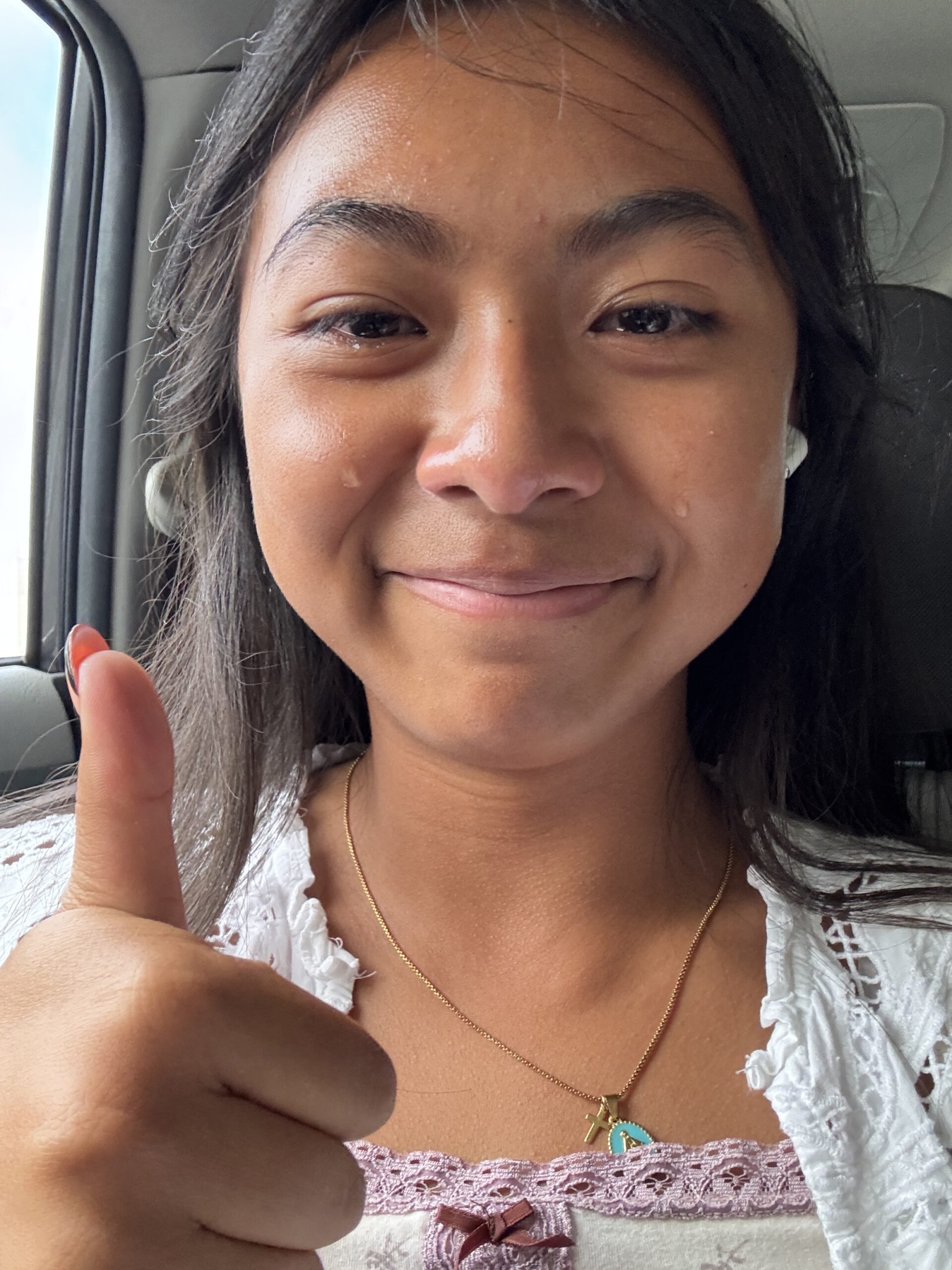
PS- this was the aftermath of my last day haha!
There are no comments published yet.