
06 Jul Maiya Wagner – Organic Chemistry at TSRI, Engle Lab – Week 4
Hi everyone, to recap my name is Maiya Wagner, and I feel so blessed to be given the opportunity to work in San Diego interning at the Scripps Research Institute. I am working at the Engle lab, which works with catalysis, and is run by Keary Engle, and with Madison Wagner, a third-year graduate student and PhD candidate. It’s hard to believe it’s been a month already!
I started my week off by learning that the pink sludge is probably okay the way that it is, we let it sit and air out for a few days to let everything evaporate, and it turned a lot less pink and a lot more brownish-red. We didn’t do anything with it at all this week, so next week we might continue to work with it. On Monday, Madison and I started with a reaction she had made before I arrived at the lab, we spent most of the day purifying it. After lunch we ran a prep plate for it, filtered out the product from the silica, and it glowed under the UV lights! Tuesday was the most intensive day with new techniques. We took the compound filtered from yesterday and ran it in a reaction that day! We added some chemicals, like tolylboronic acid and iodobenzene, as well as palladium and GABA, and ran it for about two hours. We also added Lithium Methanolate, a base that can’t really be in air and is kept in the ‘glove box’ of chemicals in inert atmospheres. We had to get it out of the glove box and that was really interesting to learn about the different conditions of each place. Afterwards we added hydrochloric acid(HCl), a strong acid, and ethyl acetate. We packed a small bit of cotton and sodium sulfate into a tube and ran the compound through to somewhat purify it. We then ran it in the rotary evaporator and took an NMR.
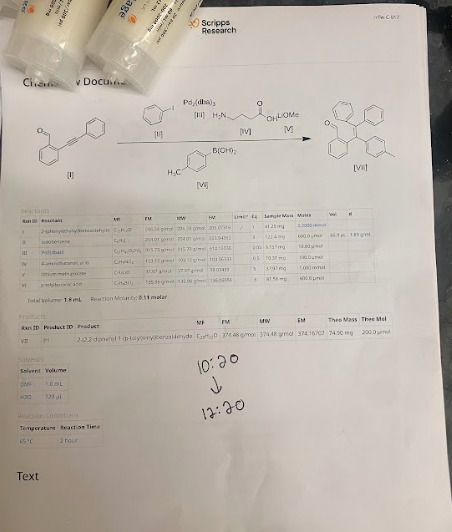
This was the procedure and materials for the reaction we ran on Tuesday.
This is called alkyne difunctionalization. Alkynes are compounds with C-C triple bonds, and difunctionalization is essentially when these alkyne groups are introduced in one step. This is faster and less complicated than other methods that can also be less accurate. We added two catalysts, Palladium(Pd2(dba)3) and GABA, two carbon groups. GABA is a neurotransmitter but it’s also used in difunctionalization reactions commonly because it has an amine group(NH2) and a carboxylic acid group(COOH) attached to its 4-carbon chain. We also added a TDG(transient directing group) to help guide the reaction. After it was done, adding the HCl took out the TDG and it could be filtered again. We added dibromomethane, as well as the normal deuterated chloroform, the dibromomethane allowed us to determine a yield because we knew exactly how much of it we added because of the molar ratio between On a side note, dibromomethane can be really dangerous because it is considered a genotoxin and can essentially damage your DNA. After running the NMR, it came back with a 74% yield – which isn’t bad, as Madison told me it is usually around 80%. Thursday was lighter, and the majority of the day was running prep plates for the reactions we had made that week.
I didn’t go to work on Friday, because it was the 4th of July. All of the Pinterns here went to the beach in the morning, and then came back to make burgers and s’mores and watch all of the fireworks. Apparently they get set off from barges in the ocean, and there were four fireworks shows we could see going on almost in sync. The fourth was also Jennie’s dog Patillas’s birthday and so we gave him a burger too. Saturday we went to explore the Westfield UTC mall, an outdoor mall. It’s really big and there a lot of really nice stores there, and we all enjoyed Panda Express and boba tea walking in the sun. On Sunday, Lana and I went to a park early morning and Shiloh and Azari went to surf. This weekend has been less packed and a lot more relaxing. All in all, it’s been a really fun experience and I can’t believe it’s been four weeks already!
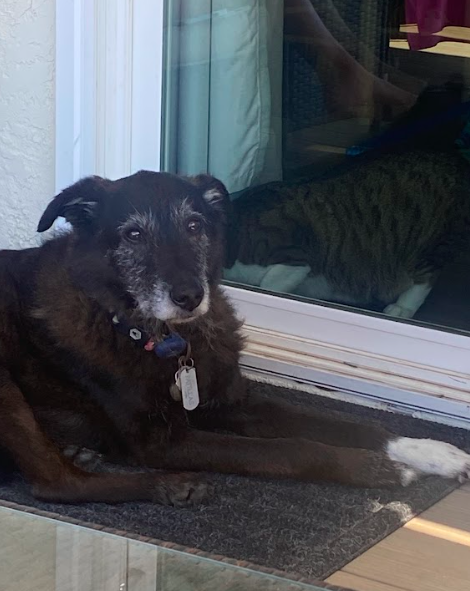
Happy Birthday Patillas!
Frank Whispell
Posted at 07:54h, 07 JulyNice work Maiya! Looks like you’re having a great time while learning a lot!