
29 Jun Shiloh Warthen – Immunology + Microbiology at Briney Lab, TSRI – Week 3
Welcome back! I’m Shiloh and this is week 3 at the Briney Lab at Scripps Research Institute in San Diego, California. Quick Refresher: the Briney Lab operates within the Immunology and Microbiology department at Scripps as a subsection of the Burton Laboratory. Its members work to analyze human immune responses to infectious diseases like HIV, Lassa, Ebola, and SARS-CoV-2 in order to identify and develop antibody proteins capable of effectively targeting these pathogens in a process known as “reverse vaccinology”. Last week we focused on the process of creating plasmids and transfecting host cells. This week, our attention was directed towards antibody production and purification!
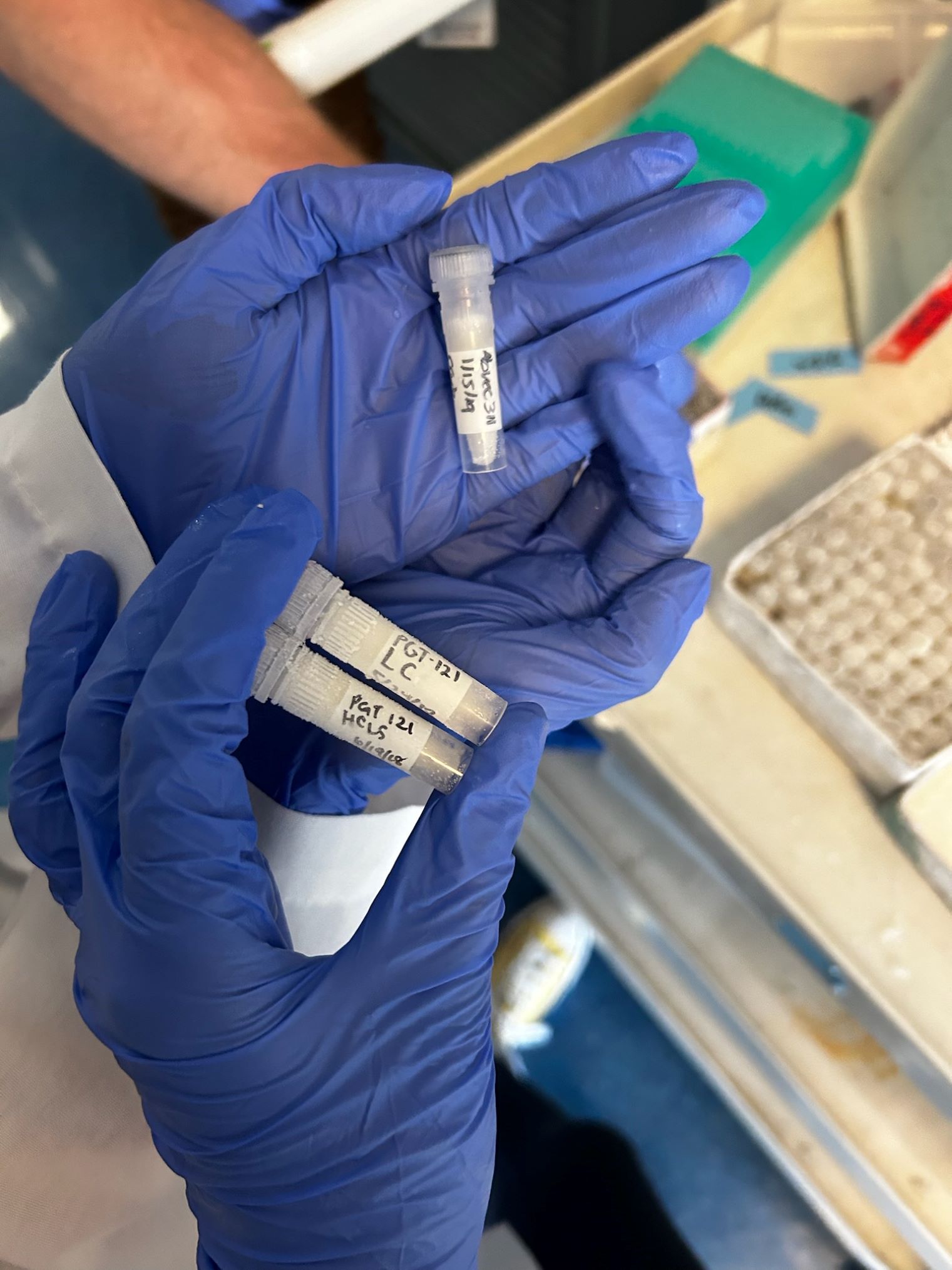
antibody coded plasmid stock!!
Having been drilled in the processes of the central dogma, we selected antibodies of our own to cultivate this week. I chose PGT121: a monoclonal broadly neutralizing antibody that has shown significant potential for effectiveness against HIV. Azari chose a Malaria antibody called 311. We retrieved the glycerol stock of the plasmids engineered for these antibodies, as they’ve been grown in the lab before, and left them in incubators and bacteria media to grow. Azari and I each started with four samples; two sets of heavy and light chains, one set resistant against carbonate antibiotics and the other resistant against kanamycin. Both my chains grew in carb but not in kan, Azari’s heavy chain only grew in carb and her light chain only in kan. We then ran through the lysis and purification process, the amount we grew constituted a miniprep. At the end I had 581.7ng/ml heavy chain and 982.9ng/ml light chain which is pretty good! Both my counts were higher than Azari’s (brag). Both our cells were in acceptable range for transfection so we made 30ml each. 6.9ug of the HC (13.3 ul) and 17.1ug of the light chain (17.4ul) are mixed with 3 ml of optimem and 24ul fectopro which is a similar reagent to 40k PEI. Let that sit and incubate for 10 or so minutes then mix with your 30ml of host cells and move to the incubator. Now these cells will begin creating PGT121 antibodies. Everyday since we’ve been spinning down our transfected cells and taking a sample of the antibody supernatant. If we continue to do this over the next week or so we can track how effective our cells have been at producing the PGT121 and 311 respectively. We even got our own sample boxes to store each days tube.
It’s important to note that Expi 293 cells require feeding 24 hours after transfection. Their meal of choice is .3ml glucose and .3ml of VPA. Back in the incubator and they’re happy as can be. After we transfected we also ran a gel with our leftover DNA but added the wrong dye for the ladder so our results were inconclusive. We kind of screwed up this gel entirely to be honest with you; Yenni asked us to run a pair of his plasmids through our gel and we loaded the completely wrong ones (Yenni we’re sorry!!!!!!). Thankfully Yenni is super forgiving and kind; he wasn’t too upset with us for our mistake.
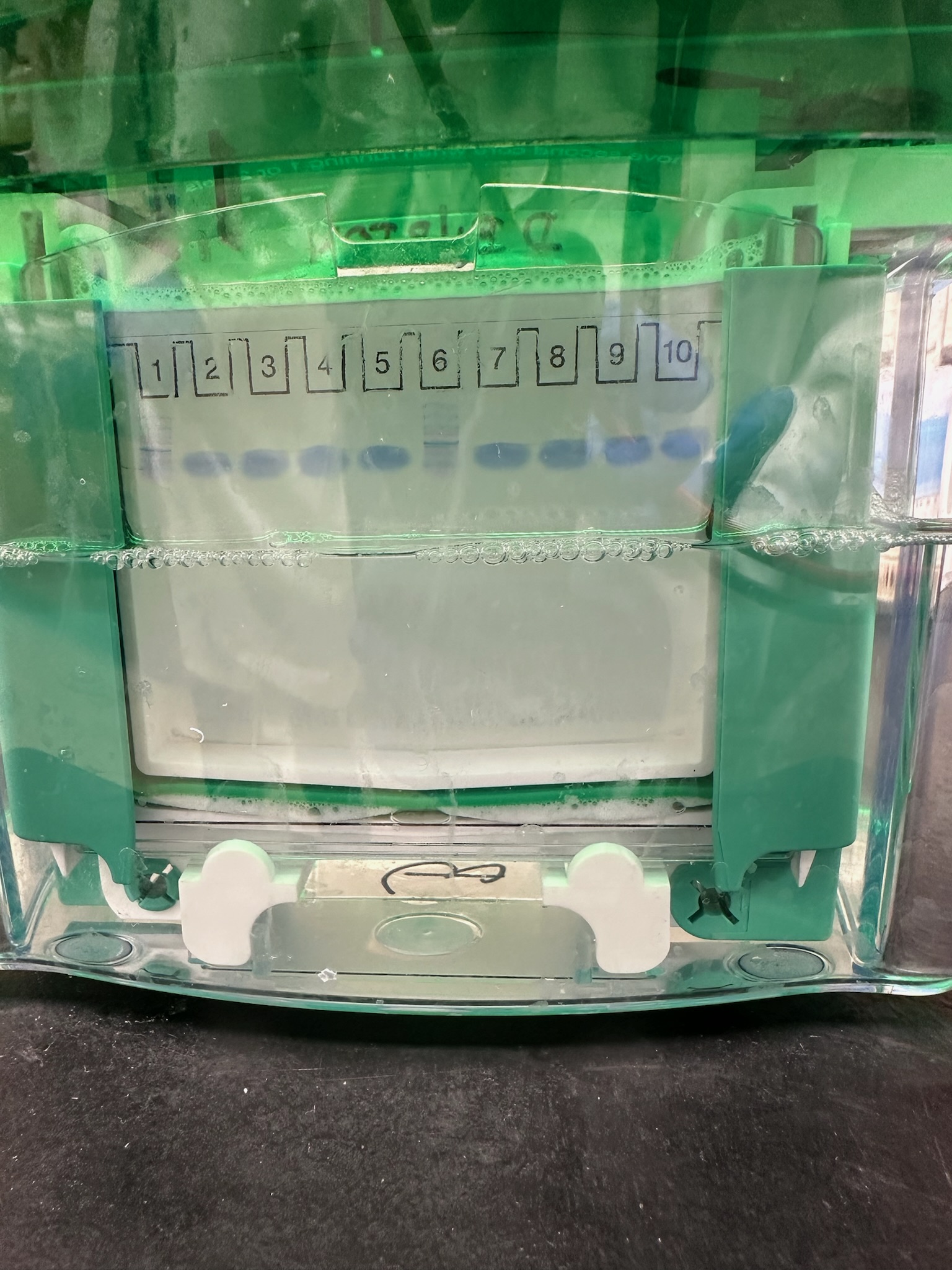
The gel we messed up before we knew we messed it up :9
On the topic of gels, Yenni also taught us about protein gels and how Coomassie InstantBlue dye allows us to examine their results with the naked eye instead of the use of UV light. This stuff is super nifty because unlike it’s cousin standard Coomassie blue dye (which requires a lengthy process both to apply and remove) InstantBlue dyes a gel in 3-5 minutes and washes out with just a few rinses in water. The images of the ladder left on the gel are very clear and surprisingly easy to read. A singular antibody protein should measure up at about 150kDa in size with the heavy chain weighing in at 50kDa and the light chain sinking deep at 25kDa. “Shiloh,” you say, “Fifty plus twenty five is seventy-five not 150, can you not do math?” I passed Algebra just fine: the weight is double because an antibody is made up of two light chains and two heavy chains. When you picture an antibody you can think of it as a doubled lined ‘Y’. The Y has two arms and a stem: the arms are called fabs and the stem is called the fc region. Split down the middle both ‘sides’ of the antibody have a heavy chain that makes up the stem and the upper part of the arm as well as a light chain that forms the lower branch of the arm. Two heavy chains is 100 and two light chains is 50. Tada! 150kDa and I’m not so hopeless at math after all.
Now that we’re producing antibodies we also need to learn to purify them. After the cells are transfected, they can be spun down so that the cell debris is concentrated at the bottom of the tube and the supernatant(the solution left suspended) can be extracted. Those are the steps we take to retrieve daily samples but the full run through of antibody purification extends much further. Sepharose G, a type of super small bead, is added to the solution so that the antibody proteins have something to stick to when we filter out the media and rinse with PBS. Antibodies are so small they would slip through the filter if they didn’t have something to attach themselves to. But we don’t want the beads to stay so we soak them in 15ml of .2M citric acid, which causes the antibodies to fall off the beads. We have to make sure it doesn’t sit for too long though, or the acid will break the bonds holding the antibody itself together too. The acidic solution is then neutralized 4.5ml of 2M tribase, the aim is to keep the pH relatively close to that of the natural human system (which is just above 7). After that we create what basically amounts to a bucket of water and PBS, then put our antibodies in a permeable membrane and let it bob about like a little buoy in the bucket while they sit in the cold room overnight. After we remove them the next day we can count them. In our case, the antibodies were more concentrated than Nate B. wanted so we diluted them before running them through a protein gel. We’ll check the results of the gel next week.

Testing concentrations of purified DNA
We also did 16 DNA minipreps for Sean completely independently which was super fun and really proved to Azari and I that we have gained new skills throughout this experience. It was really awesome that Sean trusted us enough to just let us at his cultures because if we had made any mistakes or cross contaminated any of his samples the DNA he was trying to purify would have been ruined and he’d have to start over. Luckily, we didn’t mess up and all our yields were well within acceptable range! The true test of purity will be the results that come back next week after the samples are sequenced but I have faith that they’re going to be just fine. This week also included an attempted blood donation since, as it turns out, you only have to be seventeen to participate in certain blood drives. I made it all the way to the chair before I was turned away because my veins were “too small”. They still gave me a cool shirt though so it’s all good, I do wish I had been able to actually donate though. We ended out the week by attending a Scripps sponsored concert with Nate B. which was super interesting. By the way, shout out out to Nate B. for driving us to lunch on two separate occasions this past week.
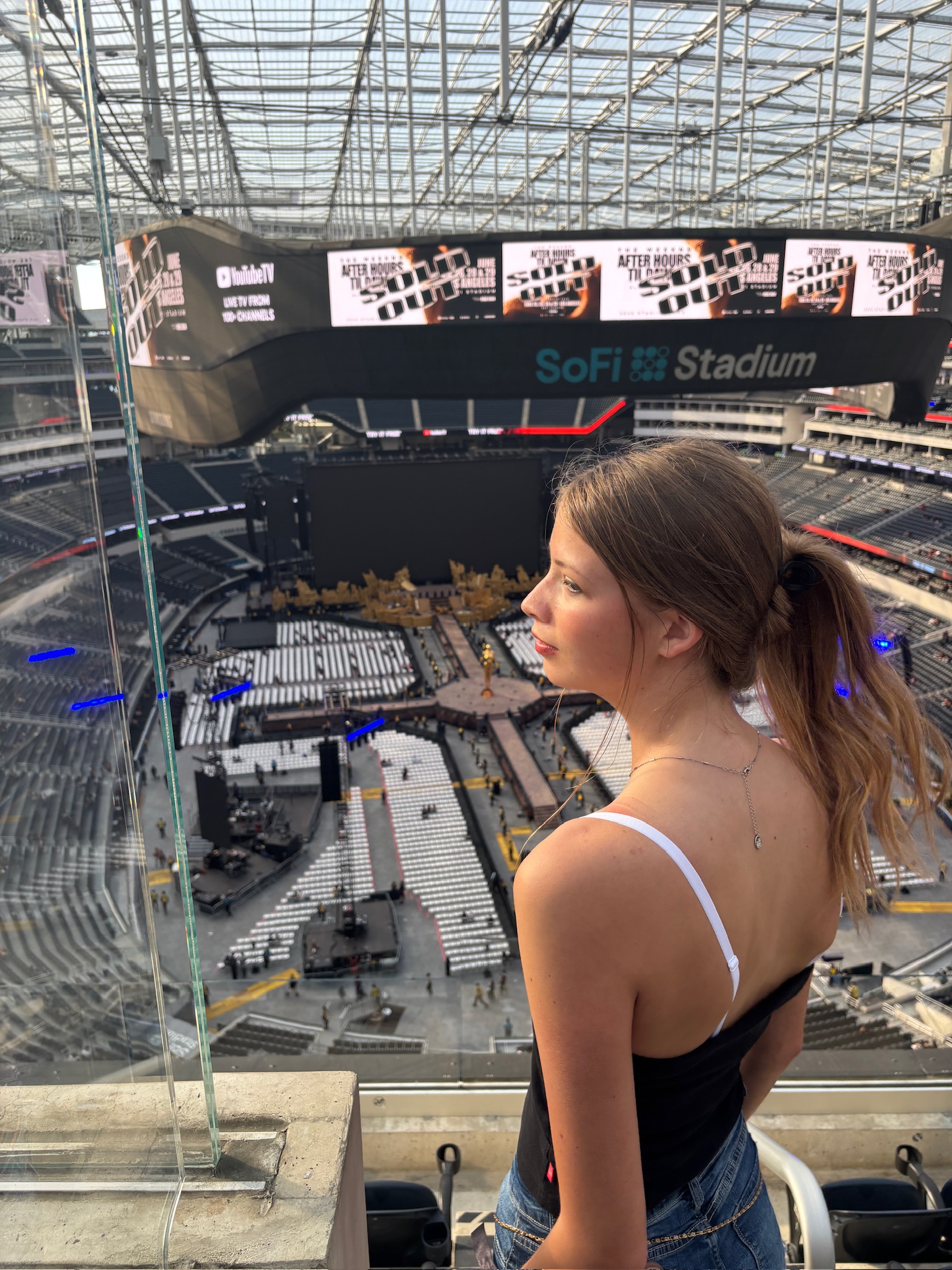
pre-concert
Making it halfway through this internship is bittersweet; I’m super proud of myself for how much I’ve grown through these past three weeks and yet the experiences I’ve had and people I’ve met make me sad knowing I have to leave at the end of it all. That being said, the memories I’ve made and skills I’ve learned both in and out of the lab are things I’ll carry with me for the rest of my life. Just this weekend, our house group made another great memory together: we drove to LA and saw The Weeknd live at Sofi Stadium. For a lot of us, it was our first time attending a concert without our parents and for Lana, it was her first concert outside of
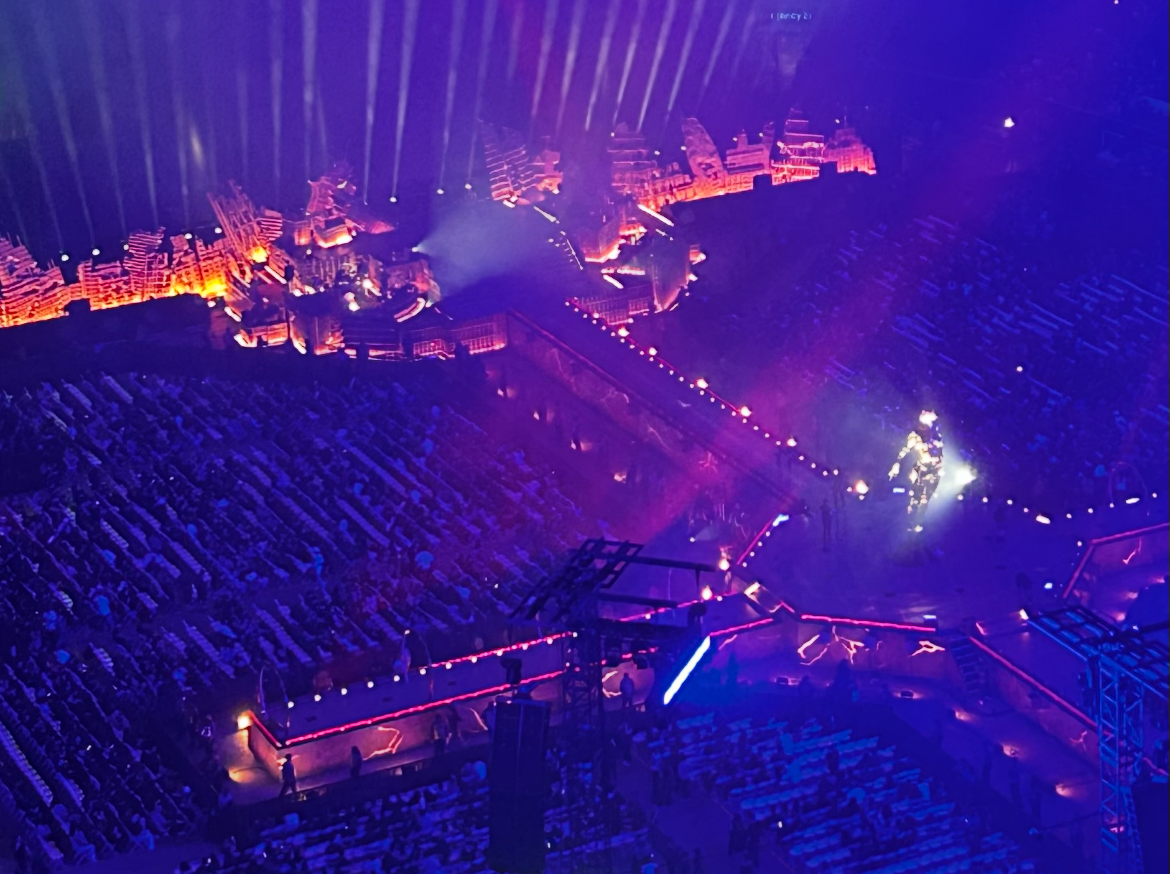
AAAAAAAAAAAAAAAAAA
Bluegrass EVER. It was crazy to realize that attending a concert like that is something we can just do completely independently which I guess is a big part of what this internship is all about. I was really proud of how us girls handled everything on our own; from parking to safety to setting up post-concert accommodations everything went so smoothly (shout out Lana’s Grandma for letting us stay in her condo; you are so so awesome!!). And of course, the Weeknd was SO GOOD!!! I don’t know what the next three weeks will hold but I know that they will be filled with so much opportunity to learn and grow so I can’t wait!
This weeks tally is one gel ruined, two concerts attended, three weeks down, and four times too many that I spent money on lunch! See you again next week!
Azari Guerrero
Posted at 13:36h, 29 JuneBest three weeks!!! I don’t think anything can top the concert haha
SUSAN HUNT
Posted at 18:37h, 29 JuneIt was a pleasure meeting you, Shiloh! Good luck with the DNA.
great grandma Judy
Posted at 13:16h, 02 JulySounds like a great week. Work hard and have fun too!
judy ganzemiller - great grandmother
Posted at 13:24h, 02 Julysounds like a great combo of work and fun.