
29 Jun Reign Icasiano, George Lab UCSD, Week 3
I can’t believe I’m already halfway through my internship! It’s honestly gone by so fast, and I’m excited to continue to learn what I can in the last half of my stay here at UCSD. I’m so thankful for all of the George Lab staff, as they’ve welcomed me thoroughly, and it feels as if I’ve been working with them for forever. As mentioned in my previous posts, I’m working in the George Lab at UCSD studying neuroscience, mainly dealing with rats and correlations of addiction to the brain.
Mon. June 21, Day 15-
The start to the new week has been a chill one. Sonja, Ms. Molly, nor Elizabeth were in the lab today, so I had a nice work day to myself. I was tasked to finish reading the papers I had been given, which was great because I haven’t been able to finish reading them on my own time. Sonja had given me the opportunity to work from home, however, I knew that would not go well for me. So like everyone else at home, I went out to UCSD to give me some work time onsite! The lab has become a space for me to learn, so it only felt right to finish my readings there. I was alone for most of the day, but I did get to see Joseph in the lab and he was working on some of his own projects.
Tues. June 22, Day 16-
Although I’ve been at the lab for a bit, I’m still learning something new everyday! Today was another great day in the lab. In the morning, I started off with plating some more brain slices. Even though I’ve been plating a lot recently, the plates I did today were quite tricky. A lot of the slices were curled up and ripped, making it hard to place them correctly on the slide. However, I was able to get them all plated, and Sonja was now able to use them for IHC. After plating, Sonja showed me how to use the cryostat. The cryostat is the brain slicer, and for our purposes, it slices the brains on the coronal plane (anterior/posterior), at a 40 micron thickness. So basically, really really really thin slices. The cryostat is this big and chunky looking machine: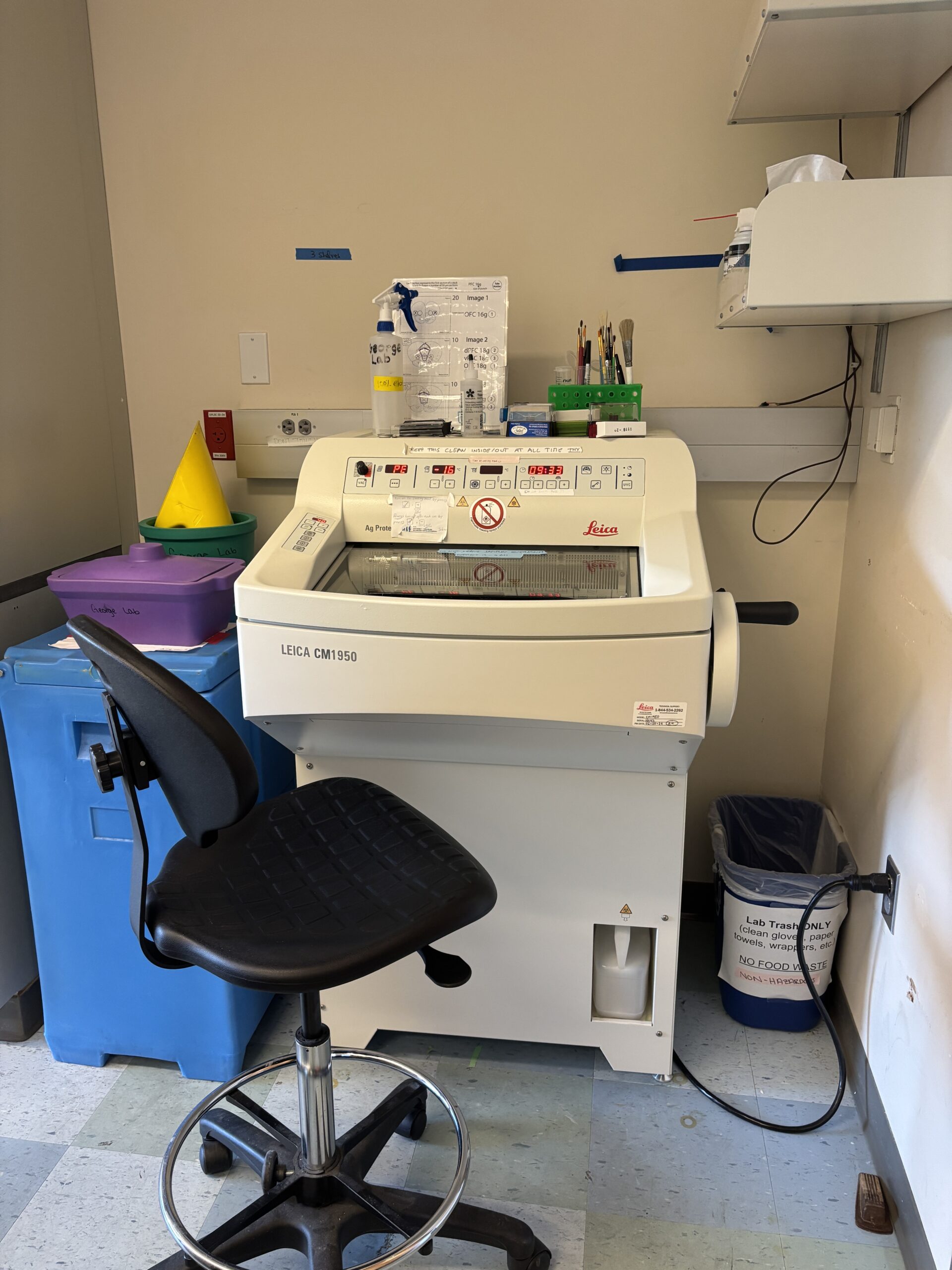
To work the cryostat, there’s a knob on the side that you push around in a circle to move the platform the actual brain is on. Moving this platform forward allows the brain to be cut by the blade that’s underneath it. Every time you turn the lever, the farther the blade cuts into the brain. The brain is placed on this little circular thing called a chuck, and the chuck sticks on to the back of the cryostat so it’s put into the correct place to cut. On the chuck, and surrounding the brain, this substance called OCT Compound (Optimal Cutting Temperature Compound) acts like a glue for the brain to stick onto the chuck, also so that the brain doesn’t go anywhere while it’s being cut.
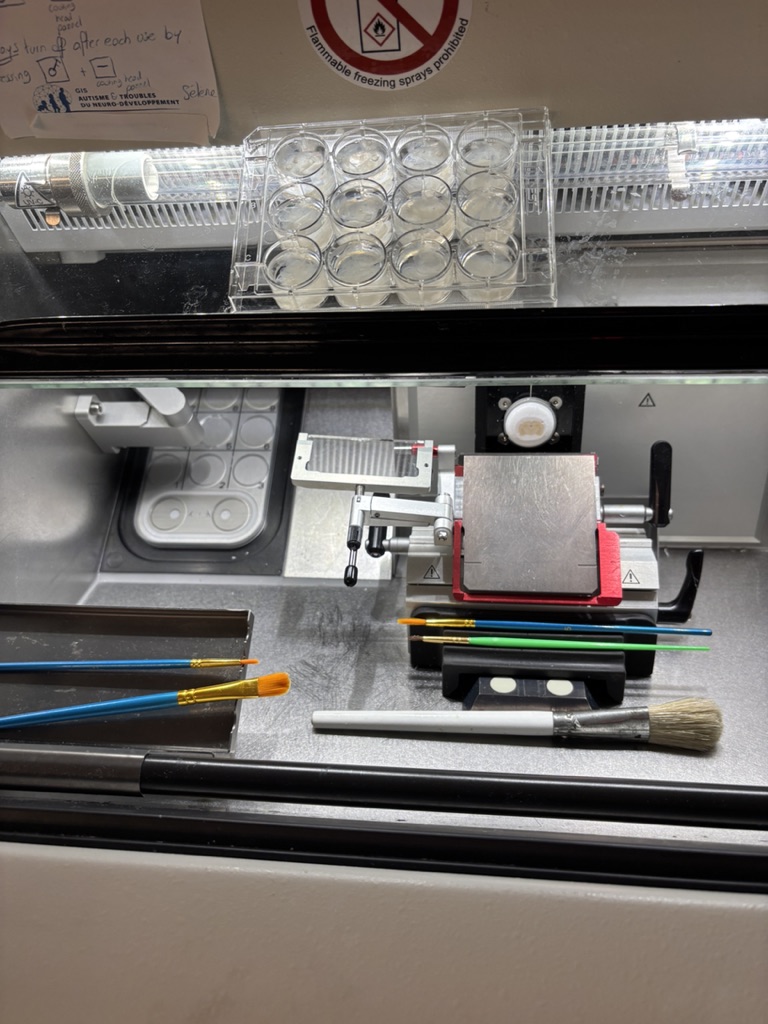
Closer look at the interior
There’s a thick glass slide placed over the platform in front of the blade and acts like a net to catch the slice. The interior of the cryostat is kept at a cold temperature to preserve the samples. Paintbrushes are used to delicately transport the slice of brain from cryostat to well. It’s so cool to know how and where the slices come from, because this whole time I’ve been doing plating, when the brain wells were just handed to me. Sonja said, now I’d be able to plate my own brain that I sliced, which is so exciting! I’ve pretty much seen the whole process: from animal to dissections, then to slicing and plating, after that, staining and imaging. I have yet to see surgeries and injections, but Sonja said I’d be able to shadow the injections tomorrow! Slicing the brain seems simple and looks easy enough,
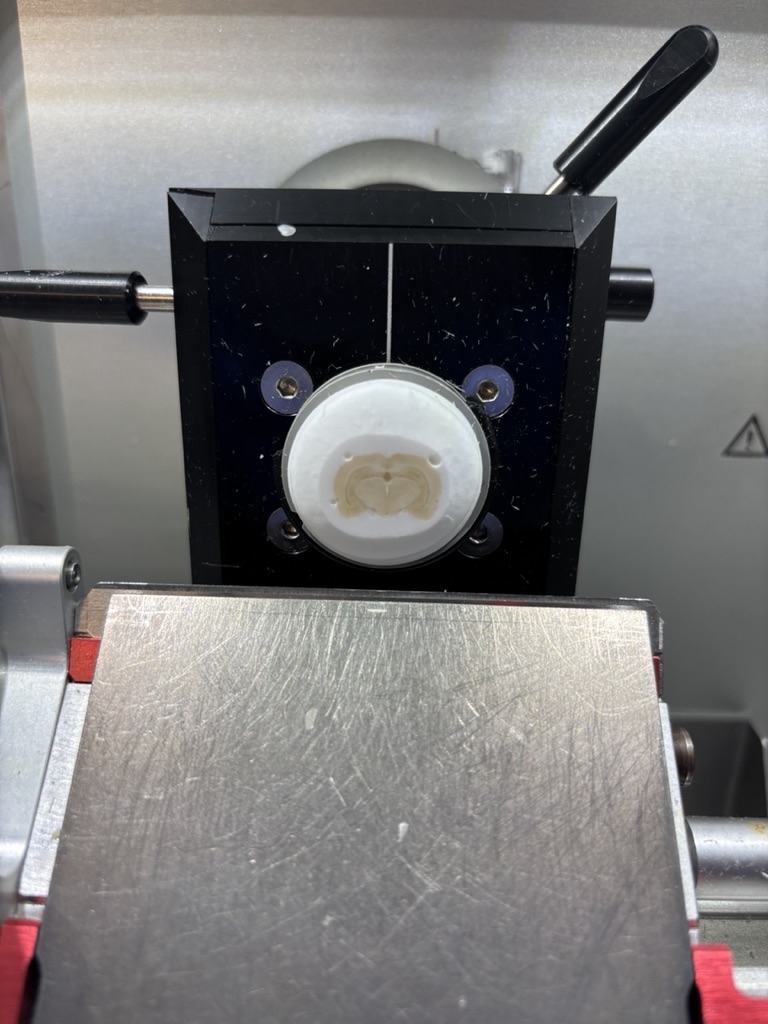
Getting through the brain!
however, I was stuck slicing a singular brain for a good three hours. Let me tell you, my back and legs have never been more happy than when I stood up after sitting down for that long. Being at the cryostat was so fun though, because I was able to just work by myself, listening to some music while doing the same thing over and over again. Through the process, I got a system going with all of my paintbrushes and developed different techniques that worked for me. Of course, there were some slices that just did not want to cooperate, and unfortunately, didn’t make it into the wells, but don’t fret because most of them made it in! I am pleased to say that I left today with a new skill that I’ll never forget!
Wed. June 23, Day 17-
We all have our good days, but some days we in fact have our not so good days. Today, unfortunately, was the latter. The last time Sonja and I did IHC, we did it all in one day, however, the IHC protocol calls for it to be a two day lab. So yesterday, while I was on the cryostat, Sonja completed Day 1 of the new IHC group. So today, we finished the second part of the protocol. If you remember from my last blog, IHC requires a lot of washing steps and different antibodies. In IHC part 1, blocking buffer and the primary antibody is added, and it day two, the secondary antibody is added and washed. The secondary antibody is really tricky because it’s light sensitive, making things a little harder than with the primary antibody. On the actual cellular level, the secondary antibody is what binds to the primary antibody and is what makes that primary antibody glow or show up when you image the plate. So, when dealing with the secondary antibody, it’s really important to work quickly and precisely to make sure that the antibodies don’t get exposed to light, or else, they won’t show up anymore. I think the stress with handling something with such a big impact got to me, because I put way too much of the donkey serum in the blocking buffer, making it 4x the concentration I needed. Thankfully, Sonja caught what I was doing before I got ahead of myself and didn’t ruin the rest of the steps to follow. So, we were able to dilute the solution down to what it needed it to be, but I still overused the product I needed, meaning I used up a lot of what was needed. I felt so bad, and I still do. Science is not cheap, so there’s a lot less lenience in making mistakes. However, it’s still important to own up and move on, so I apologized, and we trudged right along through the rest of the process. While the secondary antibodies were incubating, I was tasked to plate more brains. Unfortunately, some of the brain scans that I needed to plate did not cooperate with me very well, but thankfully I was able to plate most of them, with one of the sections having to free float. Free floating scans are those that are very delicate, making it so you have to put the section in a petri dish. You’re still able to perform IHC with free floating sections, it just makes it harder to collect the excess antibodies. I learned that everyone has tough days, but the important thing is how you move on from the situation. Later in the evening, I attended a ballet class at San Diego City Ballet School. I was definitely a little rusty because I haven’t been in the studio for a little, so getting to attend the class was a nice distraction from my mess-ups earlier in the day.
Thurs. June 24, Day 18-
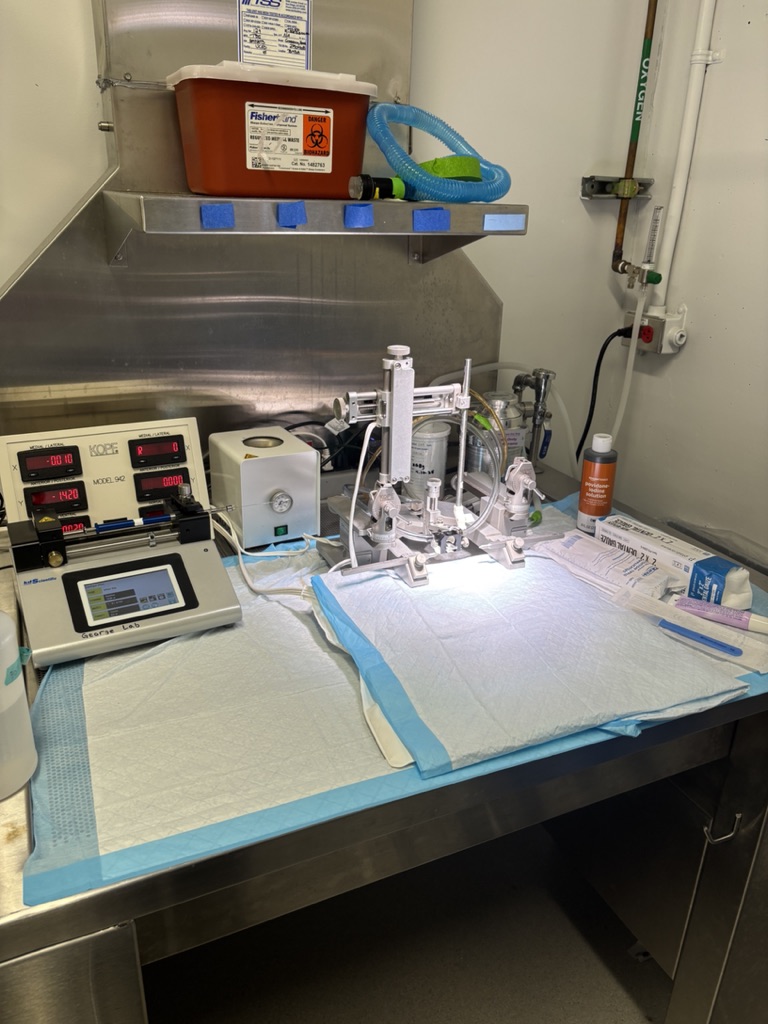
The setup for injections!
I’m glad I did not let my bad day yesterday ruin my amazing day today! It was so interesting and I learned so much! Today I got to shadow Sonja as she did surgery to inject virus into some rats. The rats she injected today were just pilot rats, meaning they weren’t for the actual experiment yet, and were just for testing some logistics. She wanted to make sure she was hitting the right spots in the brain, and also seeing if her dosage amount was enough. I didn’t realize how long these surgeries took even though it was just an injection! The basics of the procedure went like this: knock out the rat, open up the rat, inject, close up the rat, and then let the rat wake up. The way we put the rat to sleep is really similar to dissections, but instead of watching them until their last breath, we make sure they’re still breathing. The rat is put under isoflurane so it takes a shorter amount of time to knock them out than the CO2. After the rat is asleep, we shave their head to make it easier to get into the skull. The shaving also happens to make sure that no fur infects any internal body parts while we’re doing the procedure. Once the rat is shaved, we put it back into the sleep box to make sure it’s out long enough before we put it into the surgical head holder. The surgical head holder is the tall piece of equipment in the picture on the very right. This is used to make sure the rat’s head can’t move, but the rest of it’s body can. There are two ear holders and a teeth holder to keep the rat in place while the surgery happens. This is connected to tubes of anesthesia and oxygen to keep the rat breathing while still knocked out. After the rat is placed correctly in the holder, then it’s the start of actually getting to the brain. Sonja first cut open the skin and then started scraping the skull until she reached the brain. Then, using the coordinates given by the XYZ machine, Sonja was able to inject where she wanted to. Injecting was definitely what took up the most time. To inject, you have to be precise, and there are a lot of extra steps that I didn’t even think about. The initial injection is just the catheter, then the catheter needs to be pulled up to insert the needle to the bottom of the injection site you wanted, the needle then injects for 5 minutes, and then stays injected for 10 minutes after that. You then do the same thing to the other side of the brain. We did the surgery twice: once for the control, and the second for the actual virus. The whole surgery process took the whole day I was there, but luckily, Natalie, an undergrad student working at the George Lab was also there to shadow, so I got to know her a bit better as well! The three of us had fun conversations and they gave me fun activities to do while in San Diego!
Fri. June 25, Day 19-
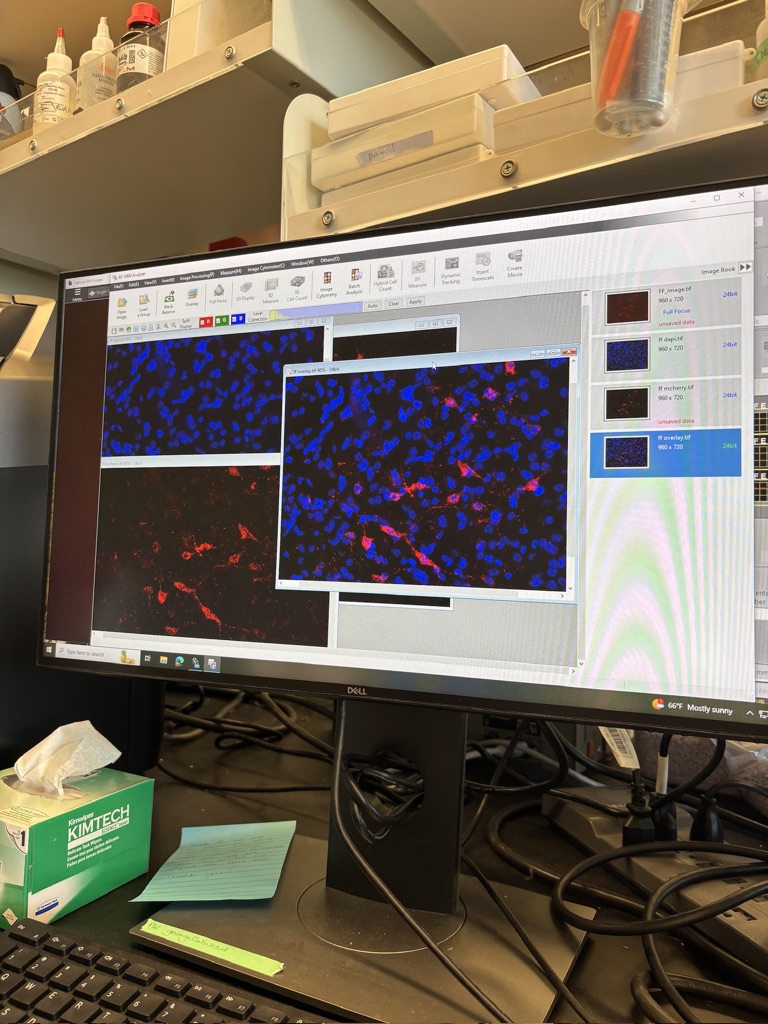
Amazing pictures from imaging with Sonja!
After a big day of surgeries yesterday, I got a big chill day today. The first thing we did was check up on the rats from surgery yesterday. There’s this scale to judge whether or not the rats seemed to be doing well or not, and thankfully, they were recovering great! While we were in the rat room checking on them, we got to play with the baby rats more! We did this yesterday with Natalie before we headed into the surgery room, so it was nice saying hi to the babies again! These baby rats are the cutest little creatures ever. They’re so tiny and when they all pile up in my hands they just fall asleep and are so adorable!!! Sonja said that these babies will stay like this for another week or two, and once they’ve grown more, they fall into the stage called “hoppers” because the rats just love to hop all over the place. Kinda weird considering they’re rats and not rabbits… But after the hopper/teenage stage, they start to develop into the bigger adults we work with. Once we were done in MTF, we headed to Skaggs, and it was a lot of doing some stuff on my own while Sonja was imaging. I shadowed her for a bit, and there were a lot of good pictures taken! So far, the IHC we’ve done has been going well, according to the imaging, so that was a big relief for all of us. While Sonja was imaging, I got to work on my laptop, and helped whenever I was needed. In the afternoon, Natalie dropped into Skaggs to do her Day 2 of IHC. I helped her coverslip the slides she did, and I think I’ve gotten better at coverslipping thanks to her tips!
Sat. June 26, Day 20-
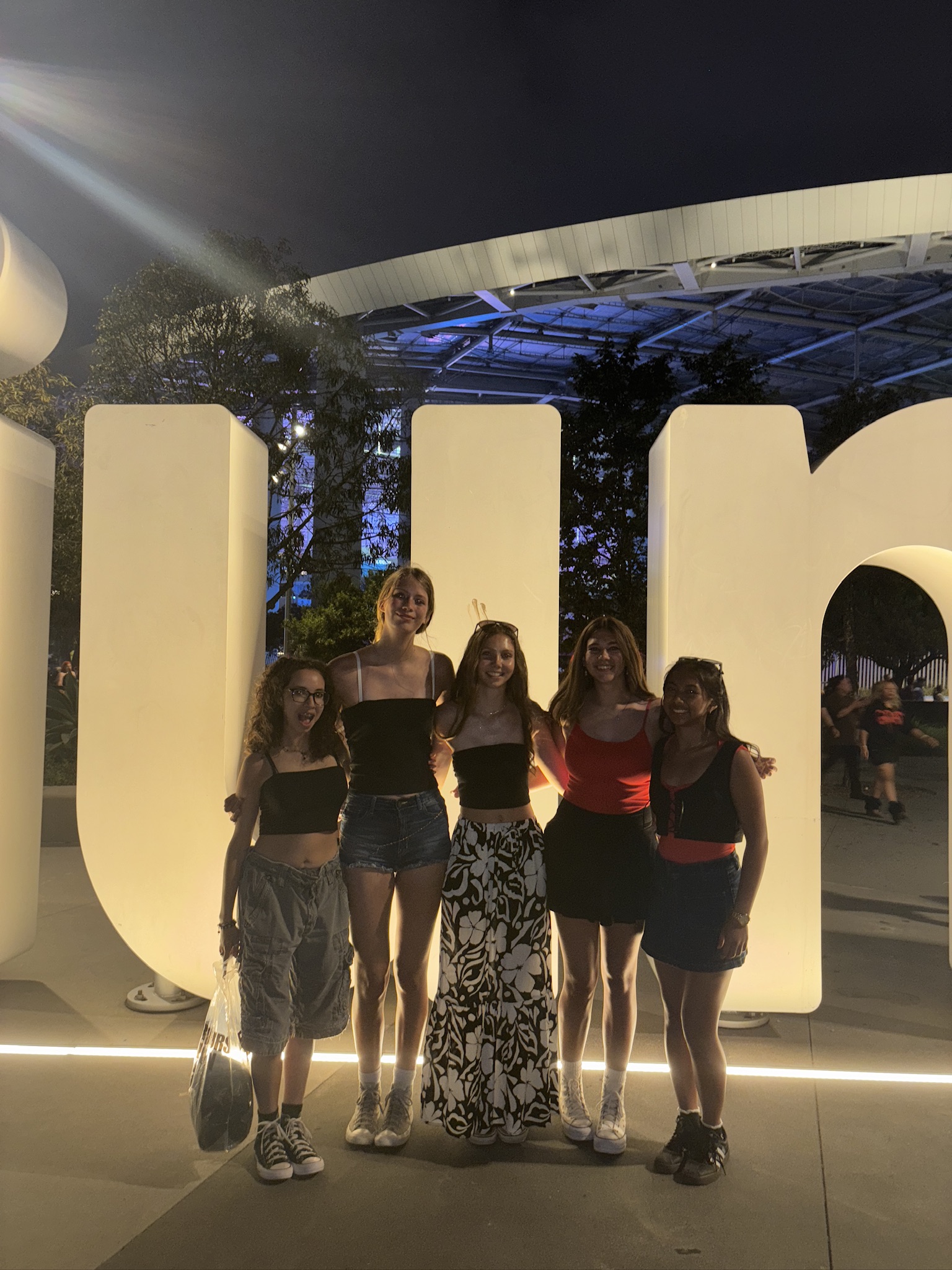
Post concert!
The Pinterns and I had an AMAZING Saturday. We had a little day trip to LA and headed to The Weeknd concert later in the evening! The roadtrip itself was so fun, jamming out to music in the car, while looking at the cool architecture of California. Lana’s grandma, so generously allowed us to stay at her condo to get ready and stay the night, so after lunch, we headed to her condo to start getting ready. We got concert
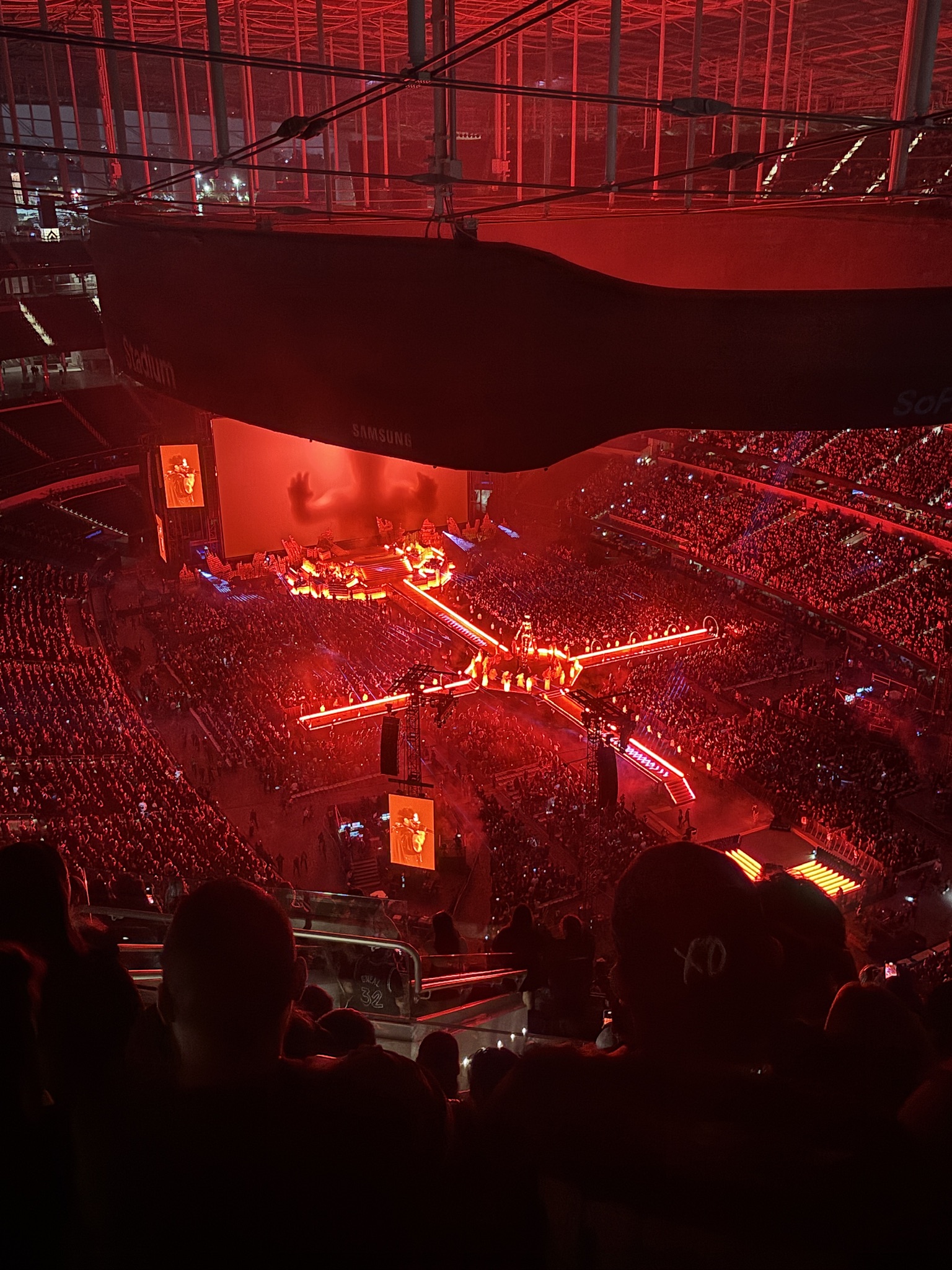
THE WEEKND!!!
ready in great time, so we headed to the concert, and were had so much fun! By the end of it, my ears were ringing, my voice was gone, but I was smiling from ear to ear, enjoying the amazing experience I just had. It’s still unbelievable to me that we got the opportunity to even see him, and I feel so lucky to do once in a lifetime things with the coolest people ever!
Sun. June 29, Day 21-
After our crazy concert night last night, Sunday was a big chill day. We got to enjoy breakfast with Lana’s grandma, one of the coolest and sweetest people I’ve met, at a local diner. I needed that nice breakfast to calm myself from the festivities of the weekend (pun intended). After breakfast, we went back to her condo, cleaned it up, and enjoyed the beach view from outside her window. We headed back for San Diego, but we made a pit stop at a nice outlet mall we found on the way to LA. I was surprisingly able to hold myself back from buying a lot of stuff, but I knew my bank account would be happy that I did! Once we got home, we refreshed ourselves and prepared to go to work for tomorrow!
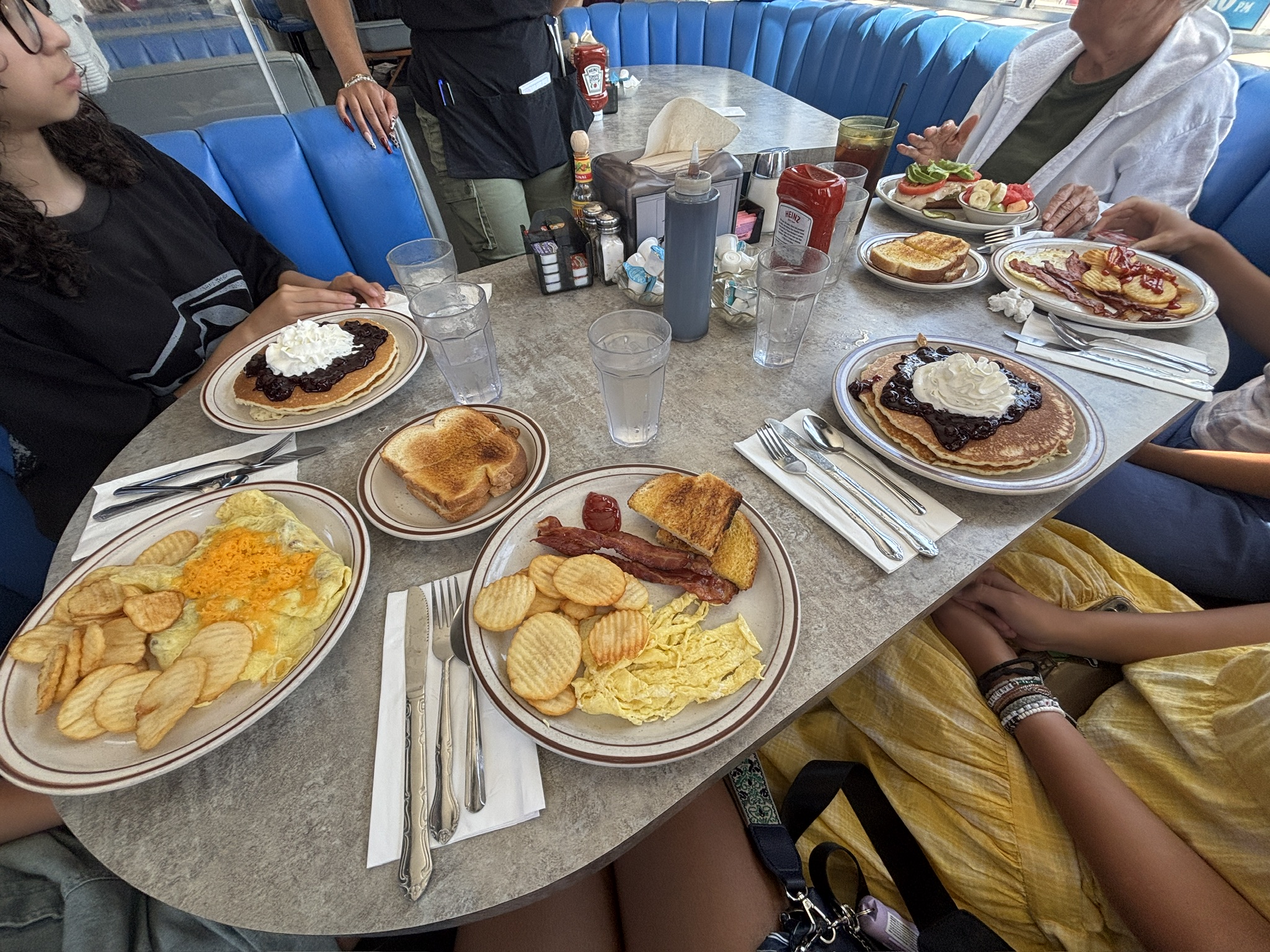
Breakfast!
No Comments