22 Jun Maiya Wagner – Organic Chemistry at TSRI, Engle Lab – Week 2
Hi everyone, my name is Maiya Wagner, and I feel so blessed to be given the opportunity to work in San Diego interning at the Scripps Research Institute. I am working at the Engle lab, which works with catalysis, and is run by Keary Engle, and with Madison Wagner, a third-year graduate student and PhD candidate. There are a few other people in the lab too, a mix of PhD Students and Post-Docs, who are all so smart and kind. This week short but fun, as I was only in the lab three days. I met Keary Engle, as he got back from Spain this week. He’s so kind and accommodating, as is everyone else in the lab.
This week, my second week, we ran two reactions, to create some more products. These used pyrrolecarbaldehyde, copper iodide, and cesium carbonate. One of them used bromomethoxybenzoic acid, and the other used bromobenzene-diol. We first measured out the reactants, which was really hard because it’s in a very small amount – one of them used only 19 mg, so much less than a gram and some of the reactants were crystallized and hard to put into the tubes and measure accurately. After measuring everything out, we then added a stir bar and sealed the pear shaped flasks with a septum and electrical tape. Similar to last week, the reactions couldn’t be performed in the open air, so for each tube we vacuumed out air and replaced it with nitrogen gas to aid with this. We then added triethlyamine again, as well as some other liquids. Then it was done and we let it sit to spin in an oil bath, the reaction was supposed to run for 40 hours. However, by the next day one of them was done. We could tell because after running a TLC, there was no more starting material in one. The other one wasn’t but that’s okay, at least one was done. We took the flask out of the bath and rinsed it out with hexanes (this works because the oil and the hexanes are both nonpolar and so it takes off the oil easily), and then partially filled a buchner funnel with celite and filtered the mixture. The buchner funnel works by using a vacuum to pull down and filter all of the materials more quickly than an ordinary funnel. We then could purify the mixture and run it through a column. We also ran more NMR’s, used the rotary evaporator more, and other things.
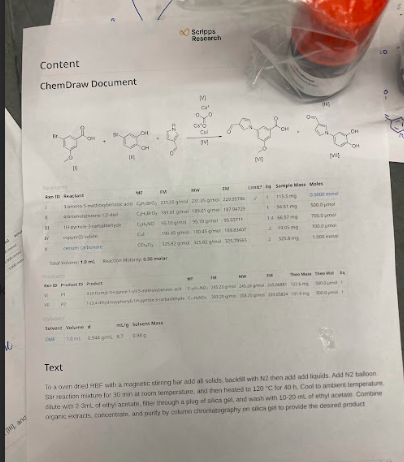
This was the document we used for the reactions, that told us how much of everything we needed for the reactions.
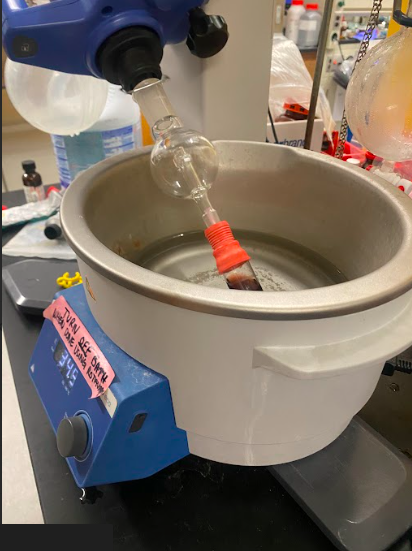
Using the rotary evaporator!
On Friday’s group meeting, there were more presentations from new people, and there was a new problem set that was intermediates of a catalytic cycle. It was again really hard and I did my best to understand (to no avail basically) but everyone was again very nice and helped me through it. The catalytic cycles were hard, but I was at least able to understand the basics of how they worked on my own. On Friday we also had a surprise celebration because it was the Engle Lab’s 10th anniversary! It’s very cool to be here at the same time as the 10th anniversary, and I feel very lucky. We had a party Friday after group meeting to commemorate to occasion, with food and a video for Keary of all of his alumni congratulating him!
It’s also definitely worth mentioning that Shiloh and Azari, in their lab, created host cell cultures that they named Bellamy and Rihanna. They celebrated their birthdays (the cultures, not the cells) with cards and cake. Outside of work, our Pintern group has stayed busy exploring the city, from Ocean Beach and shopping around University Avenue to Little Italy and the farmers markets and bookstores all over town!
Kathleen Wagner
Posted at 16:23h, 24 JuneLove all the work you are doing! Truly top level!
Kathleen Wagner
Posted at 17:03h, 29 JuneVery cool work!!