
Hi everyone! Last week, I was almost done with the laser plate and practiced aligning the cyan laser. This week, I became more comfortable using the miller and learned how to use the lathe. There’s a lot of work to do before using the Raman spectrometer, but it’s rewarding to build components of my equipment.
Lab Work
Thankfully, this week I finished and assembled the laser plate. Because my first measurements were off, I went back and elongated the attachment points, making sliders. I was disappointed the first one didn’t work, but I enjoyed learning a new technique. After cutting the excess aluminum off with a bandsaw, I smoothed every edge to make it safer and more professional.
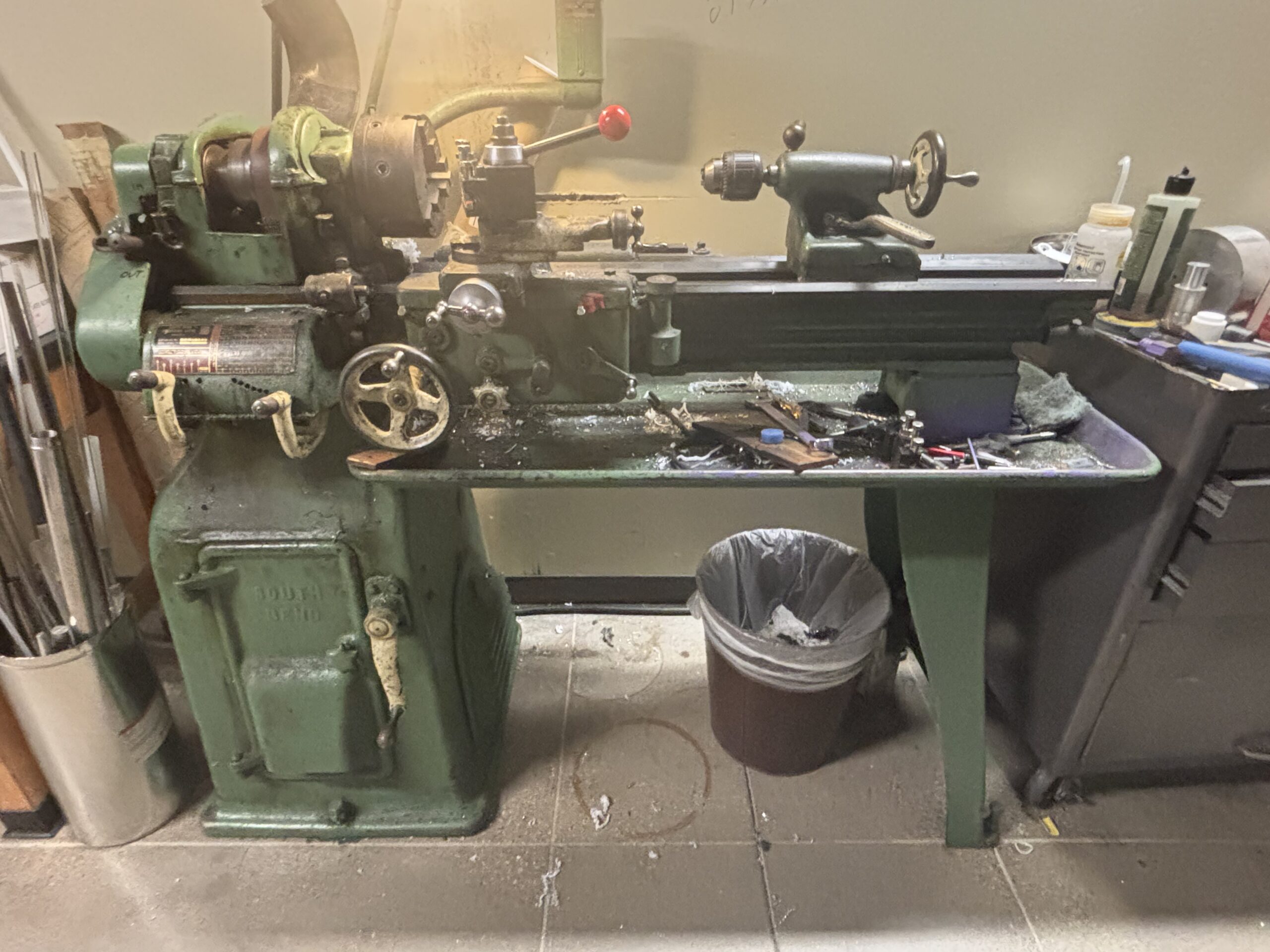
The lathe I used.
Next, Professor Baldelli showed me how to use the lathe to make risers for the plate. I found an 18-inch metal pole that I cut into four pieces with a hacksaw. Each was 4 1/4 inches long, giving room for error. I used the lathe to smooth the ends and remove excess material for each pole to be exactly 4 inches long. Slowly removing about 0.05 inches at a time, I got each to be the same size. Next, I drilled into each pole and, just like the plate, I used a tap screw made for a lathe. It took a few extra minutes to set up, but it made the job much faster and easier. Because this tap screw was attached to the lathe, it was already centered and improved the quality.
With everything ready, I cleaned each piece with soap and water, dried it, and began putting everything together. The posts didn’t wobble, and everything fit!
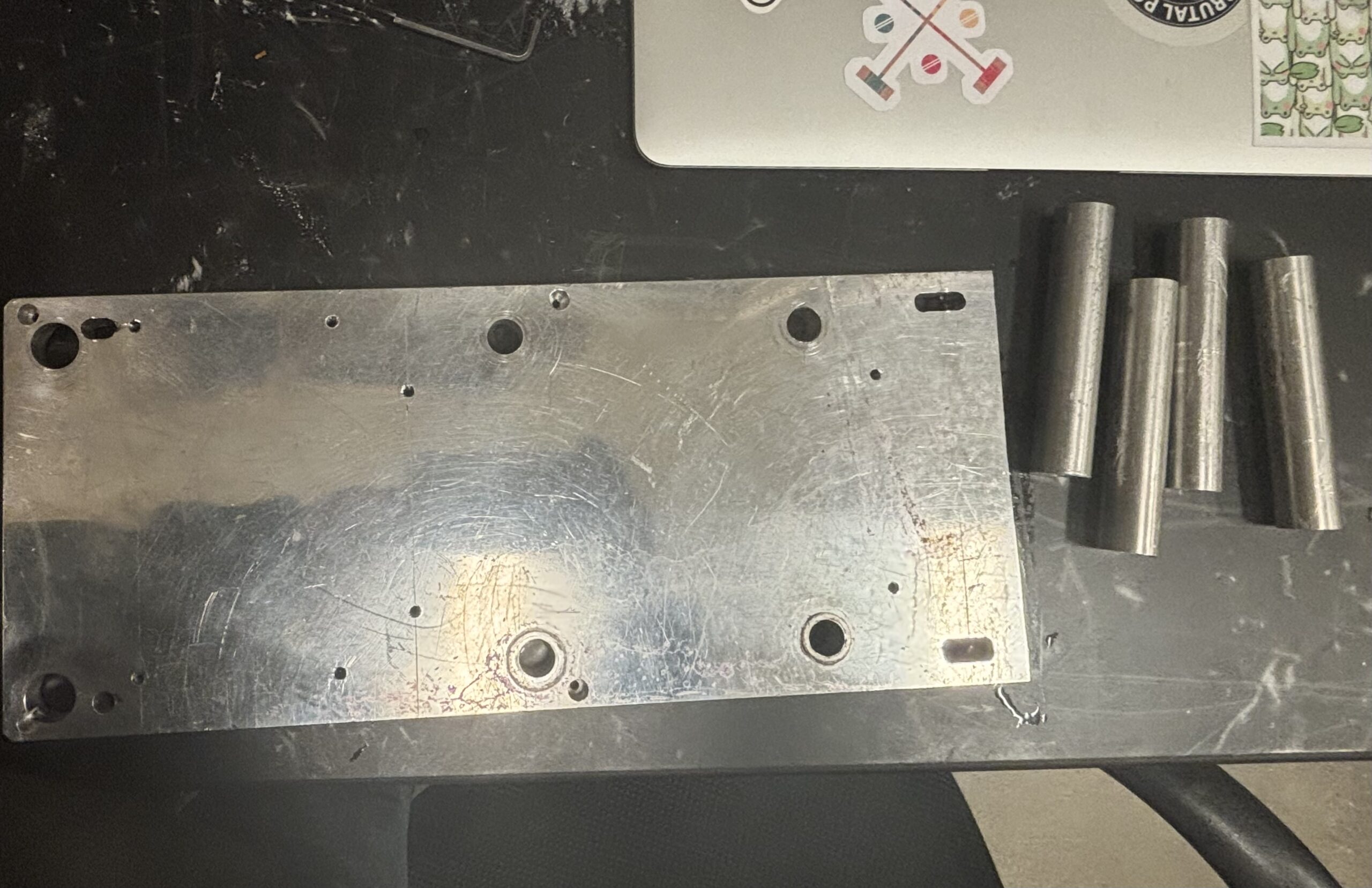
The disassembled laser plate and stands.
As for the Raman spectrometer, it still needs some work to align the laser, but everything is connected and set up! I added mirrors to connect the laser I’m using to the shared equipment. The added mirrors are used to angle the laser 180 degrees and connect to the previous setup. Each laser is used individually, but must pass through to the data collection site, so they must share the setup’s last half. Because we were placing mirrors, a grad student taught me how to identify the reflecting side and properly clean them. On mirrors at home, light is moving through glass, hitting a reflective sheet of metal before moving back through the glass. However, mirrors used in Raman spectroscopy move through a thin sheet of glass, then bounce from the reflective sheet of metal to reflect the most amount of light. It can be confusing due to the similarity of the back of spectroscopy mirrors and the ones found at home.
Adventures

Last Sunday, I left campus with the Welch group to get lunch, go to a bakery, and Trader Joe’s. I had a great time and got to know everyone better. Trader Joe’s was especially out of the ordinary because this one replaced a movie theater! At first, Kaitlyn and I played cards with a few other high school interns, but now everyone gets together to introduce new games and master old ones.
Today, I went with four other interns to Chipotle and H-E-B for lunch and groceries. Campus restaurants aren’t open on weekends, so we try to buy snacks and quick meals.
Next week
My goals for the next week are to finish setting up my portion of the Raman spectrometer, fix the microscope, and learn more about glass blowing. Once I finish the spectrometer, I can begin making samples. The microscope filters require a cover to work properly, so I will find or make one. I also might need to clean or grease the mechanism for the filters to fall into place, instead of getting stuck. Hopefully, I can work with a graduate student to connect the microscope to a spectrometer to see samples visually and see the photon light emitted from them.
I’m excited to learn more next week!
There are no comments published yet.