
22 Jun Shiloh Warthen – Immunology + Microbiology at Briney Lab, TSRI – Week 2
Welcome back! I’m Shiloh and this is week 2 at the Briney Lab at Scripps Research Institute in San Diego, California. Quick Refresher: the Briney Lab operates within the Immunology and Microbiology department at Scripps as a subsection of the Burton Laboratory. Its members work to analyze human immune responses to infectious diseases like HIV, Lassa, Ebola, and SARS-CoV-2 in order to identify and develop antibody proteins capable of effectively targeting these pathogens in a process known as “reverse vaccinology”. Last week we focused on transformation: a step of the central dogma and the process by which antibody encoded DNA is replicated using E. Coli as a natural incubator. This week, our attention was geared more towards the steps before a transformation and the step after. Hear me out now because this one is going to be a bit of doozy.

Gibson Assemblyyyy – I did four parts of the heavy chain 😀
Sean was back in the lab this week and was happy to teach us about Gibson Assembly: a DNA assembly method that joins together DNA fragments (the insert and the vector) to create a singular plasmid. We use these engineered plasmids to create antibodies we can test for effectiveness against viruses like HIV. Restriction enzymes splice the antibody gene from an already existing plasmid and what is left of the DNA ring is the vector; it’s what will carry the antibody gene and allow it to express itself. The insert is the antibody we want our plasmid to eventually express; it can be fitted into the opening left by the spliced sequence. An enzyme called exonuclease ‘chews’ the ends of both the vector and the insert to make them partially single-stranded and sticky. The two ends will then be slotted together like puzzle pieces by the primer and bound by polymerase. A primer is a short strand of DNA fitted to match each paired end of the vector and insert and acts as a temporary joiner and landing pad for the polymerase which will permanently anneal the fragments together. DNA Ligase will seal any nicks in the sugar-phosphate backbone (the sugars of the nucleotides (A, T, C, G) joined and stretched across the strand of DNA). When bases are paired in Gibson Assembly, the backbone is not covalently sealed. Luckily, ligase can fill the gaps to ensure DNA stability and plasmid function. When we do Gibson assembly in the lab these joining enzymes come commercially pre-mixed for us in a solution officially labeled as ‘HiFi DNA Assembly Master Mix’ which is super duper convenient. It means we can just combine 2 microliters of our antibody gene fragment (the insert) with 1 microliter backbone (the vector) and 3 microliters of Master Mix, then pop it in incubator at 50 degrees celsius for an hour and bam! We’ve got recombinant plasmids ready to go for transformation.

thermocycler set for PCR
Before we can create recombinant plasmids, though, we have to gather the pieces. We can obtain large amounts of the necessary components through Polymerase Chain Reaction, aka PCR, a DNA cloning technique used to amplify specific insert segments of DNA. A gene is selected and when the gene is run through a thermocycler, the double stranded DNA is split into single strands at 98 C (denaturation) and then cooled to 66 C so primers can attach to the ends of the target region (annealing). Raised again to 72 C the DNA begins to extend from the primers to create new DNA strands (extension) and it does this again and again doubling each time. During the first few cycles, the strands are slightly longer than the exact target. However, once the new primers bind to these products, the DNA polymerase begins copying only the region between the original primers; these precise copies are what accumulate exponentially. PCR can make millions of copies in only a few hours with only a small amount of DNA originally present. That explanation is probably a bit convoluted and slightly incorrect but a common thread in immunology is the concepts behind a process oftentimes being much more complex than the actual actions taken to complete them. After we’ve created the plasmids we need using PCR and Gibson assembly we can transform our plasmids into E.coli with a quick heat shock so that they can be replicated through the natural function of the bacterium.
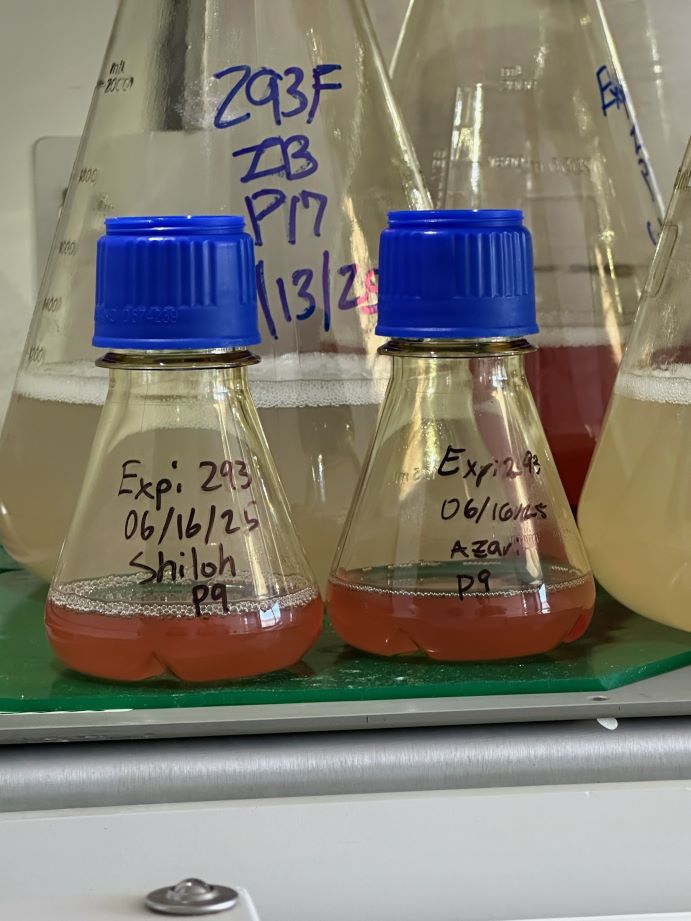
Bellamy + Rhianna in the incubator
Once the DNA is extracted and purified (see Week 1) we can ‘transfect’ the plasmids into Expi 293 host cells which are selected for their high product output. Said cells do not come ready made. Starting on Monday, Nate B. delegated two 50 ml flasks of Expi 293 cells to Azari and I to cultivate. For the past week we’ve split, counted, and grown our cells basically on our own. We’ve gotten pretty attached to them; they have assigned names and genders, we celebrated their tenth birthday when we split them into their 10th passage on Wednesday much to the amusement of our lab mentors. Birthday cards were written (by us) and a birthday candle was searched for in the breakroom (by Liendo). We treat them like our literal children and I’m pretty sure our housemates are thoroughly tired of Azari and I singing praises of our care for them at the dinner table each night. Cell count for incubated Expi 293 theoretically doubles every day and at his first split my cell culture, Bellamy, was undergrown. It’s important to swirl suspended cells like Expi 293 before taking a cell count to ensure you don’t end up with an inaccurate count and underfeed your cells. Even if his cell count had reached 1.5×10^6 cells/ml Bellamy still would have had less than a hundredth of a percent of the cells needed to make a human fetus, which is crazy! Luckily, addition of extra media at his split allowed him to grow to 2.71×10^6 cells/ml with 99% viability by Friday; which made him perfect for transfection.

performing transfection under the hood
Rhianna, Azari’s cell culture was at less than 2×10^6 cells/ml and wasn’t ready yet so we split Bellamy into two 40ml transfected solutions and I’ll grow him back up from the 10ml leftover. We transfected Bellamy with the help of Sean, who was hoping to express an antibody from the gen sequence PCT64-LMCA . The Expi 293 cells I had grown were transfected with the heavy and light chain of PCT64-LMCA. Before transfection though, the DNA is mixed with a transfection reagent or liposome known as 40k PEI and suspended in an ultra nutrient rich transfection media called optimem. 40k PEI creates a cage for the DNA so that it can pass through the membrane of the host cell but it’s actually slightly toxic to the cell so the media is higher quality than usual to ensure the cell survives the transfection. Think of it like the doctor giving little-bittle-baby you a lollipop or sticker to keep you from crying after you get a shot. For our 20 ml cultures we used 2ml optimem + 8ug HC + 8ug KC + 4ug TPST2 (a gene that tells the cell to start creating protein). The microliter amounts are calculated using the DNA concentrations and the micrograms necessary; we used 22.4 microliters heavy chain, 10.6 microliters kappa chain, and 3.3 microliters TPST2. 80 microliters of PEI is added to the solution and then it’s ready for transfection. This preparation is done under a biological hood as is the actual transfection, since work is being done with live cells and sterile technique must be adhered to. The DNA solution is mixed with however many cells you wish to transfect and then sent to incubate and begin producing antibody proteins. Yippee! We’ve now physically run through the majority of the central dogma in mismatched order and the puzzle pieces can finally be put together.
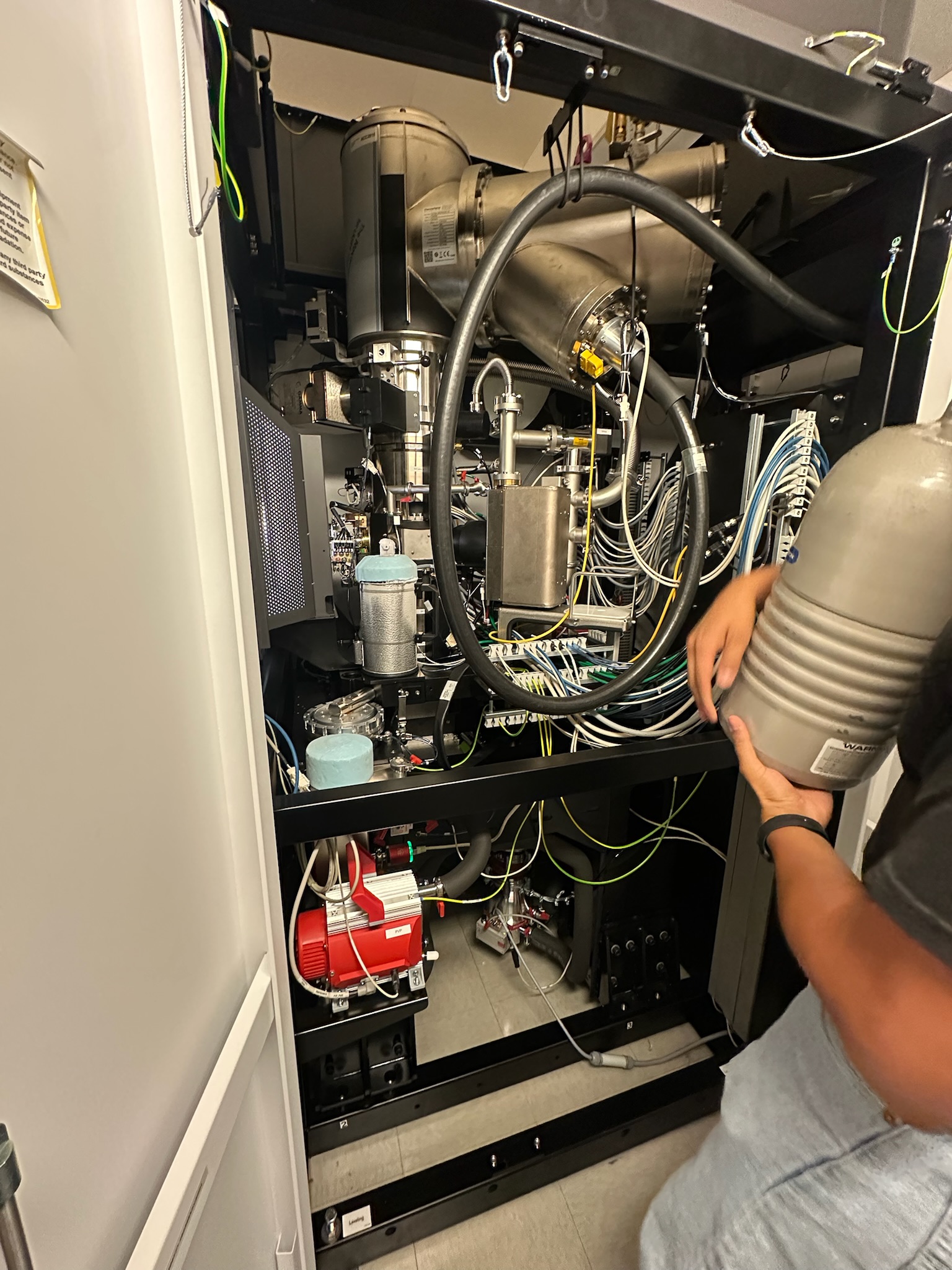
the inner mechanisms of one of the cryo-electron microscopes
Other things done in the lab this week include running DNA and Protein gels with Yenni and Nate B., attending a Briney Lab meeting with Sean, and examining the pictures taken by a Cryo-Electron Microscope with Liendo. The DNA gels were fun and easy, we were able to examine them under UV light to see our single double and uncut results which checked out. We also observed the layering of a Western Blot with a stack of of PVDF membrane and transfer papers soaked in buffer to extract the proteins from Yenni’s gel. Most of the lab meeting was on computational analysis models and a lot of it flew over our heads (we were forewarned of this being a likely possibility by Sean before the meeting). We still got to meet all the lab members for Briney, who were all super nice, and some of their projects were super cool; one was the training of an AI model to predict mutations from the germline and was actually pretty successful. Liendo’s work in the Ward Lab is CRAZY. Most research institutions are lucky to have a single Cryo-Electron Microscope. Scripps has four.
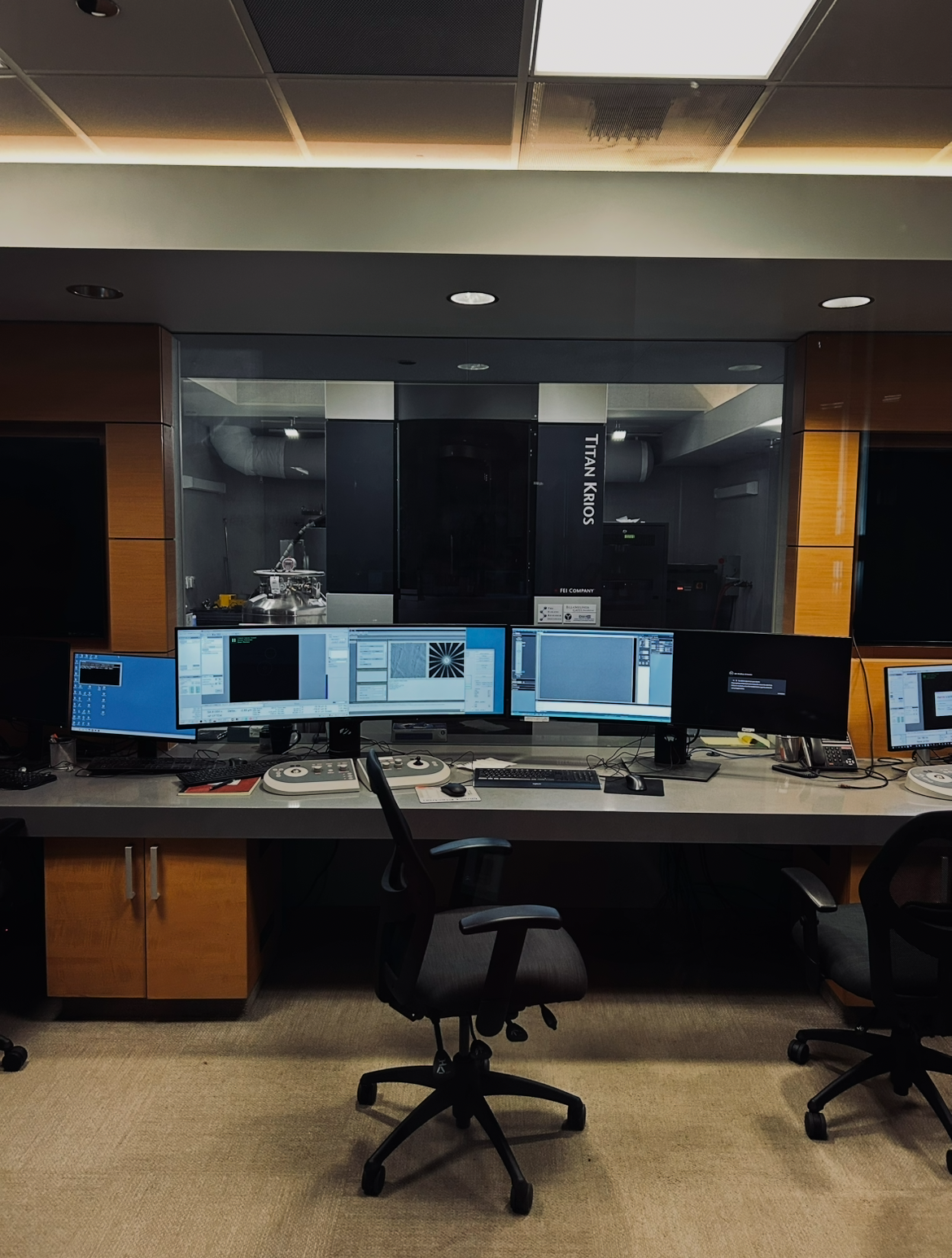
Titan Krios – the most powerful microscope in the world
One of those four is Titan Krios, a multimillion dollar machine largely regarded as the most powerful microscope to ever exist as of present day. Andrew Ward, the PI of the Ward Lab has patents on the proteins developed for the Moderna AND Pfizer COVID-19 vaccines, making him one of the richest PI’s at Scripps; and he developed those proteins using the images taken by Krios. Liendo works extensively with one of the three smaller cryo-electron microscopes to examine how antibody proteins bind to viruses like Lassa and HIV. He took us on a field trip to see the microscope and run a grid through it. Using a combination of negative stain technique, the images taken from this microscope, and a refinement pipeline, these proteins can be examined on the literal ATOMIC level. Liendo has already discovered several new naturally appearing antibodies; something that hasn’t been done in over a decade. He’s working on projects that, if successful, will be scientific firsts, and he does it with complete casualty. That’s definitely one of the biggest culture shocks of the lab; everyone there is doing such amazing work and for them it’s completely normal, just a part of their daily lives that ‘everyone else is doing too.’ I assure you that I am not out here doing what’s never been done before in the entire course of human history so I’m not quite sure which “everyone” they’re referring to here. All things aside, witnessing this kind of work is wildly inspiring and I find myself so impressed with each and every person we meet who are all somehow extraordinary both in their pursuit of science and their humility.

Exploring North Park!!
Outside of the lab is almost as much an adventure as inside the lab. We had Thursday off in honor of Juneteenth which meant we totaled three off days this week! On Thursday we hung at Ocean Beach which was nice and quiet and found a farmer’s market in North Park while attempting to thrift. We danced to jazz, took free samples, and got matching henna tattoos. There was a really cool book store and a record store as well; I would’ve bought a few if I owned an actual record player (I wish). We were hooked on the market kick so on Saturday we headed to Little Italy where we explored one of the largest farmer’s markets I’ve ever seen: Little Italy Mercato.
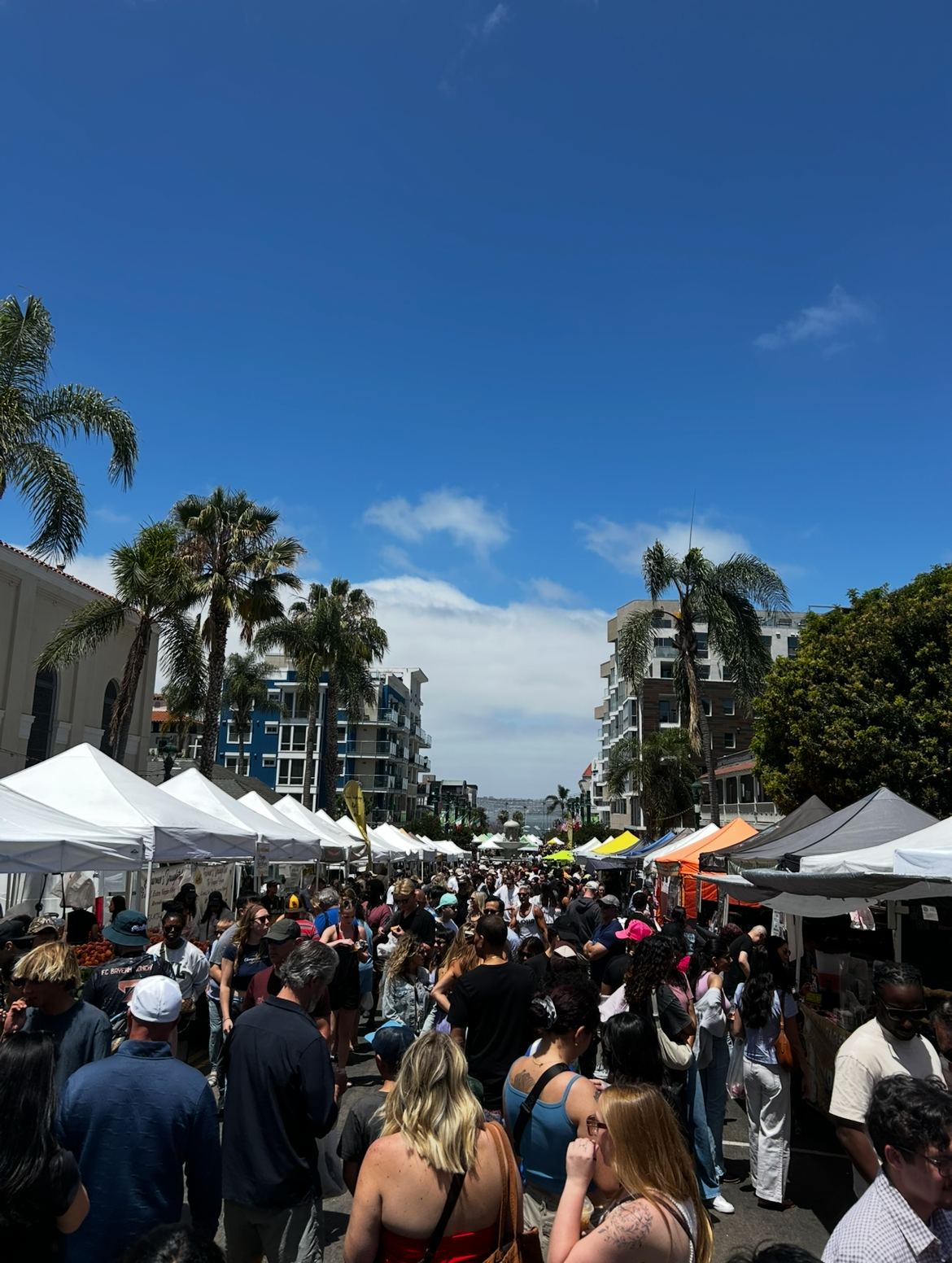
Little Italy Mercato – this photo is only from the midpoint, the full length of the market is HUGE
Hundreds of booths spanning over four blocks of city streets and we saw it all. We ate a lot of good food and, again with the matching, collected a group of lil crochet buddies. Afterwards, we headed back up to North Park for some fro-yo and to revisit the book store we’d fallen in love with on Thursday only to discover ANOTHER outdoor market in full swing; one focused entirely on thrift. Good luck on us since we had failed in our thrifting on Thursday. We also have such good luck parking; we find really great spots a lot of the time and I don’t think we’ve had to pay once (shoutout Lana for her awesome driving skills). On Sunday we headed down to Del Mar to watch the sunset and hang out on the beach. We got pizza and ice cream and lots of pictures. San Diego is so fun; even when we just hang out at home we have a blast singing off-key karaoke and setting up house leaderboards for games like Ping-Pong and Uno. (I will reach the top of that ping-pong bracket, I will!!) All in all, screen-time is down, the sun is up, and my bank account is nearly empty. #rememberthatrealisaconcept. See you same time next week?
Gandmother Judy
Posted at 18:28h, 22 JuneCannot get the tech stuff – that is for you; Keep exploring and learning too. Sounds like a great program – over my OLD head. GGM