
22 Jun Azari Guerrero, Burton Lab at Scripps Research, Week 2
Hi everyone, I’m Azari and I just completed week two of my internship here at Scripps Research!! Just a reminder, I’m interning at the Burton Lab at Scripps Research in San Diego this summer. I currently work with Nathan Beutler, a post-doctorate immunologist who, through antibody discovery and therapeutic design, is working to understand why an effective vaccine for malaria hasn’t been developed yet. The lab itself isolates and characterizes antibodies that are crucial for fighting viruses/infections such as HIV, malaria, SARS-CoV2, Lassa virus, etc. The Immunology and Microbiology department at Scripps plays a vital role in the ongoing development of various vaccines. This week we focused on amplifying and analyzing DNA, transfecting cells, and repeating procedures from last week.
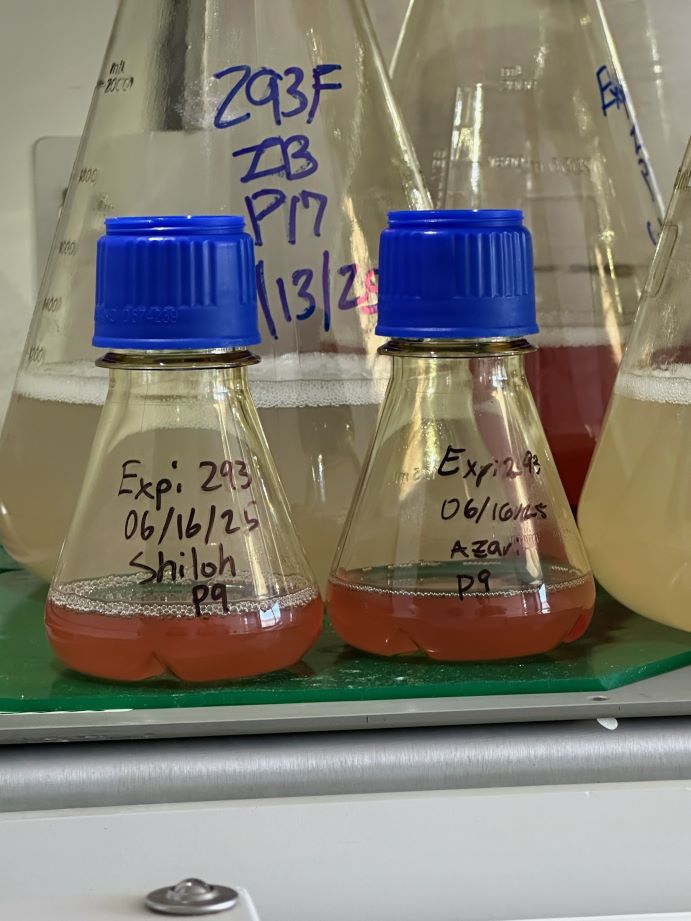
Shiloh and I’s cell cultures (Bellamy and Rhianna) before passage 10
First thing in the morning on Monday, Shiloh and I successfully counted and split our cells from Friday all by ourselves. They were very healthy and at a great count. I guess we felt protective over them because Shiloh named her cell culture Bellamy and mine Rhianna. This kind of cell (Expi293) needs to be split every Monday, Wednesday, and Friday. The majority of the day was spent with Shiloh’s other mentor, Sean. We shadowed him as he began the Gibson Assembly, a way of joining DNA fragments to create a recombinant plasmid. We start off with PCR (polymerase chain reaction), a way of cloning and amplifying the DNA segments that Sean designed. These segments are designed to create a specific antibody he’s looking for. PCR involves denaturing/separating double-stranded DNA into a single-stranded DNA and cloning them. The DNA is then annealed by adding primers, short DNA sequences that bind to the 3′ and 5′ of the insert/vector and work as a temporary glue. The permanent glue is polymerase. DNA ligase is added to seal any imperfections in the backbone and in general just stabilizes the DNA plasmid. After finishing up the Gibson Assembly, we prepared an agarose gel to test how successful our assembly was. Agarose gel electrophoresis works by pushing down the negative charge of sugars in DNA. Larger DNA will be higher up and smaller DNA will be lower down. Our DNA is inserted into the gel, submerged in TAE, and run at 120 volts for 20-30 minutes. The machine malfunctioned a few times, but fortunately, our assembly was successful!!
The next day we recounted our cell cultures and mine was at a perfect count and viability while Shiloh’s count was low. Luckily she was able to get them at a healthy count later on. We prepared a maxiprep with Nate L. until Nate B. got to the lab. After his arrival, we prepared and ran a .8% agarose gel with heavy chain malaria plasmids. Plasmids come in three ways: linear, circular, and supercoiled. We separated the samples into cut, uncut, and double-cut. We want our DNA to be linear when running it, which is why we cut out the insert (antibody). To cut our plasmids, we used a sall1 restriction enzyme. This enzyme is designed to recognize a specific sequence in the plasmid and make an incision there. The single-cut and double-cut fragments stay up high, the uncut supercoil is lower while the uncut circular stays up, and the insert is pulled way down because it’s so small. We ran our DNA at 120 volts for 45 minutes. We weren’t able to check the results because it was getting late and the other interns were waiting on us.
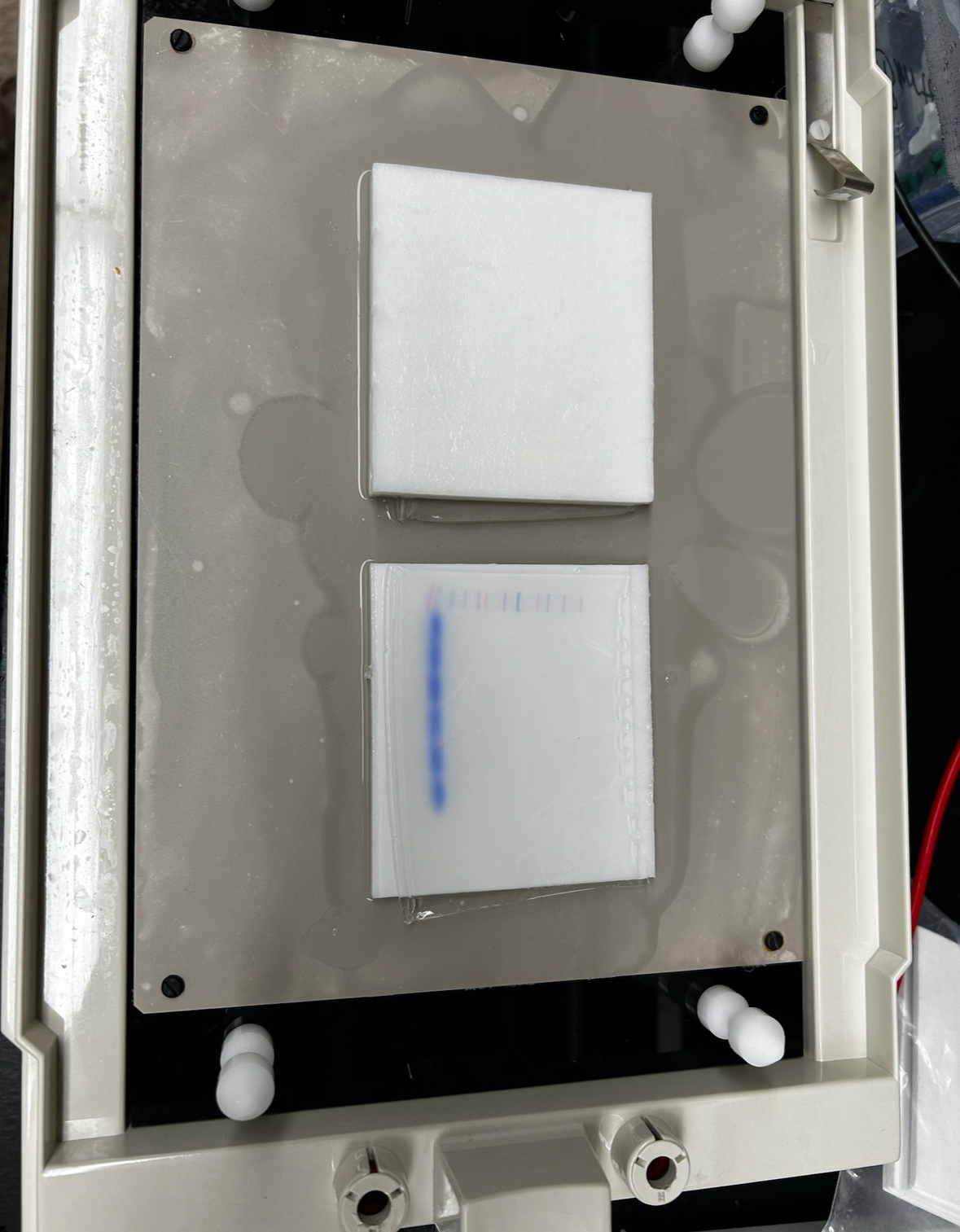
Protein gel in Trans-blot machine before running
While waiting for everyone to arrive at the lab the next day, Yenni, a post-doc who works closely with Nate B., showed us how to run proteins. The process is pretty similar to how we run DNA in an agarose gel but is much more meticulous. The gel comes pre-made because some of the ingredients are toxic and overall it’s just hard to make. He prepped the gel to go into the Trans-blot machine (similar to the agarose gel electrophoresis machine). First, he submerged the transfer paper into a transfer buffer and carefully placed it into the Trans-blot machine. Then he activated a PVDF membrane with methanol and submerged it into a transfer buffer. This was stacked on top of the paper. He submerged and stacked the gel and another piece of paper on top. The gel is rinsed with deionized water before transferring. He also pipettes a small amount of transfer between layers and makes sure there are no bubbles that could disrupt the process. He ran it at 200V for 30mins and when finished he said it was successful. Nate B. got to the lab pretty early so we analyzed our agarose from the day prior and everything looked how we expected it to. With Sean, we put together our plasmids/backbone from the day before. We inserted our gene fragment into our backbone (half heavy chain, half light chain). The fragment put in is the antibody we’re looking for. We added 1ul of our backbone, 2ul of our gene fragment, and 2x (3ul) of our enzyme (Hifi DNA assembly master mix). We then mixed and centrifuged it. Sean then placed the solution into the thermo-cycler (incubator) at 50°C for 1 hour. While waiting, we celebrated our cell cultures’ 10th passage. I’m very grateful that the lab I was placed in is open to Shiloh and I’s way of joking and they even participate. We brought in birthday cards for our cells and (I think) our mentors found it funny.
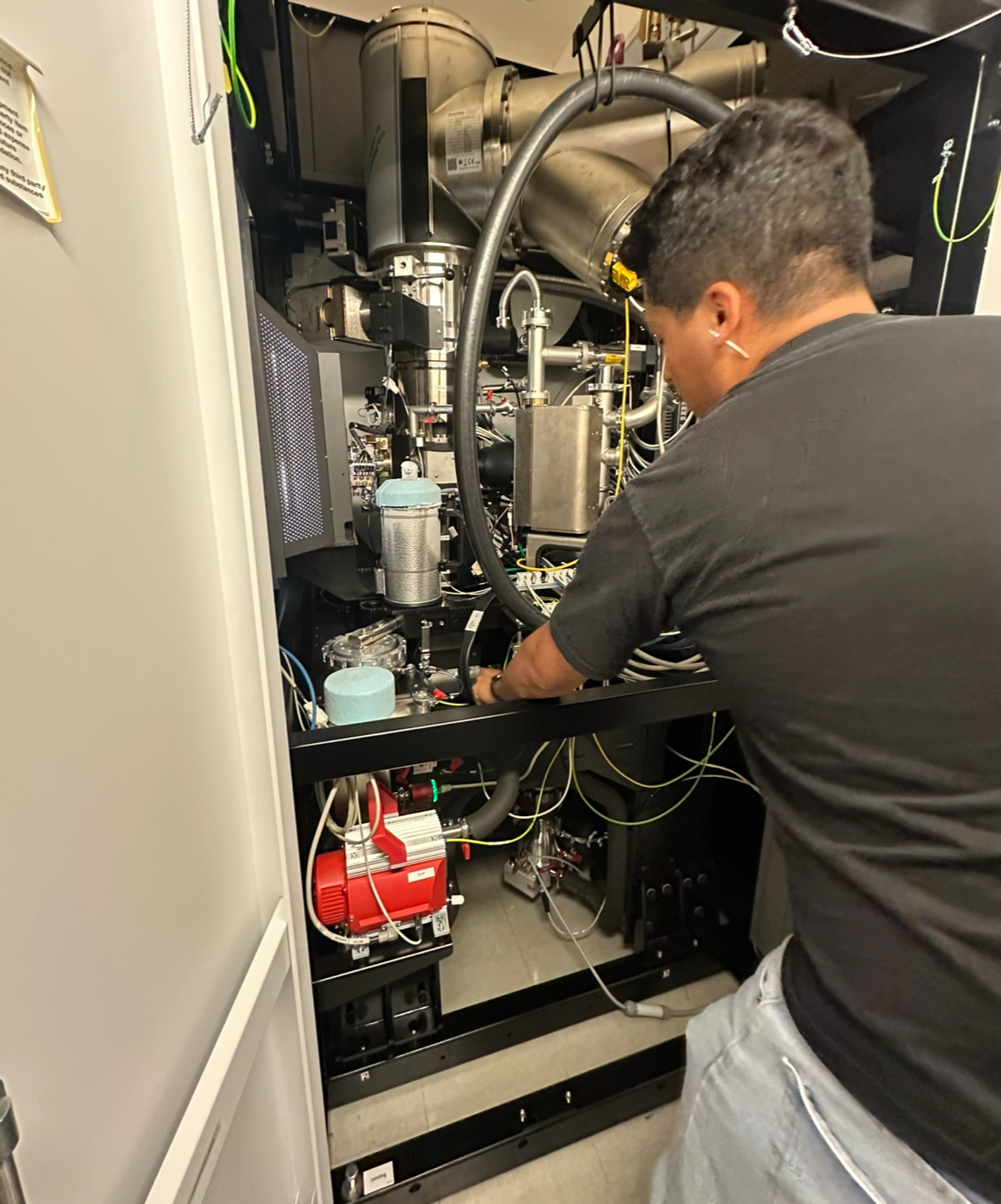
Nate. L setting up the inside of the Cryo-electron microscope
We had Thursday off for Juneteenth so Friday was busy enough to make up for both days. I counted my cells and they were a little low so I split them in a way that would ensure I had 3 million cells per ml (50ml). Shiloh’s cells were a bit overgrown but perfect for our first transfection. Sean transfected the DNA that we’ve been working on. There are four components in transfection: 20ml of cells, DNA, transfection reagent, and transfection media. Our transfection reagent is 40k PEI; it allows DNA to get in, starting the central dogma. We need an antibody heavy chain, kapa chain (light chain), and TSPT2 (our gene). This has to add up to 20ug; so 8ug of HC and KC, and 4ug of TPST2. In a tube with 2ml of optimum, we add our DNA. Then, we add 80ul of our PEI and mix. It’s then incubated for 15-20 minutes before adding the mixture to the cells. After incubation, they’re heat shocked together. In the heat shock, the cells open up and go into the DNA. Our DNA is negatively charged so they pull the positively charged cells in the shock. Sean used his own cells but we used Shiloh’s cells. There has to be 3×10^6 cells; hers had a bit less but it’s okay. All our components are mixed together. Part of our solution needed to sit on the agar gel over the weekend so we’ll see how everything looks on Monday. The rest will be incubated for purification next week. We had a bit of time on our hands so Nate L. took us to the Ward lab (his other workspace). In this lab, he analyzes proteins at an atomic level to determine whether a vaccine works or not. If a vaccine is attached to the protein, it means the vaccine works effectively. He’s able to look at these proteins on a tiny grid placed in a huge Cyro-electron microscope. It was so insane to me that he and others in the lab use this regularly and are so casual about it. Nate L. spoke about how he’s the first person to find a naturally occurring protein in the last decade and he’d be the first person EVER to complete another project he’s working on. He was honestly too humble when saying that “Everybody does this, I’m not doing anything new”. Shiloh and I were in awe for the entirety of his explanation. It was very shocking seeing somebody do something so impressive and be so indifferent about it.
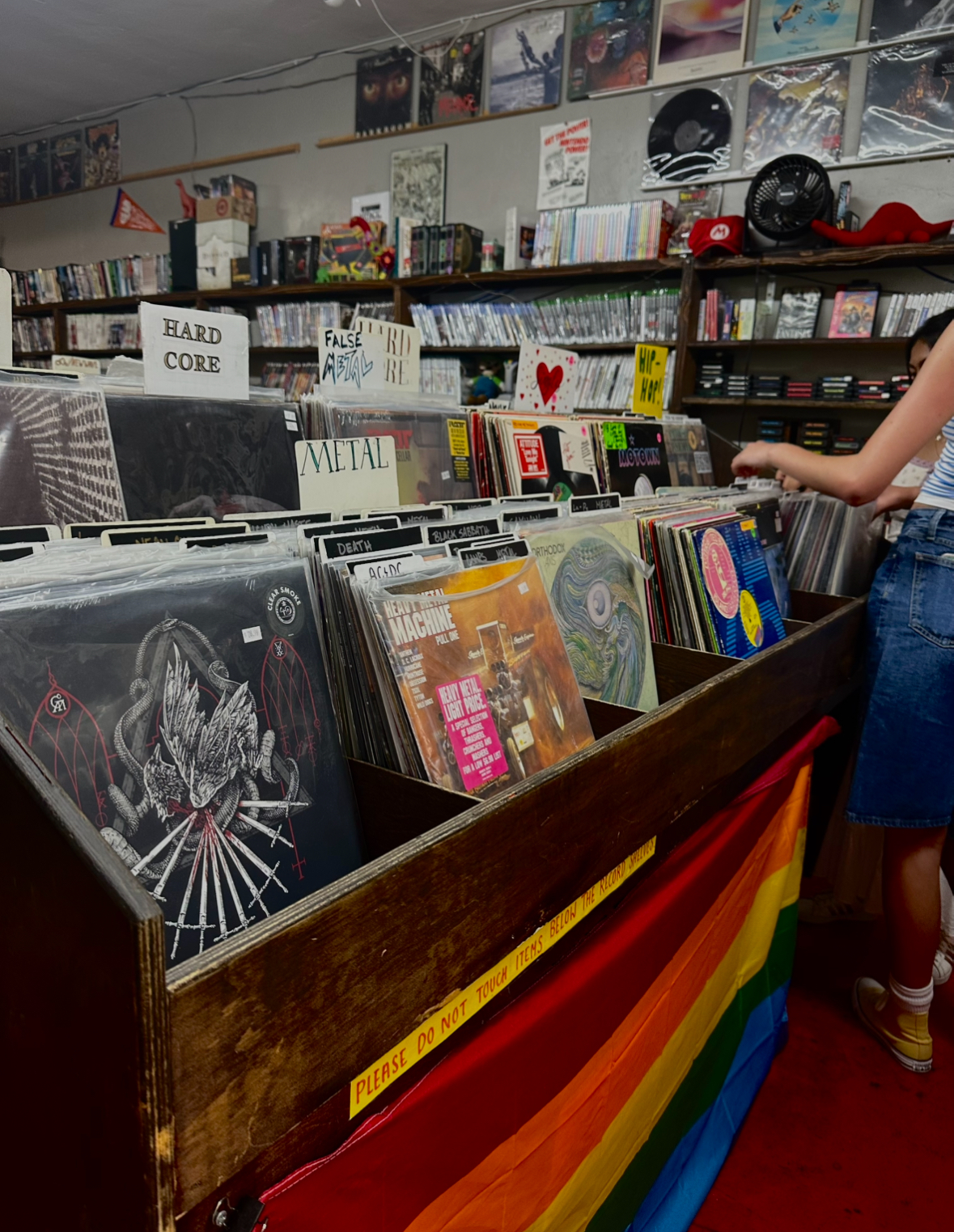
Record store near the farmers market
Outside of the lab has been so much fun, too. We’ve all been making amazing meals, had intense ping-pong matches, preformed very off key karaoke, and continued to explore the San Diego area. We’re on a mission of going to and rating as many beaches as we can until we find the best one. I’ve gotten sunburnt at each one so I hope we find the best one soon!! My favorite adventure is definitely exploring the farmers markets scattered around San Diego. There’s so much going on at all times and I’m so happy I get spend my summer with a great group of people in a great city.
Thanks for reading, see you next week : )
Yenni
Posted at 18:42h, 23 JuneGreat job, girls! Very detailed and interesting — I’ll need to learn more of the “New English” soon 😄
Just a couple of minor corrections: it should be “PVDF membrane” and “200V, 30 min”.