Welcome back! Week 3 has been so much fun! For those only now reading my blog, I have been interning at the Ye Lab within the Dorris Neuroscience Center at TSRI. I am assisting my mentor Cailynn Wang with her work on CATCH and mapping drug distribution in the brain (and other organs). So far I have observed the first few steps of the CATCH pipeline, including: intraperitoneal drug injection into the mouse, transcardial perfusion and harvesting of the desired organs, clearing, sectioning, and the click reaction. This week we focused embedding the 24 brains we harvested last week in a hydrogel so their proteins can be crosslinked (enabling the important structures of the tissue to remain intact while the lipids are washed away to clear the tissue).
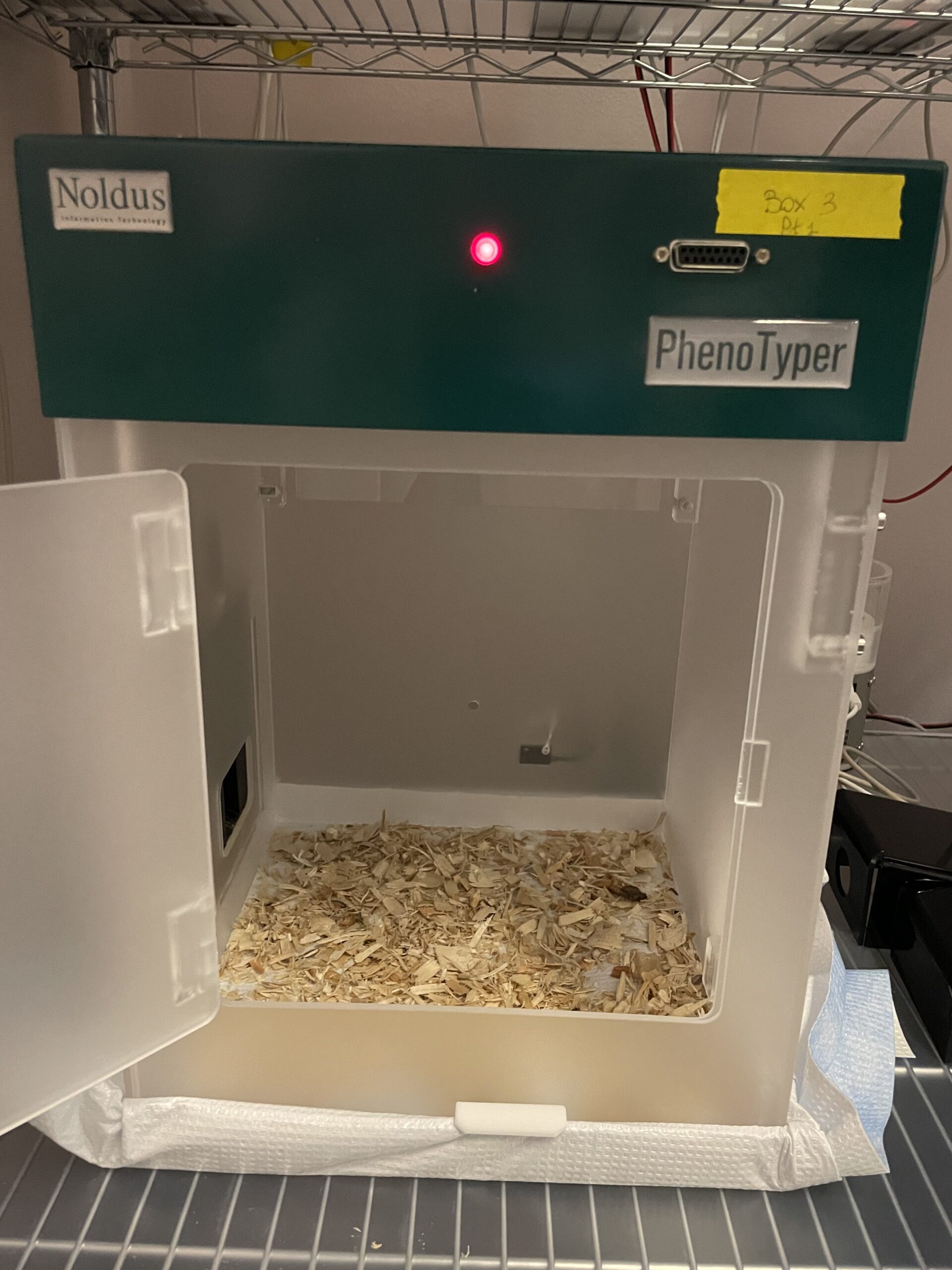
A mouse behavior suite which includes a camera and heat tracking sensors that record all sorts of data
On Monday I spent my morning researching hydrogels and crosslinking in order to be prepared for actually creating a hydrogel with Cailynn in the afternoon. Crosslinking is the process of forming covalent bonds to link together different molecules (usually proteins) in order to stabilize and immobilize the structure. Crosslinking is important in the CATCH process because drugs are easily washed away or relocated during tissue processing and crosslinking stabilizes the drugs (which are bound to the target receptor) so information about their location is preserved for future imaging. The crosslinking process is achieved through radical polymerization and initiated by an azo initiator that forms free radicals (highly reactive molecules looking to gain an electron) that in turn react with the monomers in the tissue to form a stable polymer chain. Similarly, hydrogel embedding is also used to maintain the structure of the tissue. However, unlike crosslinking which immobilizes the protein-to-protein interactions, hydrogel embedding consists of placing the tissue in a buffer of PFA (basically formaldehyde), acrylamide, and bis-acrylamide (which acts as the crosslinker because the hydrogel and crosslinking process are simultaneous) that forms minuscule methylene ‘bridges’ within the tissue and acts as a sort of molecular mesh to hold all the structures (except lipids) in place. The reason that hydrogel embedding is needed is because the process of removing lipids is very harsh on the delicate tissue and without it other molecules (like proteins or the experimental drug) that we need to see would be washed away along with the lipids. In the afternoon I helped Cailynn remove the agarose gel from her 24 brain samples so they could start the crosslinking/hydrogel process. It was a very tedious task, though, because I had to exercise extreme caution to prevent damaging the delicate brain tissue. I ended the day by creating a “cocktail” called A1P4 under the fume hood that will be used to create the hydrogel in the tissue later.
Tuesday’s focus was assisting Cailynn with another, mini, experiment. I watched her harvest four more brains but this time she didn’t perform a perfusion because the goal of this experiment was to determine RNA retention in order to see whether the virus injected into the mice brains actually knocked out the target it was supposed to. RNA degrades rapidly after death, so she had to harvest the brains very quickly and then immediately place them in a freezer set to -80 C (brrrr!) so that the RNA would remain in the brains. Later, I degassed the 24 brain samples (in A1P4) by infusing nitrogen while the samples were locked in a vacuum chamber. The removal of oxygen prevents the formation of bubbles which could hinder the polymerization process or potentially block visibility in later imaging studies. This occurs because oxygen is a free radical scavenger, meaning it competes with the initiator (VA-044) for electrons, which slows down or even sometimes stops the polymerization process altogether. After lunch I made the SDS buffer, which when heated will begin the polymerization/hydrogel process. The final step to the crosslinking/hydrogel embedding process is to place the tissue samples in a warm “bath” of SDS solution, which washes away the opaque lipids because they aren’t chemically anchored to anything, unlike the proteins and drug.
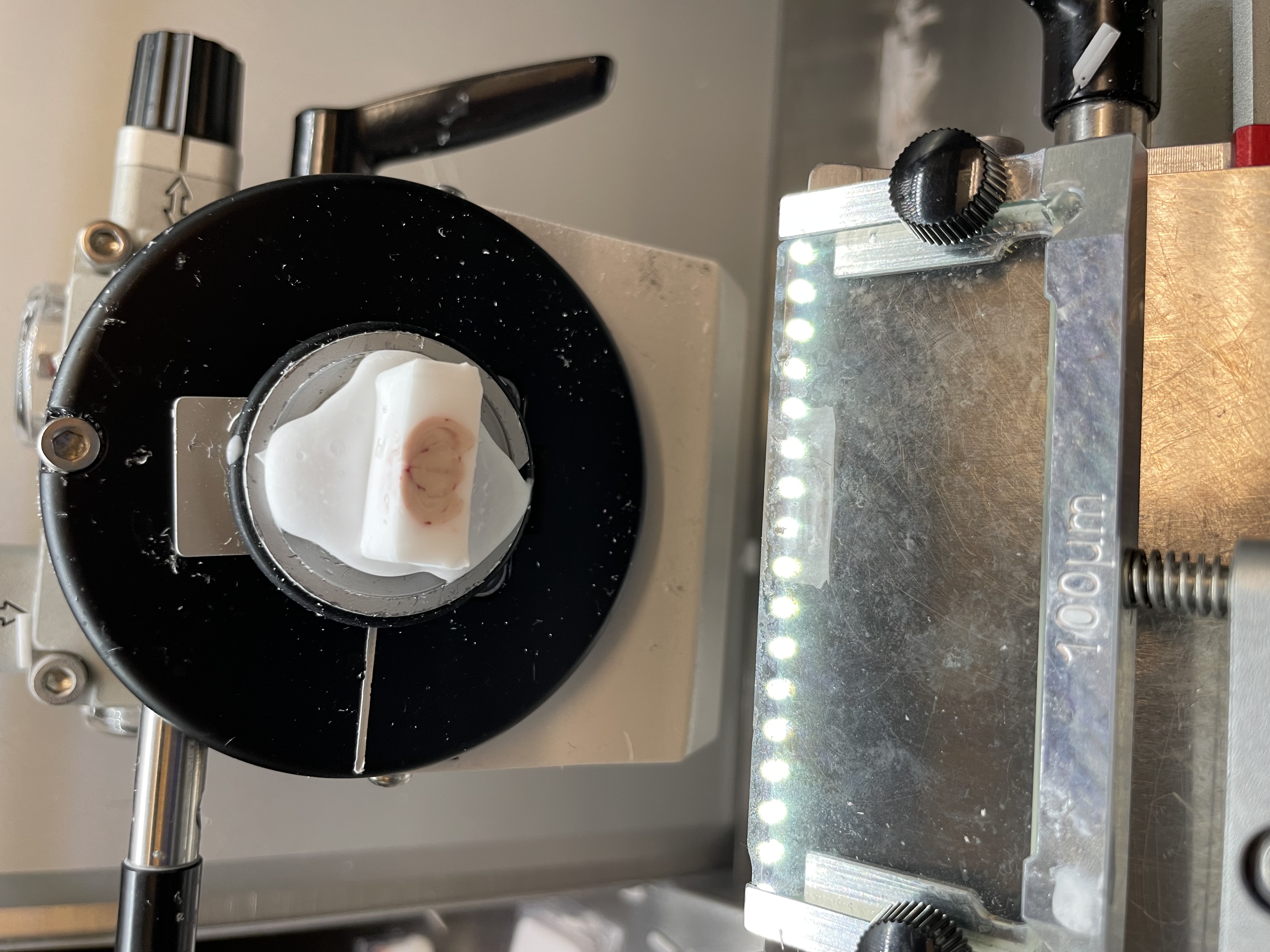
A frozen mouse brain mounted on the Cryostat machine and ready to be sectioned into 50 micrometer slices
On Wednesday we returned to focus on the four harvested brains from Tuesday that had frozen in the cold room and were now ready to be sectioned and amplified for imaging. RNA is so tiny that it must first be amplified through a process called the Hybridization Chain Reaction before it shows up under a microscope. This is done to double check whether the injected virus actually worked (knocked out the target receptors in order to create a control) because antibody staining alone is often unreliable. Because the brains were already frozen, Cailynn decided to section them using the Cyrostat machine. However, without perfusion the brains had not been infused with the fixative and therefore were very delicate and friable, when you touched the tissue with the brush to move in onto a slide it simply dissolved instantaneously. This was very frustrating and led to some innovative thinking by Cailynn in order to successfully transfer the fragile brains onto a slide to be fixed with PFA. In the afternoon I planned and researched for my own experiment next week! I was given the choice between two drugs to study, a FAAH inhibitor or pargyline, and I chose pargyline. Pargyline is a monoamine oxidase (MAO) inhibitor that has potential to treat depressive disorders due to its prevention of the breakdown of neurotransmitters like norepinephrine, serotonin, and dopamine.
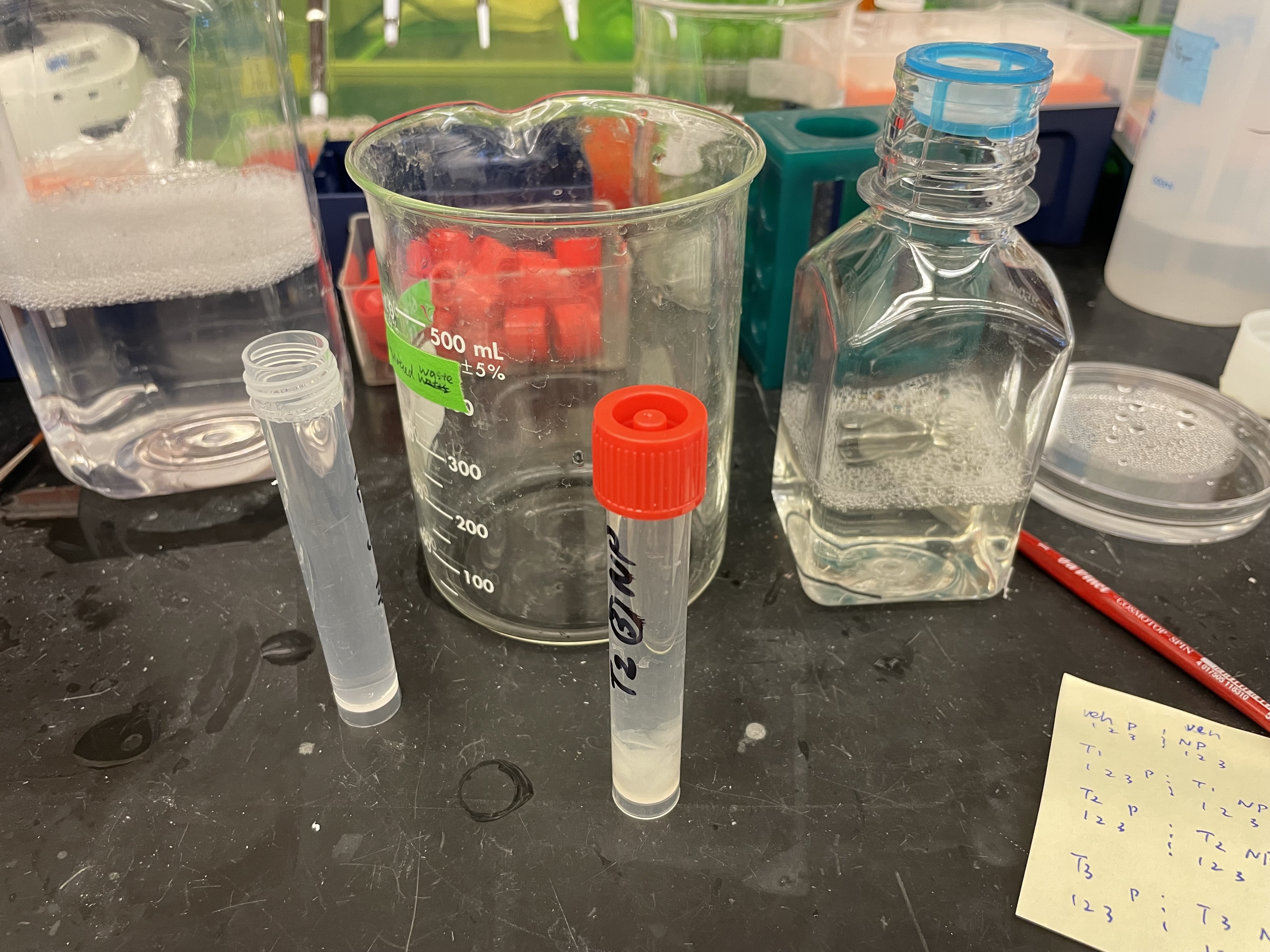
Changing buffers! This process took a lot longer than usual because the 24-brain sample was extraordinarily large!
Thursday was a pretty chill day, especially the morning, and I had extra free time in between changing the buffer (PBST) on the 24-brain sample. After being cleared of lipids in the SDS wash, the tissue samples needed to be washed three times with PBST and then once with PBS to wash away any remaining unbound molecules. PBS (or PBST) is used in place of water because it is a saline/phosphate solution that more closely mimics that within the body, thereby better maintaining the tissue’s integrity during handling. In the afternoon Cailynn brought me down to the vivarium (the mouse room) and I practiced grabbing and injecting the mice with saline if preparation for actually injecting them with a drug next week. It was kind of difficult at first because you have to push down and grasp the mouse firmly behind its head and I was worried about hurting them. After I got the hang out of it Cailynn passed me the needle and I injected into the peritoneal cavity (either the lower left or right quadrant of its abdomen).
Friday was another very chill day and I spent most of the morning playing geoguessr with two other lab members before we celebrated one of the lab members’ last day with cake and boba! After that I helped Cailynn start a new CLICK reaction by mixing together the azide, copper, ligand, and solvent.
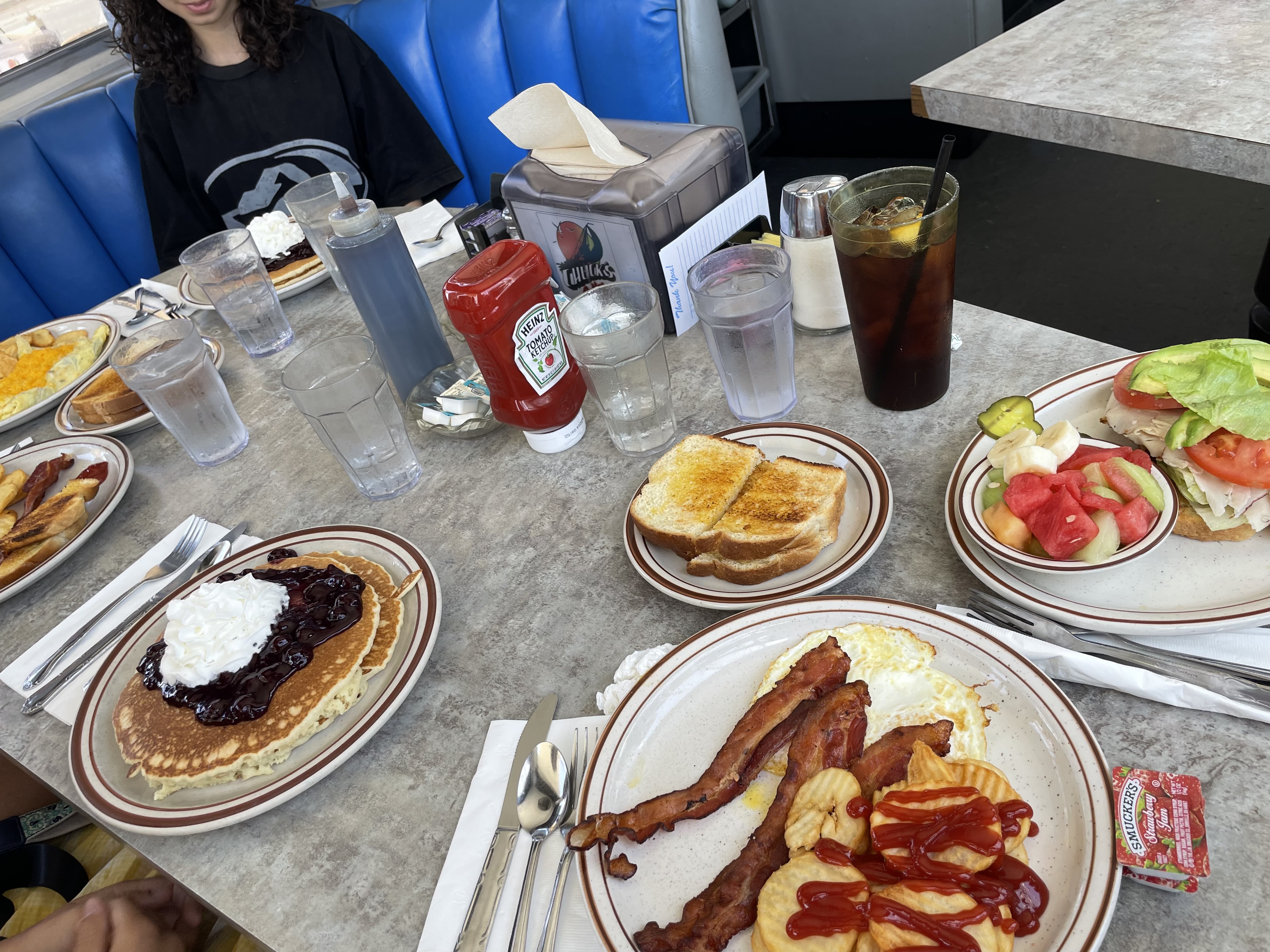
A delicious breakfast (thanks Grandma!)
On Saturday we drove up to LA to see The Weeknd concert!! It was my first concert so it was a little overwhelming considering the stadium was massive and could hold 75,000 people (most of which were there). The show was so much fun and I loved getting to see the entire stadium lit up with the glow bracelets that resembled thousands of stars in the night sky. After the show we went back to my grandma’s condo in Long Beach and spent the night with her. She treated us to a lovely breakfast in the morning and after that we chilled while listening to the waves lapping at the beach. This week has been incredible and so memorable and I can’t believe all the new things I’m getting to experience this summer! Can’t wait for next week!
It was so much fun seeing you all!