
28 Jun Brylea Butler – University of Houston – Week Three
Three weeks down, only one more to go! This week was so much fun, working with such an amazing group of grad students and my lovely lab partner Riley. Along with getting to spend time with my awesome suite mates.
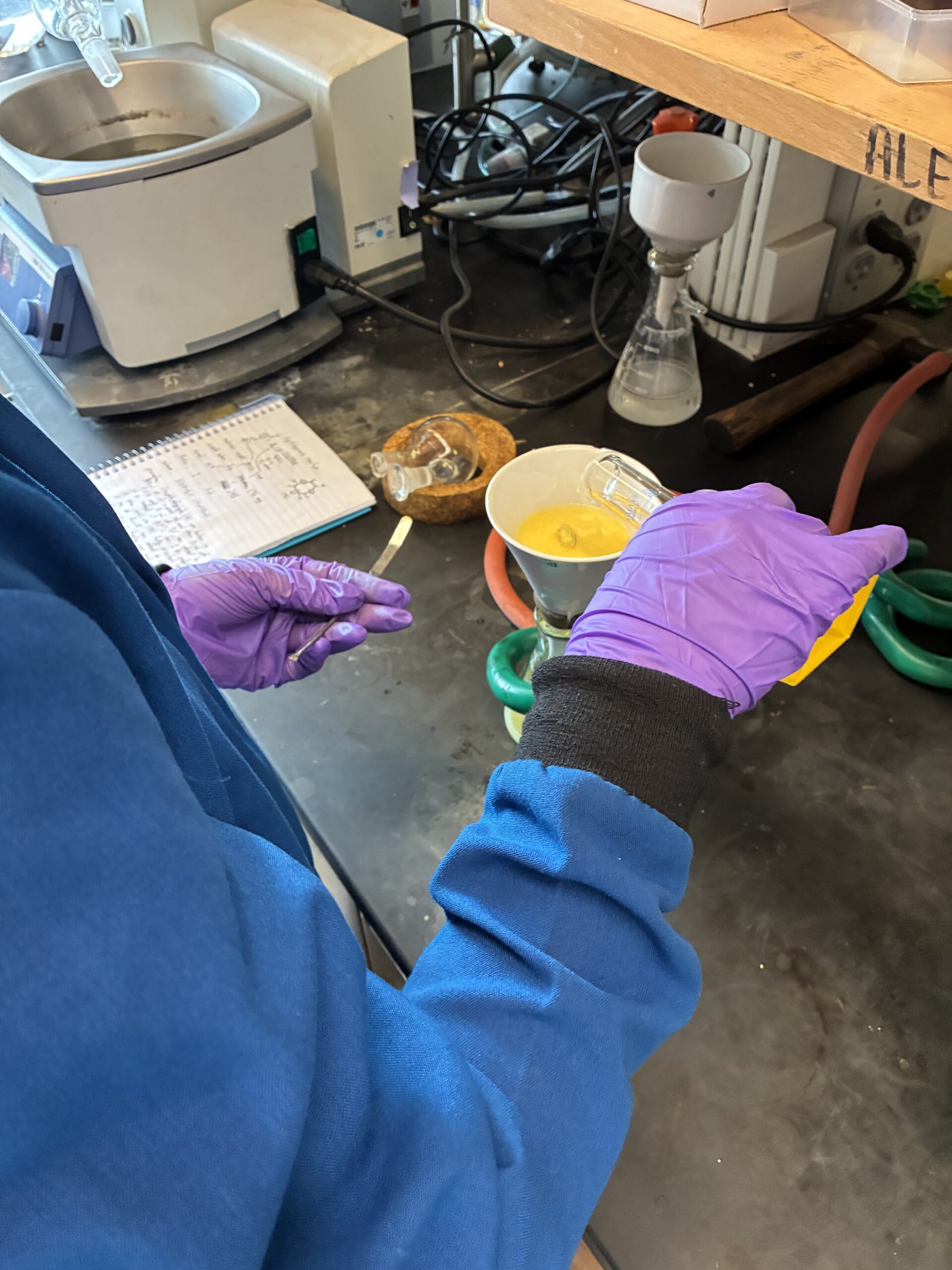
 This week we jumped right into starting a new reaction called cyclotribenzoin synthesizing. With all of the work we have done in the lab these last couple weeks, this reaction was done with much more independence. We went over the procedure, calculated to make a smaller quantity, and then got right into. We started with one of the most important steps in the lab, cleaning the glassware we were going to use. If there is any leftover residue in the glassware it could completely change your reaction. Then we could start the reaction, starting with Isophthaldehyde, which we added to a closed reaction system. Then we added 15 mL of ethanol and deionized water to the system. After the starting material was fully dissolved we added our catalyst, cyanide. We then waited 48 hours for the reaction to finish. We then had to dry out product which is done using a vacuum filtration system, which we let run for a few hours then weighed our product to see what our yield percentage was. I weighed in .9863 grams of product giving me a 49% yield, which is very good for this reaction since the expected was around a 41% yield. We also got to begin the cyclotribenzion esterification reaction but that will not be done until next week.
We ran several NMR titrations this week including one of the cyclotribenzoin condensation that me and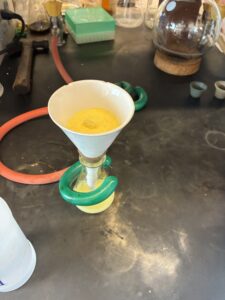 Riley made. We also ran NMR titrations with Bromide and Iodide, which came up with extra peaks in the NMR that we were not sure where they came from, but could possibly be impurities that were not caught on previous titrations, so we will have to run these again. These also gave us a very large percent error, so they are unreliable for the research we are doing and cannot be published.
This week we also got the chance to the crystal X-ray machine and how it works. We got to see a single crystal X-ray diffraction be run. Setting up this test is very tedious and must be done with extreme care. Since you are placing a single crystal onto a round needle it can be very difficult. These crystals are extremely fragile so the must be handled with care. The X-ray is used to determine the structure of the crystal using lights that can be amplified by the electrons showing where they are most dense.
 This weekend was also by far my favorite. We got the opportunity to visit the Houston Museum of Natural History. My favorite thing to do whenever I’m in a big city is to visit the museums, especially natural history museums. I got to see marine history and wildlife of Texas, fossils, artifacts from ancient civilizations, and how the oil industry functions. It was such an amazing experience with so much to
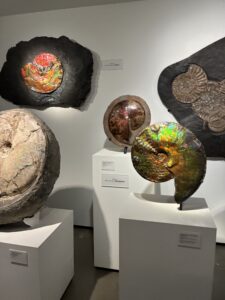 explore and learn from.
One final week left and even though it is bittersweet to say goodbye to all of the incredible people that I have met along the way, I’m ready to be home.
No Comments