
18 Jul Zoe Schiffer – Chemistry at TSRI – Engle Lab – Week 5
Hi everyone, just a recap: my name is Zoe Schiffer, and I have had the amazing opportunity to spend 6 weeks in San Diego interning at the Scripps Research Institute in the Engle Lab. The lab is run by Keary Engle. I have been working with Madison Wagner, a 4th-year PhD candidate, as my mentor. At this point, I only have 1 more week in San Diego, which means only 1 more week of working in the Engle Lab.
This week was fairly repetitive with purifying things, but with each purification I’ve learned something new and gotten to do a bit more. The explanation of purifying with columns may be repetitive, since I’ve mentioned it in past blogs, but I have a better understanding now and can convey it more effectively.
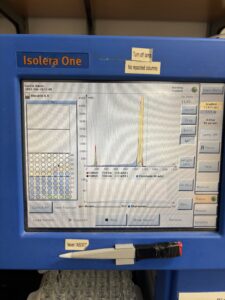
 The column works by pumping a mixture of solvent through a tube containing the product suspended in silica. To create this suspension, acetone and silica are added to the product and put onto the rotovap. This evaporates the acetone, leaving the product in the silica. As the solvent is pumped through the column, it separates the components of the product based on polarity. The pure product has its own polarity, so it separates from byproducts and side products, allowing us to isolate the desired product from the reaction. On the Biotage, this shows up as a peak, which represents the amount of UV absorption the components have. This week I was purifying alkynes, which have very high UV absorption, so the desired product shows peaks in the 4500 mAU range. This makes it fairly obvious which test tubes the product is in.

Short Wave UV
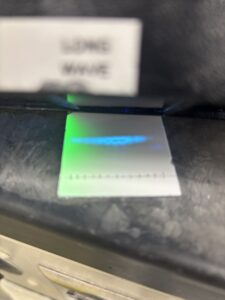
Long Wave UV
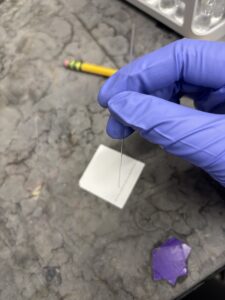 To check this, I take a TLC of the test tubes we think contain product, along with a couple of tubes on either side, to make sure any excess product is collected. On the TLC, a line indicates where product is present, while spots outside that line indicate none.
From there, the test tubes containing product are rotovapped down so that only the product remains. Sometimes they’re rotovapped in separate groups so we can determine which ones actually contain the product and which are still impure.
An NMR is then taken of each one to determine whether the product is pure.
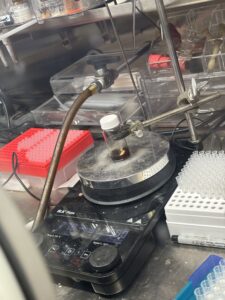
Before
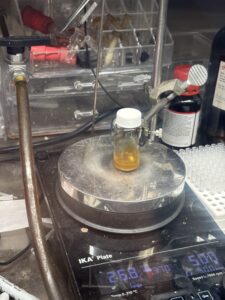
After
I also shadowed Wenji again this week. He was running a ligand exchange reaction, which involves mixing lignin with palladium using toluene as a solvent. Since the reaction was air-sensitive, it was done in the glove box; I still don’t know how they manage such dexterity with those astronaut gloves. The reaction had a very distinct color change, going from a dark reddish-orange to a much lighter brown as a precipitate formed. This precipitate was his product, so he had to filter it out.
Outside the lab, we’ve been fairly busy. We spent a day at Windansea Beach, which is mainly a surf beach. It had rocks I was able to walk on and explore, some of which led out into the 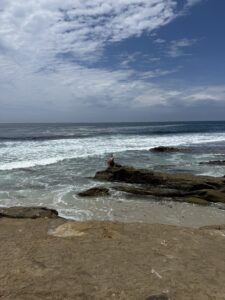 water and made a great spot to sit. I also went to the climbing gym a few times this week. Other than that, there hasn’t been much going on. This was Stella and Kaila’s last week working at UCSD, and they’re heading home now. The house will definitely feel different without them.
I only have one week left in San Diego, and it’s gone by so fast. I can’t wait to see what my final week has in store.
No Comments