04 Jul Zoe Schiffer – Chemistry at TSRI – Engle Lab – Week 3
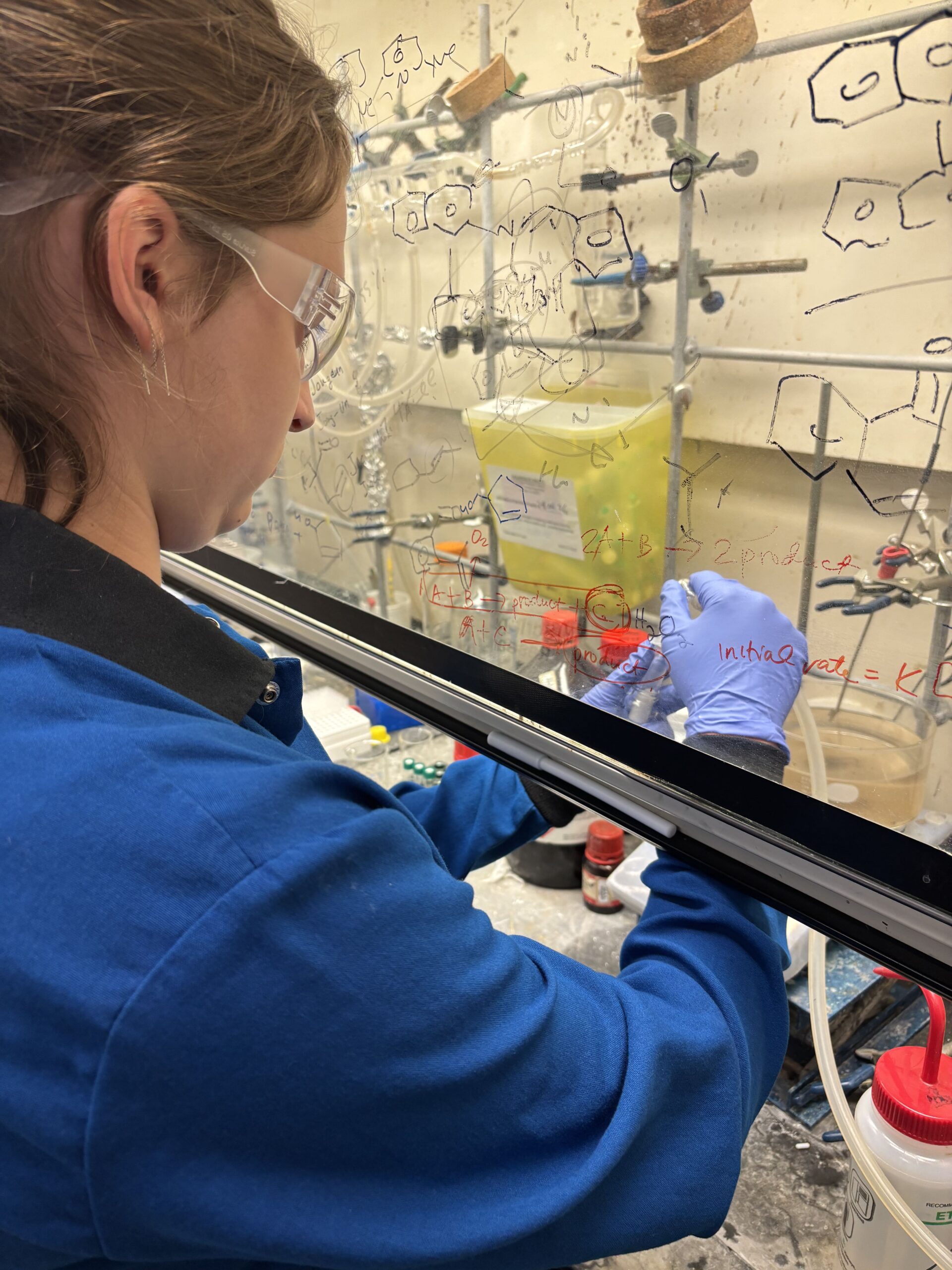
Hi everyone! Just a reminder, my name is Zoe Schiffer, and I have had the amazing opportunity to spend six weeks in San Diego interning at the Scripps Research Institute in the Engle Lab. The lab is run by Keary Engle, and I have been working with Madison Wagner, a fourth-year Ph.D. candidate, as my mentor. This week, Madison was back, so I got to do a bit more than just watch.
This week, we did two alkyne difunctionalization reactions. It involved a lot of precise weighing of the reactants, which did get a little tedious, partially because I am still figuring out how much everything weighs. Eventually, I was able to get everything weighed out into the two different vials as precisely as possible, and Madison added the reactants that were in liquid form. Before we could start the reactions, we had to make a stock solution, which simply involved adding a base from the glovebox and another chemical to it. I was quite surprised that Madison was able to quickly measure out the base in the glovebox while wearing the “astronaut gloves” because I can barely put a chemical away.
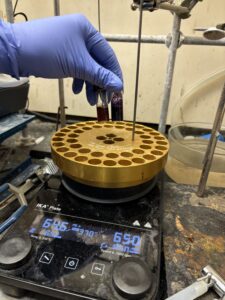
I was very intrigued that one was purple (the right one)
After all the reactants were measured out and the stock solution was added, everything had to mix for two hours. After the two hours, the mixture had to be filtered because it contained both solids and liquids. Some of the solids included palladium. After the mixture was filtered, Madison performed an extraction on both compounds at the same time. She made sure to mention that when I do it for the first time, it will probably look very different because she has been doing it for a long time. It’s reassuring to know that, as much as I want to be perfect the first time I do anything, that isn’t what’s expected.
If you remember the column from last week, I learned that it is one method of purification so that only the desired product is collected. Another method of purification is using prep plates. Another throwback to last week was TLC, or thin-layer chromatography. Prep plates are essentially a scaled-up version. This process consists of applying all of the product in a line onto a glass plate covered in silica. The product is added in layers until all of it has been applied. The plate is then placed in a solution of solvents with different polarities. The solvents travel up the plate, separating the desired product from the impurities. Once the product has been identified, it is scraped off the plate with a razor blade. It is then rinsed with acetone to remove the product from the silica, and then rotavapped several times with deuterated chloroform to remove any excess acetone. An NMR is then run to confirm that what we obtained is actually the product we wanted.
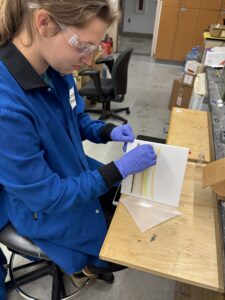
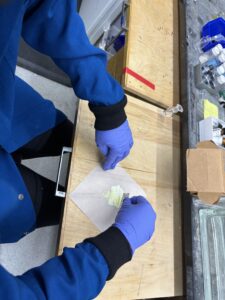 I can confidently say that I know how to do this process and am now allowed to do it without direct supervision, except for placing it into the solvent solution and identifying the product we actually want. Though it may seem like a tedious task that a high school intern can do, it is the reality of chemistry, and I’m all for it.
While at Scripps, we have also done some things outside the lab. People were replacing lights in the building one morning, and they were working in the office where we usually work, so we were temporarily kicked out. Madison and I ended up getting breakfast at a parakeet-themed café on campus. We also got lunch with Wenji and attended another SURF meeting.
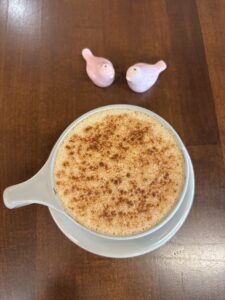 Outside the lab, we have gone on boba walks and spent time at the beach. We also had another Pintern over, Izzy, who is also working at Scripps. It’s safe to say that we are staying busy while also spending a lot of time working in the lab.
That’s about it for this week! I really enjoyed getting hands-on experience in the lab, and I felt like I learned a lot from it. As I have said before, I think my gap in knowledge is slowly closing. I can’t wait to see what next week brings!
No Comments