05 Jul Stella Coe- UCSD George Lab- Week 4
Hello everybody! Welcome back to my Pintern blog. This week marked the beginning of our fourth week in the George Lab at UCSD. With one of my mentors away on vacation, my schedule looked a little different than usual, giving me the opportunity to spend more time with Selene and learn about several new techniques being used throughout the lab.
Monday 06-29-26
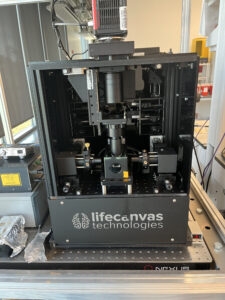
While Kaila worked on her brain-clicking, Selene and I headed across campus to prepare the light-sheet microscope for imaging. Later that morning, we all returned to the microscope facility to watch the imaging process firsthand.
It was very fascinating to learn how brain imaging worked. Rather than slicing the brain into hundreds of thin sections, the tissue is first chemically cleared until it becomes nearly transparent. A thin sheet of laser light then passes through the brain one layer at a time while a camera captures thousands of images. Those images are reconstructed into a detailed three-dimensional model, allowing researchers to examine structures throughout the entire brain.
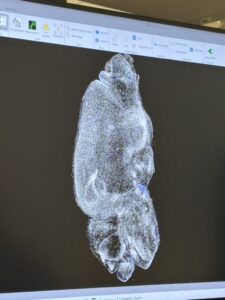
each point of light represents an active cell
Unfortunately, research rarely goes exactly as planned. While we were there, the microscope wasn’t cooperating, and Selene spent much of the visit troubleshooting the system. It turns out that one of the lasers isn’t working, which is going to require some maintenance and possibly replacement of parts.
Tuesday 06-30-26
Tuesday introduced me to a completely different type of experiment. Instead of working with brain tissue, I helped Selene perform an ELISA assay to measure nicotine levels in blood samples collected from mice.
The morning involved organizing samples, labeling tubes, and carefully preparing everything for the assay. Precision was especially important because even small pipetting errors can affect the final results.
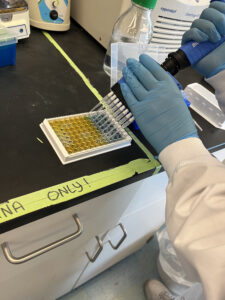
One thing I found fascinating was learning how an ELISA actually works.
Enzyme-Linked Immunosorbent Assay. Researchers use this test to measure how much of a specific substance is present in a sample, such as a hormone, protein, or—in our case—nicotine.
The process begins by adding blood plasma from each mouse into tiny wells on a plastic plate. Each well is designed to recognize nicotine using specialized proteins called antibodies, which bind only to their target molecule. After several washing steps to remove anything that isn’t attached, another antibody linked to an enzyme is added. If nicotine is present, the enzyme causes the solution to change color.
The intensity of the color corresponds to the amount of nicotine in the sample. A plate reader measures how much light each well absorbs, producing numerical values instead of relying on what our eyes can see. Those values are then compared to a standard curve, which is created using samples with known nicotine concentrations. By plotting the standard curve, researchers can calculate the nicotine concentration in each unknown blood sample.
I helped prepare the samples and later analyzed the data by creating the standard curve and using it to determine the nicotine concentrations.
It was very rewarding analyzing the data points and creating a standard graph. I am super thankful that I got to learn the process of data analysis.
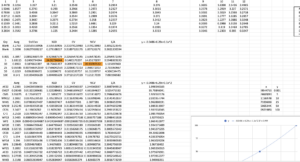
This is my data analysis
The afternoon was spent continuing our individual projects before Selene surprised us with a trip to the newly opened campus Jamba Juice.
Wednesday 07-01-26
After a morning of Von Frey testing, Wednesday afternoon gave us the opportunity to visit another laboratory and observe a technique called brain punching.
Researchers first sliced frozen brains into extremely thin sections before using tiny circular punches to isolate very specific brain regions for later molecular analysis. Watching the procedure highlighted just how precise neuroscience research can be. Every punch had to come from the exact same location in every brain to ensure that the data would be comparable across animals.
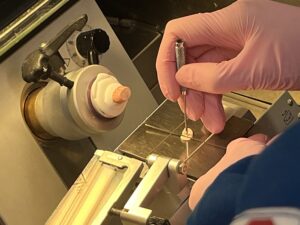
An undergraduate student from the UK taught us how to make PFA, a type of formaldehyde that is used during dissection. It was really cool to meet him- he said he heard us playing the soundtrack to Little Shop of Horrors last week and told us he played the dentist.
Thursday 07-02-26
Thursday morning, I finally finished the last round of Von Frey testing on this cohort of rats! Woohoo! In the afternoon, I worked with Selene and continued to look at the results of other ELISA tests. I also completed my PE classes for the week!
Saturday 07-04-26
We celebrated the Fourth of July with a quieter day at home because of how crowded the beach and the entirety of San Diego had become. We picked up craft supplies, spent the afternoon making art together, enjoyed grilling hamburgers, and finished the evening watching fireworks.
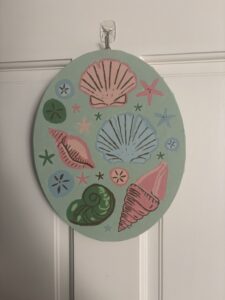 -My art
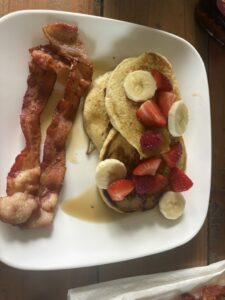
Breakfast on the 4th
No Comments