
26 Jul Isaias Gutierrez, LASP, Week 6
Hello everyone, this was my sixth week at LASP, and it was full of activities, which made it such an amazing time! This internship has been so incredible that we asked to stay for one more week, and our mentor Dmitry gladly said yes! I worked on a large variety of projects, from designing and building a way to raise a table to moving the payload of a rocket into the long tank.
The week started off with finishing the TVAC testing we were doing last week. After a scary Sunday night when the power went out 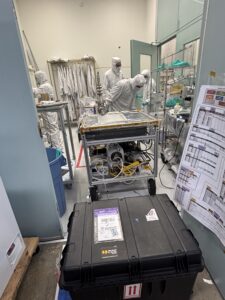 and the chamber reset, Brian, the PI of Sprite, luckily woke up at one in the morning and saw that the temperature had been increasing uncontrollably. He rushed over and turned it off. After that, we monitored it day and night as it changed from hot to cold and back to regular temperature. Once all the testing was done and Sprite was ready to be taken out, an undergrad made an aluminum case so we could be able to test the antenna on Sprite. This was needed because, without it, the radio waves would’ve bounced around in the chamber and could have hit sensitive hardware, destroying it. We put it back into the chamber and tested it. It worked perfectly, and we decided that the testing was now FINALLY finished.
We packed up Sprite back into its case and wrapped its cart in preparation for the journey from building to building. Once we started moving, of course something had gone wrong; one of the tires on the cart had lost all its air. After pumping it back up, we saw that we had moved it too much and the damage would cause it to leak too much air. With no other solution, we grabbed a pallet jack and started towing the cart back to the building. Once we arrived, we put both the cart and Sprite into the clean room, including to clean everything thoroughly, and turned it back on. While Alex was in the Clean room helping everyone with the connection of all the wires, I was outside looking at the monitors and turning on all the detectors and having the trouble of communicating with one of our coworkers without using the walkie-talkies. After a few grueling minutes of having to figure out that pointing at a green glove meant to click the green button, we were able to figure it out and had a bit of fun with it. With Sprite settled and pumping down, I started working on other tasks.
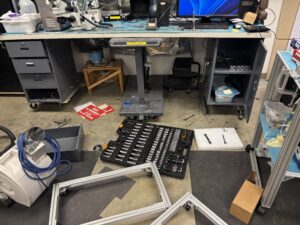 First, I helped Mike by designing, building, testing, reiterating my design, and finally raising one of his desks by five inches and seven-eighths. I searched the building for 80- 20s, had an undergraduate, Anthony, help me by cutting it, measured it to the right height, added wheels for easier movement of the desk, raised the desk with a jack, and finally attached it to the desk; the job was finished. Mike was thrilled about it because he had been wanting to do it for years now, and he hadn’t gotten to it. Once
  that was done, I started helping Jacob with his stage mishap. We cleaned the stage again, and after lots of time, we saw that it was sliding so much because the encoder had been damaged. We went to Mike to see if he could fix it, but we soon realized it would have to be sent back to the company, and they would most likely cut the wires we had soldered again. Once that news was out, we took a hiatus on that project, and I started helping Anthony on his
 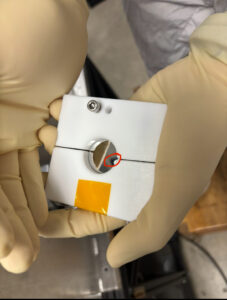 project called Waterloo. He had been getting some weird results on the tests he had been doing, so we took everything out of the chamber, cleaned it, and started analysing every piece to see if something was up with it. We discovered that the mirror had been slightly scratched, and we would have to get a new one, which was a bit tedious, but half of the test was to see how much of a difference cheap mirrors would compare to expensive ones and if we could start using the cheap ones for tests. We replaced it, and soon Waterloo was up and running again!
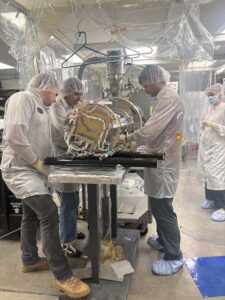 As soon as I was done with that, one of the 3d printers started yelling. Jacob and Started taking apart the machine, and after half an hour, the fix was done. The project INFUSE was the next thing I started working on; it is a rocket which will go to outer space for five minutes to test new inventions in the hope of adding them onto satellites in the future. They were adding a detector onto the back of it and needed extra hands, so of course I jumped in to help. It was a lot of lifting, connecting wires, and screwing in bolts. I was very intrigued by the new technology, and learning about it was amazing.
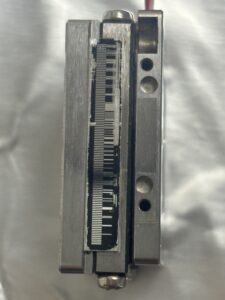
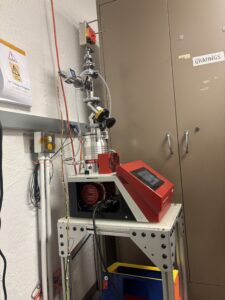 I started asking about things in the lab and landed on a detector made to count photons. This detector worked by allowing photons to enter and pass through a purple filter, which only allows the UV light to come in. It then passes through four sets of tubes that are diagonal in opposite directions; these tubes are electrically charged and have millions of electrons on the walls. As the photons crash into the walls, they hit the electrons, gathering them and knocking more and more down. They fall until they reach a circuit, which is lined up and down and side to side and has a charge going through it. Once the particles reach it, they can have from a hundred thousand to a million electrons! They hit the circuit and break the flow of electricity. The detector calculates the location of the particles because it knows how long it takes for the charge to flow and thus calculates where the particle landed and how many landed. The fact that really amazed me was that all these detectors are made by one man named Oswald H. W. Siegmund, who makes them all by hand in a garage. Since the supply is so low, each detector can cost millions.
Once my learning was done, I helped Anthony on another project for Kay, an amazing engineer who died. She was always trying to find all sorts of ways to make the labs more environmentally friendly, so we decided to start a project that recycles nitrile gloves to make a bench for Kay in her memory. After that, I stuck with Anthony and helped him a lot throughout the week. I started by helping him add hinges and a handle to a new purge box he wanted to make, but that will be continued next week. I then went into the Clean Lab, which is like the Clean room but you have to be ten times more careful. In that lab, there are giant ultrasounds, and we cleaned a lot of things at once. We first put them into the bath with a degreaser, then a cleaner, then regular water for a couple rounds, then Deionized water, and finally isopropyl alcohol. We then took them out and dried them with nitrogen before bagging them and taking them to the clean room.
I soon started helping two other undergrads, Nicole and Savanna, on their project of pressing Infuse badges onto ESD jackets for 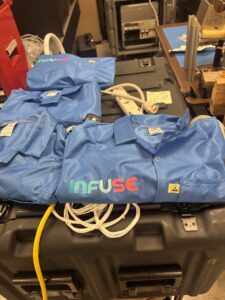
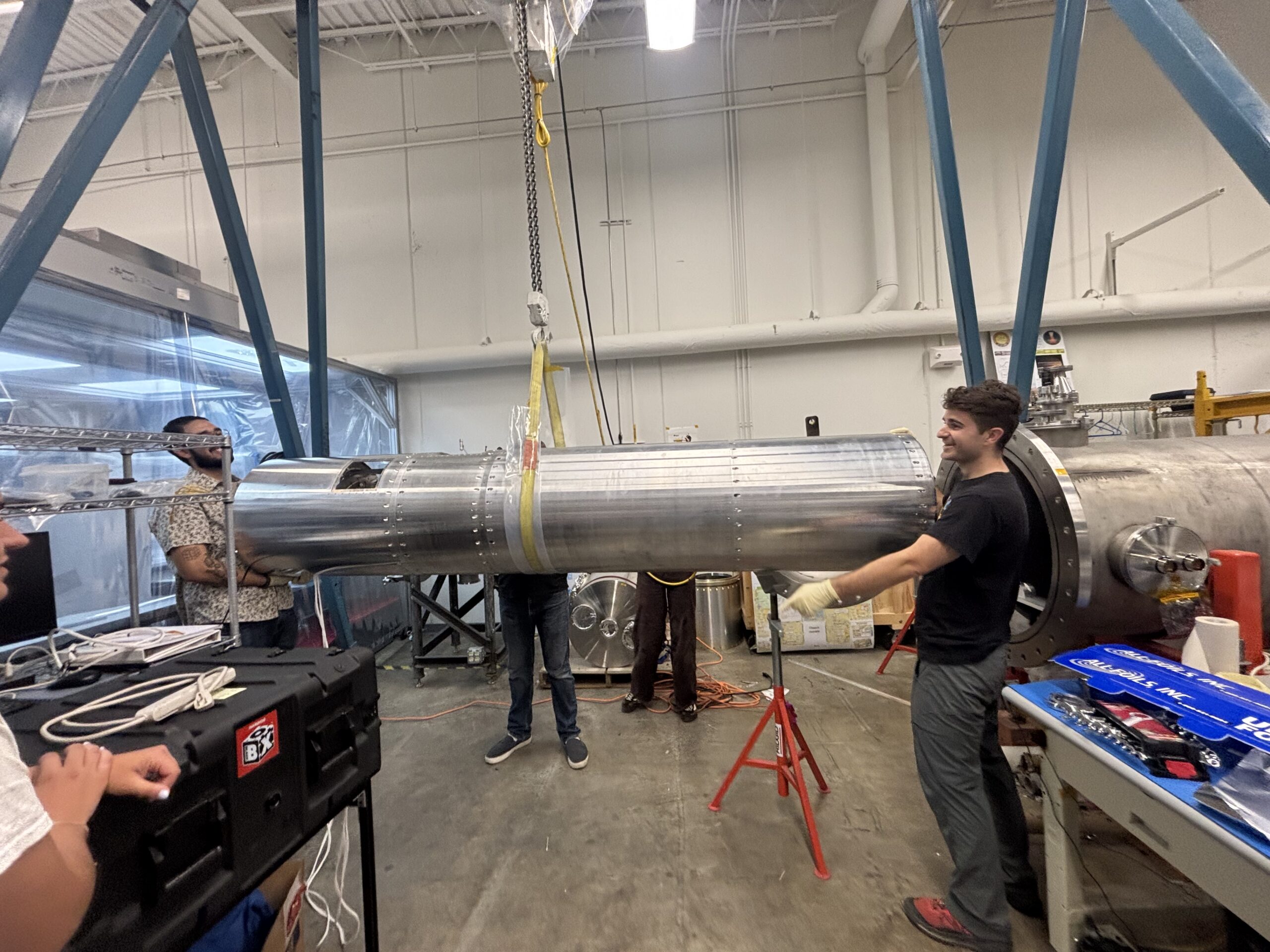
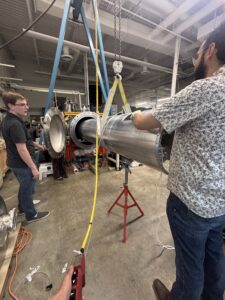 their upcoming trip to Wallops (A NASA Flight Facility and one of its main rocket launch sites). In preparation for their trip, one of the requirements is to align the camera to the optics, so we know that what the camera is seeing is exactly what the optics are analysing. To do this, we needed to put the payload into a chamber called the long tank… which is pretty self explanatory, its a tank that is very long. At one edge of the tank is where all the magic happens; the tank is made to basically make a mini sun. It does this by pumping in lots of hydrogen and lots of volts of electricity; with low enough pressure, this causes the hydrogen to arc and make a “sun.” You can control the sun’s brightness and the size of it by adding more or less hydrogen and electricity and by changing the size of the pinhole. Before putting in the payload, I helped adjust it and make sure everything was right. We started by cleaning the entire payload one last time and even cleaning every single hole with Q-tips. Then we lowered the crane, and I was allowed to operate it. I controlled every little adjustment to the payload, from its height to the direction it was in. We needed to align the payload to the light source, which took us FOUR HOURS. We ultimately got them aligned, and the day was finished.
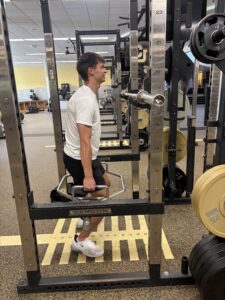
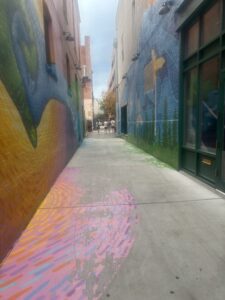 Throughout the weekend, I went to the CU Boulder rec center to play hockey. While I was there, I met a D1 hockey player, and he invited me to train with him. We spent hours on the ice, and I learnt many different skills from him. After he invited me to work out with him, I learnt many of the workouts that helped him improve off the ice. It felt like a fever dream, and I was amazed the entire time. Besides that, Alex and I went to watch the new movie The Odyssey and walked around Pearl Street, where we went on an amazing adventure to find Geocaches throughout the city.
No Comments