12 Jul Isaias Gutierrez, LASP, Week 4
Hello everyone, my fourth week of LASP was full of learning, as usual. The week started off slow because almost everyone at the lab was at a conference in Copenhagen either presenting or watching presentations, but as the week went on it slowly picked up and became full of many different projects!
 Throughout the week we attended as many Astro Academy lectures and tours, for example we went to the NSF NCAR Mesa
Laboratory and saw a tour of their clean room and the projects they are working on. The lectures we attended were about flight dynamics and flight vehicles. We also attended a student brain break lego build which was a great way to relax and have fun. Astro Academy was a big part of our early week because we didn’t have much to do.
Throughout the rest of the week we worked along side two undergrads Jacob and Thomas. They know how to work practically everything at LASP and were a big help. Thomas this week helped us add an attachment to our asteroid sample project that allowed us to adjust where the location of light shines.  With that we watched him and gave him input on how to code the user interface so we could manually alter the position of the light. Later on in the week, I worked with him to take specific photos with the spectrometer to practice for the real thing when we get the asteroid samples. We took four different types of images, 1) dark images – deuterium lamp off, shutter closed. 2) background images – deuterium lamp off, shutter open. 3). system throughput calibration images – lamp on, shutter open, spot on teflon sample. 4) sample images – lamp on, shutter open, spot on some sample. (with a piece of aluminum and their surface had to be relatively clean but not a mirror polish) Finally with these photos we were able to determine the reflectance of the aluminum using the data collected. We talked a lot with him about college life, especially on his workload and curriculum. We were able to see many of the assignments he had and the math behind them. He taught us basic integrals and derivatives along side with how to solve them using the power rule.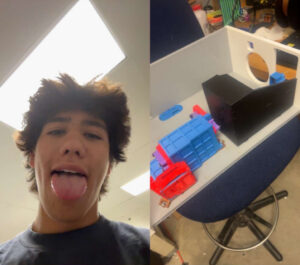
With both undergrads we started working on the instrument side of the 3d model Mantis, which is a Small Sat. We 3d printed many of the instruments and put in inserts very carefully so we could screw them into the base plate. This will soon attach to the electronics side of the model that we worked on in prior weeks.
Thomas and Jacob sent a motor that moves the optical fiber inside the project that they are working on to get fixed and when the 
 company sent it back we realized that they cut some of the wires, so we had to reconnect them. While Thomas stripped the wires and prepped them, Alex and I made coils so we could connect both sides for an easy solder. After doing this we were interested in soldering so with the help of Mike Kaiser, an instrument engineer who works closely with wires and everything needed for the electronics on the projects LASP works on, he began teaching us how to solder. First by desoldering and on Monday we will continue by soldering.
We helped Mike a lot on Friday with the projects he was working on, he needed to put a metal piece and  wires into the “scrubbing bubbles” machine aka the bakeout chamber. The process is always clean, (with isopropyl alcohol and acetone) assemble (we didn’t need to assemble this time), and finally pumping and purging (into the machine). This process was super cool to do in real time and very meticulous because we have to be very careful to not touch the cleaned parts with anything so we don’t dirty them.
Other than work, Alex and I went swimming at the cu rec center and I played hockey on the weekends which was  very exciting for me. We watched many World Cup games with out host family and made some homemade pizzas! After many meals we have been going on walks, on our way we pass through this field where we are free to do whatever, so naturally we brought a frisbee and had lots of fun!
No Comments