

12 Jul Colorado School of Mines, Week 5
I have reached the end of week five here at the Colorado School of Mines here at the RoSE lab and this week prototypes and parts for the rover arrived and the physical testing of the IPEx rover is beginning.
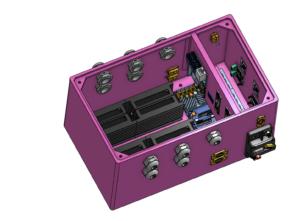
The final Avionics Box CAD with all the components
This week was a whole bunch of problems that I thought weren’t going to be a problem until I looked a bit more into them. Lets start at the beginning of the week on Monday and Tuesday, I began my week with finishing the CAD model for the avionics box with a new team member Charlie, we worked to fit all of the new avionics in and in a place that makes most sense for both heat management and practicality for mounting and wiring. After everything was in the box and fit in ok, but it wasn’t very practical. So we found a cardboard box and we used it to pitch idea about what could give us more space without making things hard to reach, so we landed on the idea of a “vertical shelf” that wouldn’t go all the way to the bottom of the box but would be perfect to mount the brains of the system to and make it easy to monitor their heat. After adding this to the CAD model everything fit in it’s place and was both easy to reach and connect. Later in the week I finished by adding circuit breakers and the ports for the wires to get out of the avionics box to go to the motors, encoders, sensors, and batteries. Then an issue with the strain gauges came up again, they weren’t nearly as accurate as they needed to be. The original gauge and the amplifier board to make the signal readable was making an accuracy of ±1 Kilogram and when talking to Hayden our lead, we needed an accuracy down to the gram of regolith in the drum. I went to research amplifiers that were more accurate and gauges that were more accurate and after a while of looking through amplifiers that wouldn’t work for our project I found one with a much better accuracy and Charlie found a new gauge that was 5 times more accurate than the old one and now we had a calculated accuracy of ±1.2 grams which was enough to meet the requirement of knowing the amount of regolith in the drum.
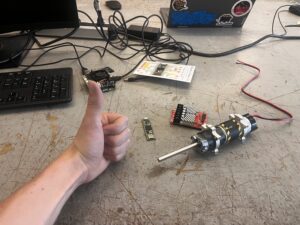
Parts are arriving!!!!!
This brought me to the end of the week where I was doing dome calculations about how many what we call cycles the rover can do, one cycle is to drive to regolith, dig it, transport it, dump it, and then drive back to the start. I was calculating how much the battery charge would drop over each cycle and how much the voltage would drop after each cycle because as a battery discharges it looses some of its voltage and we need a minimum of 24 volts to keep the motors running. I was doing this math and initial came up with some horribly wrong answer of around 80 cycles but after reviewing it came down to a much lower number. I was doing all my math worst case scenario so that we knew that it could only be better than what I was calculating with the rover running at full speed and pulling as much power as it could to complete a cycle and got that it could only run for about 9 minutes.

New battery calculations at full power and full speed
I began revising this and will continue next week and the time should be much longer as the motors current draw will decrease as they run and will only peak right when they start moving, and the stepper motors will not be running at full power the whole time. Finally this week the first motors for the drive train and the components we need to get a motor all arrived this week and we have begun work on getting a program on the raspberry pi to get a motor spinning and finally get the first avionics prototype. Also this week throughout the week drum prototypes have been made and updated and are getting tested in the test bed for how well they are working. This week 3 redesigns have been made with increasing results and we are well over the minimum amount of regolith needed to be collected in the drums and are approaching or target of 30Kg. Finally during our meeting on Wednesday we voted and decided on the color scheme of IPEx to be (drumroll) Pink and White!!!!!
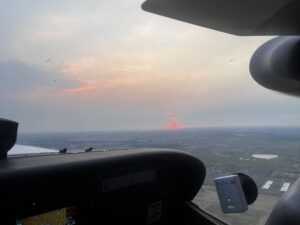
Morning sunrise from the sky
Outside of the lab this week I still am doing my evening bake rides exploring new trails on the Southside of golden and the mountains to the west finding new amazing views. I am also continuing my flight training and took two flights this week early in the morning when the weather and wind are the best, we continue to work on my emergency procedures and landings. This week my instructor wanted to continue to push my skills and see if I could land in a very specific short area on a small runway and after a few tries I was able to do it, it was crazy I was aiming to land almost right at the end of the runway and it felt cool but also sketchy to be flying around 10 feet off of the ground above a field watching the runway come under me just as I am letting it come down to land. Gunnar, Luke, and I also went to play a mini golf course that we found and ended up playing 54 holes of mini golf and also went bowling yesterday which was blast! I can’t wait for what is coming this week, and hopefully the first avionics prototype.
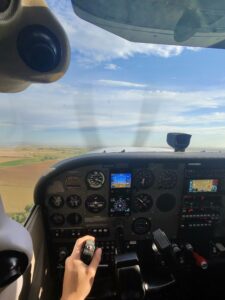
Cruising in N562AB
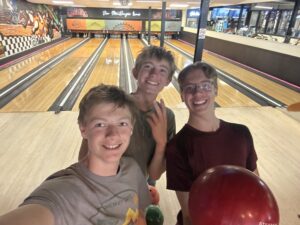
Bowling with the boys
Rcketman Fan
Posted at 07:57h, 13 JulyGreat update! It is impressive to see how quickly you and the team are moving from CAD models to physical testing and actual hardware. Seeing that strain gauge accuracy jump from a whole kilogram down to 1.2 grams is a massive engineering win—congrats to you and Charlie on digging through the datasheets to figure that out.
Don’t sweat the initial 9-minute battery calculation too much; working through the worst-case scenarios and then refining the math for real-world variables like inrush current is exactly what trial-and-error prototyping is all about.
The short-field landings sound incredible (and a little nerve-wracking to read about!). Keep up the great work in the lab and in the air. Love the pink and white color choice for the rover, too. Safely fly high and keep grinding!