

05 Jul Colorado School of Mines, Week 4

Part of the first drum prototype
It is the end of week 4 here at the Colorado School of Mines in the RoSE Lab, we are getting close to getting parts to start the prototype of the IPEx rover. This week the first prototype of the drum was made.
This week wasn’t as packed with research and work as the previous weeks have been it was mostly just editing and finalizing components to buy to start making prototypes of all the systems for the rover and begin testing. This week I work on finishing and reviewing all the diagrams I made triple checking my calculations and making a BOM (Bill of Material) for the avionics at the start of the week. Around Wednesday I was finished with most of the work I needed to finish from the previous weeks so I looked into the calculations I make to confirm that they are accurate and were done right. I found that all the calculations about the battery and power draw looked good and after I calculated the maximum current that will be running through wires so I can pick the wires we are going to use to connect all the different components together I decided to use 20 gauge wire for the sensors and 10 gauge wire for the main power for the motors and high power components.
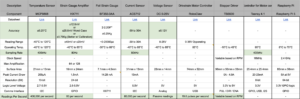
Data sheet of all the avionics components and sensors for the rover
This is when I ran into the issue of the arm and the strain gauges again, the arm design was changed and is now one beam and is very strong. I calculated that the end of the arm would only be bending downward only fractions of a millimeter with is not detectable with a strain gauge, at least not with the accuracy we need. The solution I discussed with the arm team would be to weaken the beam in the area it will be bending the most, which I found to be around 20mm form the fixed point where there arm in being held up. We have a few solutions that may work and make the weight readable and accurate with the strain gauges, first we could drill holes in the top and bottom of the beam, second we could make a oval shaped hole at the top and bottom of the beam, third we could make one giant hole in the sides of the beam, and finally fourth we could shave off some of the material on the top and bottom to make the beam thinner all of which will make that weakened pint bend to a detectable amount without destroying the structural integrity and strength of the beam much. I have been working with the arm team to test this in a process called FEA (Finite Element Analysis) where in a computer program we can put forces on a material and see how it would react to that also where it would have the most stress. I continued working on this issue along with finalizing the data sheet I was making about all the important specs of each component to the end of the week.
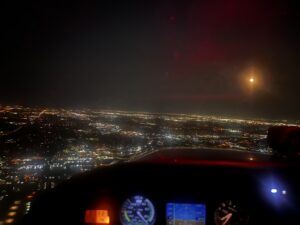
Night flight over Broomfield
Outside of the lab I was also busy this week I continue to take night time bike rides. I went on one of my favorite rides so far which took me all the way around North Table Mountain and I was able to see the entire Denver area from the side of the mountain. I also continued to go on flights to keep my proficiency in the air and achieve my requirements needed for my license. On one my flights I finished my night time requirement for landings even being introduced to a new type of failure my aircraft can experience where my landing and taxi lights don’t turn on while I am coming in for landing. I have been really enjoying flying over a new area and seeing the Denver area from the sky and finding new airports to land at. I am super exited for what’s next where we start building the prototype IPEx rover.
Sarah Stogner
Posted at 09:55h, 06 JulySounds like a great week! Love the detail on the arm adjustment options – strange for me as a layperson to think weakening the arm to make it readable by the strain gauge is the solution, but your description makes perfect sense. Can’t wait to see the IPEx take shape! Love that you’re able to squeeze in keeping up with your flight training too. Beautiful night flight pic!
Rcketman Fan
Posted at 19:29h, 07 JulyAwesome update! It’s great to see the IPEx rover transitioning from calculations and diagrams to a physical prototype. Running into that strain gauge issue with a rigid arm design is a classic engineering hurdle, but using FEA to figure out the perfect geometric compromise is exactly how solid problem-solving works. Smart move on the wire gauging, too—10 AWG will definitely handle the muscle for those motors.
That landing/taxi light failure on a night flight sounds like quite the adrenaline rush, but handling unexpected issues in the dark is what builds a sharp, confident pilot. I’m glad you’re still finding time to decompress and enjoy the Front Range views from North Table Mountain.
Super proud of your hard work and adaptability both in the RoSE Lab and in the air. Can’t wait to see the physical prototype start coming together next week!