25 Jul Belle McTigue, TSRI Briney Lab, Week 5
Wow, wow, wow! Hi everyone, welcome to my final blog! These past 5 weeks have been an amazing experience, and I am sad that it is over. I have learned so much about immunology and the importance of vaccines and studying diseases. The Briney Lab was a great place to learn and have exposure to real lab work. In addition to the lab, living with 5 other girls has been an experience in itself; I am grateful for the new friendships and all the laughs along the way.
But back to the grind: week 5 was a lot of data analysis. Quick recap — the past two weeks we’ve been building the proteins for our 38 different Lassa virus antibodies, and this week it was finally time to see what they could do.
We kicked things off working on our lab presentations, focused on everything we did in the lab, mainly our interactions with the recombinant antibody pipeline and antibody production. From there, it was straight into data analysis on the 38 antibodies. We started by organizing them on a spreadsheet with their concentrations listed next to them, and Nathan did the math for the BLI (Bio-Layer Interferometry) dilutions. BLI measures the binding of our antibodies to the antigen — in this case, Lassa virus. We dilute samples so there’s not “too much” antibody hitting the sensor at once: too much makes the binding happen too fast to measure properly and adds extra noise, so diluting keeps the signal clean and readable.
After dilutions, we loaded everything into the Octet BLI machine. It works by testing a blank, then dipping into the antigen, then the antibody, then measuring the binding by tracking the wavelengths of light. It makes a lot more sense on the graph: flat, increase, flat, increase. That’s the pattern you’re aiming for, and ideally all the lines should show a similar area and slope.
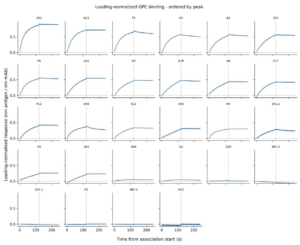
BLI results
Watching the system run, we noticed a few outliers, which told us our dilutions weren’t perfect — but on the bright side, many of our antibodies showed strong binding to the antigen, giving us hope that some of them could become strong vaccine candidates. We also got to look at some samples under the microscope, where Nathan picked the 3 best “hits” (the samples with the highest binding rates) and looked for the part of the protein each antibody actually binds to. This is a more structural view of the same antibodies.
In between all of that, Dani invited us to do her mini preps with her; of course we said yes, back to our roots. Recap: mini preps are the process of extracting DNA with the gene of interest from cells, and the process is slow and tedious, balancing adding liquids, waiting specific amounts of time, and filtering out unwanted debris. While we waited on the vacuum protocol, we asked Dani about her project. She’s working with astroviruses, a disease so few people study that many of her findings are the first ever recorded; this past year she’s been studying the virus’s structure and published a paper on it in December. What’s interesting about astrovirus is that it binds to IgG antibodies, which isn’t typical — most viruses that interact with antibodies get caught and destroyed by them, but astrovirus does the opposite. It grabs onto the part of the antibody the immune system doesn’t expect to be grabbed, and uses it almost like a disguise to sneak into cells. Dani showed us the models she built through AlphaFold and another modeling software, and it was really fun working under her. Dani also let us help with some Gibson assembly for her project, which stitches together parts of DNA to build your gene of interest. You use master mix, heavy chain and light chain parts of DNA, and bacteria to grow them, then let thermodynamics and the enzymes do their job stitching the DNA together.
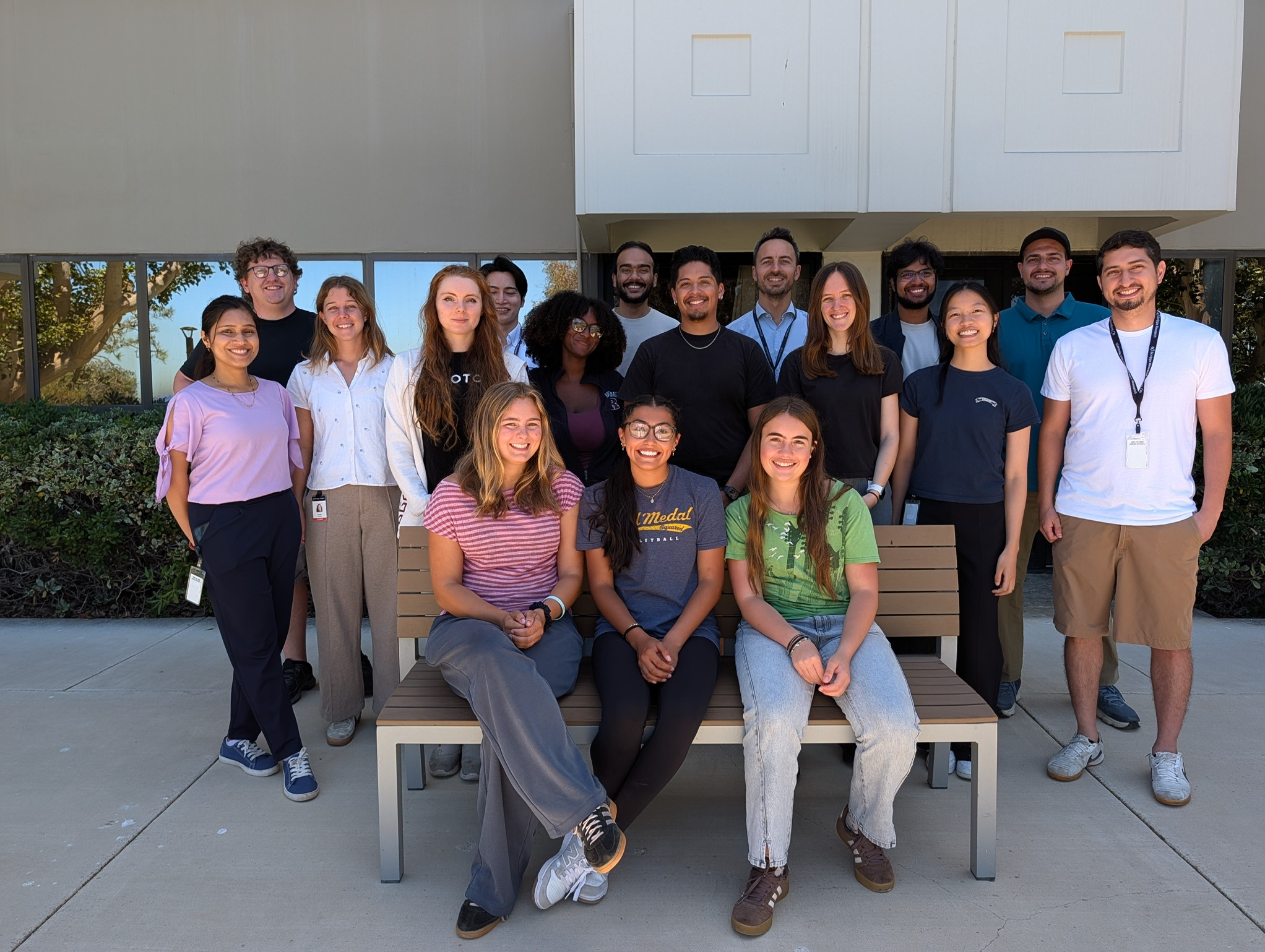
We took a slight intermission from our lab coats and gloves to give our presentation. This was a great chance to review everything we’d done and make sure it had all actually stuck. There, we found out that we saved the lab $28,000 in antibody production. So if you wanna save money, get interns! We then took a celebratory lab photo.
Back in the lab, we put some proteins that needed harvesting into a column — much more hands-off than our two hours in the cold room from last week, since we didn’t have to constantly watch and fix it this time. After that, we nanodropped and checked concentrations for Nathan and Dani. Dani’s planning to run her own BLI soon, so we helped her build the spreadsheet to calculate her dilution amounts too. We also got to look at our samples on the electron microscope twice this week, which was the perfect way 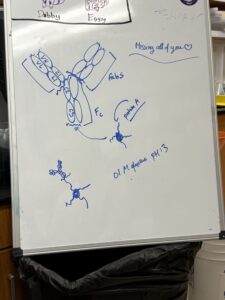 to close things out. Shadowing on it is really cool because you aren’t just staring at liquids anymore; you can actually see your sample. You can see blurs on a screen, but still… The prep itself is awesome too: you put your protein on a tiny copper slide, then blast it with plasma to clean it and make sure only the protein is left on the grid. The electron microscope itself is insane. The first time, we could see evidence that antigens were there, but the Fab (arm of an antibody) wasn’t bound. Nathan thinks this is because the samples were placed on ice beforehand, which could have deteriorated the proteins. On Friday,we looked at new samples in the microscope. We took a quick pause from analyzing as our mentors and lab friends took us on a picnic to the glider port, super fun! Sadly, we came back to find that our Fabs still weren’t binding to our proteins under the electron microscope. This finding is interesting because our BLI results determined that our binding rates were high. I am sad that I won’t be able to see the rest of this project through, but Nathan and Dani said we could consider our findings a success, and that they’re planning to explore this further downstream possibilities.
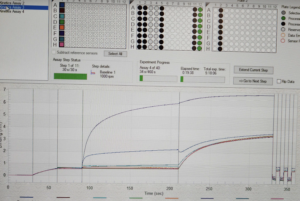
Dani’s BLI results
We luckily got to finish our internship with some pipetting. We helped Dani prep for a round of BLI. Dani is comparing two plates, testing how different antibodies bind to the antigen when a base antibody is already bound to it. In this case, she had six base antibodies and 42 antibodies to test in comparison. She’s comparing all of this against all three strains (two of them are very similar, and the third is like a cousin). Dani’s end goal is to create an antibody that can bind to all three strains — hopefully she’ll send us the results! As a little farewell gift, we got to see a live (frozen) astrovirus in a vial, and it was awesome.
I am so happy I got to have the opportunity to work in the Briney Lab this summer. I have learned so much about immunology, working in a lab, independence, and my peers. This experience was one of a kind, and antibody production is no joke. San Diego was so much fun; living with the girls was a fun and unique experience in itself, and I am grateful to be leaving here with new friendships and lots of knowledge.
Thank you to Bryan Briney for letting us intern in his lab for the summer.
Thank you to my mentors, Jonathan, Nathan, and Dani, for teaching us hands-on lab work and letting us help with their projects.
Thank you to the rest of the Briney Lab for helping us along the way and making us feel welcome.
Thank you to Jennie for being the coolest house mom, introducing us to Cocobomb, and for bringing Patillas and Goose.
Thank you to all the house girls: Stella, Liliana, Zoe, Ellie, and Kaila, for making sure we never had a dull moment.
Thank you, Sarah Holbrooke, for making this opportunity possible.
Thank you to my mom and dad for supporting me!
Thank you, Pinhead!
No Comments