
12 Jul Belle McTigue, TSRI Briney Lab, Week 3
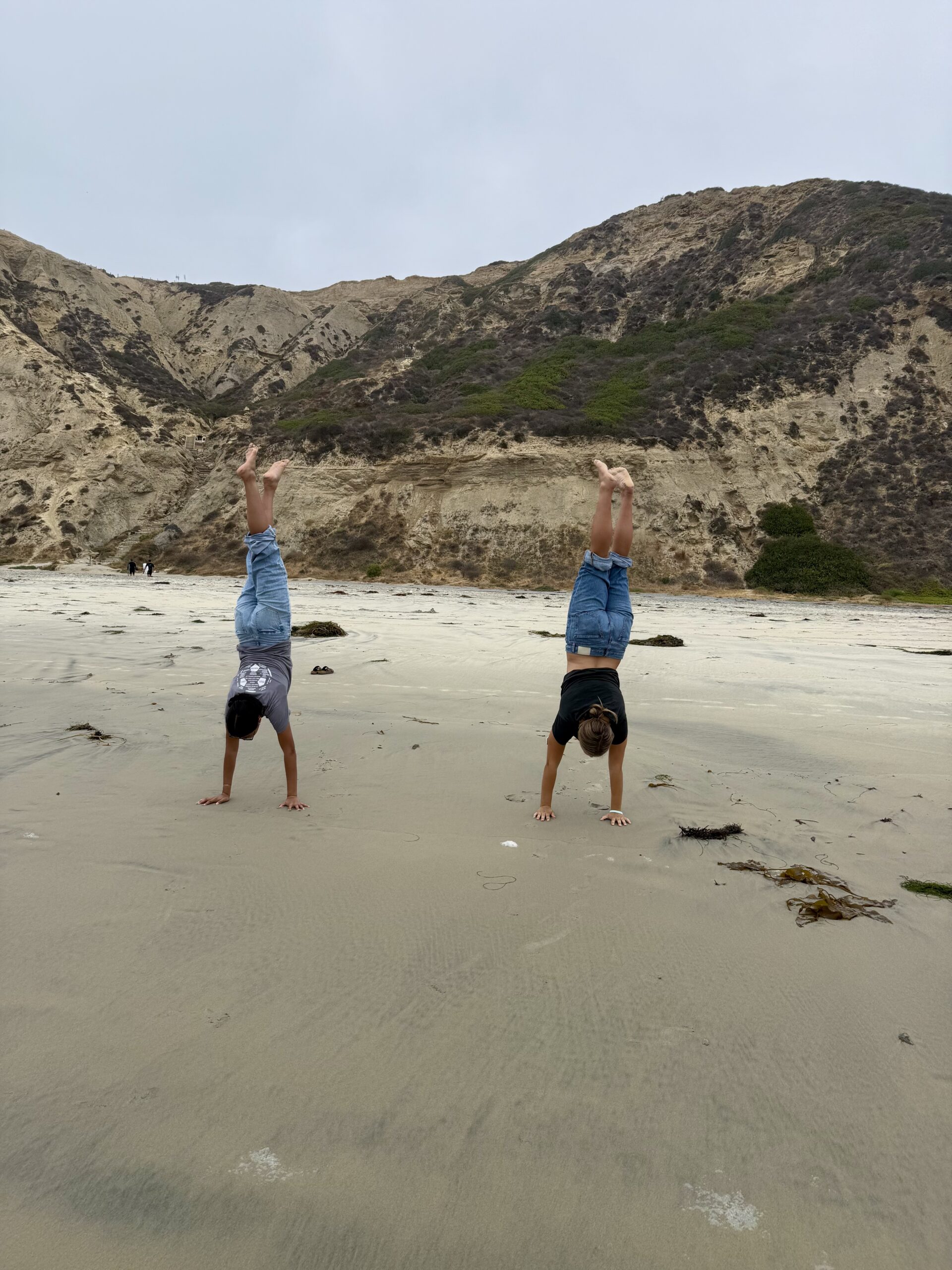
Hello all! I can’t believe I’m already over halfway done with my Pinternship! So far I’ve learned so much and loved being immersed in the world of science and microbiology. This week I did a lot of work under Nathan, who’s focusing on Lassa virus and Ebola. After a nice weekend celebrating the Fourth and plenty of fun side quests – the beach, arts and crafts, Zoe and I getting our ears pierced, and of course lots of laughing – we returned to the lab.
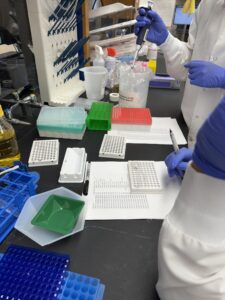 Monday was a riot. If you’re a high school student, you know I was dreading this day because AP scores came out, and well, imagine a house of 6 girls stressed about scores determining college and trying to focus on biology at the same time; let’s say all brain cells were being used. We show up to the lab and are told we’ll be doing PCR (polymerase chain reaction) cloning. PCR cloning is a technique for inserting a specific DNA sequence into a plasmid; PCR amplifies the sequence of interest before combining it with the vector. From there, the bacteria are copied over and over, giving you an endless supply of DNA to study. To do this, you prepare a master mix (buffer, water, dNTPs, and enzymes) and then load it into each well of a 96-well plate along with the specific DNA and compatible vectors for that reaction. Once the mixtures are ready, you place them into a thermal cycler to activate the enzymes and kick off the cloning. As I said, this day was stressful, so it was a delight when we got a text from Jennie (house mom, aka Mama J) saying we were getting In-N-Out. And let me tell you, all that studying for AP tests was worth it for that burger and milkshake. After this riveting news, and waiting for the thermal cycler to finish, Nathan recruited us for a huge project: 39 antibodies, ready for the entire process. He’d had the cells frozen, just waiting for the interns to show up and do the heavy lifting. Our first task was to put the cells in media — if you remember from last week’s blog, this is cell food! We organized 39 250 mL beakers of media and antibodies and quickly started adding the frozen cells. This part is time-sensitive because if the cells thaw out too much, they die and the whole thing fails. So we became the ultimate F1 pit crew — Red Bull, watch out.
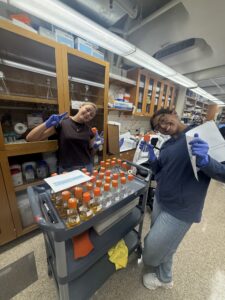 Once all the cells were happy and sitting in their “delicious” cell food, we placed them into shaker plates, which basically keep the samples warm and moving. Little did we know this was the first step of a huge process. Tuesday and Wednesday, our attention was solely on our cell children, because we had 76 midi preps ahead of us. Yes, 76, not just 39. Here’s why: an antibody isn’t one single protein; it’s two chains, a heavy chain and a light chain, hooked together. Since they’re two separate proteins, they come from two separate pieces of DNA, which means every single antibody needs its own heavy chain prep and its own light chain prep. Double the antibodies, double the work. So we built our little assembly line. First we centrifuged the media to isolate the cells, then added P1, P2, and P3 in order. P1 wakes the cells back up, P2 pops them open (RIP cell children), and P3 kicks out all the cell debris to isolate our plasmid DNA. We filtered out the P3, then added binding buffer; this is the glue that lets our DNA stick to the purification column instead of washing away. We learned this one the hard way when we forgot it on 9 samples, and all 9 came back with concentrations too low to use. Lesson learned.
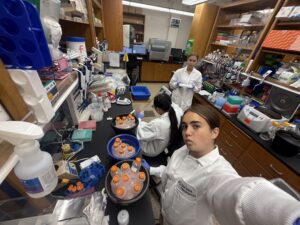 From there it was 3 rounds of washing, another spin in the centrifuge, elution buffer to finally pry the DNA off the column, a final centrifuge, and then the moment of truth: checking the concentration. We were aiming for thousands of nanograms per microliter. It’s honestly humbling when you start with 125 mL of substance and end up with less than 1.5 mL of anything usable. Tuesday we hit a 51% success rate of hitting our target,and Wednesday we dipped to around 30%. Not great on paper, but Nathan reassured us 51% is basically a win; his attempt back in January ended in absolutely nothing. This percentage is based on their yield (how much plasmid was extracted). Although the yields were low, Nathan said they were still viable due to their healthy structure.
After all the preps were done and the concentrations checked, Nathan came over to us with a stern face, and we all silently prepared to be fired from our internship. Instead, he told us there’s a competition on the back of DNA sequence order forms: you’re invited to draw a dinosaur, and if the company’s kids like your drawing, you might win a prize. Quote: “Your art becomes our sole property to exploit as we wish.” So naturally, we drew with our whole hearts and gave the world our best prehistoric creatures; we are not artists. A good reminder that work can have fun, childish moments!
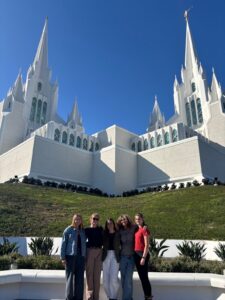 When you live with the same 6 people AND work with them, meaning you’re together 24/7, you’d think you’d get bored of each other. Wrong. Or at least for us, the girls always find some sort of side quest to do. Ours on Wednesday was visiting a Mormon temple, and what an interesting experience; don’t worry, we weren’t forced to marry or convert. ; )
But, back to the science — now that the heavy and light chains were isolated, it was time to merge them together, which meant a lot of math and even more pipette tips. Each antibody needed its heavy and light chains combined in a specific ratio: for every 17,000 ng of light chain (LC), we needed 7,000 ng of heavy chain (HC). But since every sample came out of the midi preps at a different concentration, we couldn’t just pipette the same volume for everyone — we had to divide our target ng amount by each sample’s specific concentration to calculate the exact microliters needed to hit that ratio. Multiply that across dozens of samples, and you get a whole lot of math and even more pipetting.
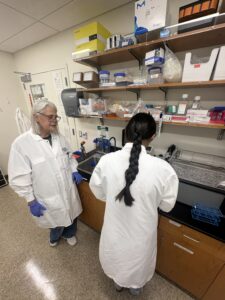 We added the chains to specific tubes with built-in filters. But once you add the chains, you can’t open the vial again; doing so risks contaminating the sample, which is a big deal going into transfection (the next step, where you introduce the foreign nucleic acid ( the antibody you just built) into mammalian cells). Since Nathan performed the transfection on the samples that evening and we missed it, we ended the week by shadowing Raiza, a staff scientist, doing a transfection. This process happened under the hood because you don’t want contaminants. This week was interesting in the way we got to see the process through, not just do one step. I am looking forward to next week and hopefully having more success!
Boompa
Posted at 11:51h, 12 JulyOutstanding and Some people thought that you were “Just another pretty face” you sure proved them ( not me) wrong ; think big Nobel Prize Winner from Telluride !! Keep it going and expanding your knowledge of Science and hangin with the motivated smart world beaters !!
Beverley McTigue
Posted at 11:57h, 12 JulyAnother scholarly week for you Belle. Fabulous! Can’t believe how much you are learning and experiencing. As for the new holes in you ears….may have something for them😘
Michael P Mctigue
Posted at 09:21h, 13 JulyWay over my Head! Great to see such enthusiasm!