
26 Jul Akira Smith, UCSB Bob Milller Lab, Week 4
Hi everyone!
This week was filled with sunny weather, lots of miniature scale mining, and some exciting new research opportunities. I spent most of my time working with Kaitlyn on a smaller project that’s part of Billy’s larger research.
Our main question was simple, why do burrowing clams choose to live in certain types of rocks? More specifically, we wanted to understand what characteristics of a rock (its composition, texture, and material) make it an ideal home for these clams. Kaitlyn and I spent a lot of time brainstorming what the “perfect” clam habitat might look like (other than, of course, being in the ocean!).
To investigate this, Billy collected rock samples from several dive sites around Santa Barbara. Some of the rocks contained burrowing clams, while others didn’t. We planned to compare them using two different techniques, XRF (X-ray fluorescence), which identifies the elements that make up a rock, and XRD (X-ray diffraction), which identifies the minerals and crystal structures within it.
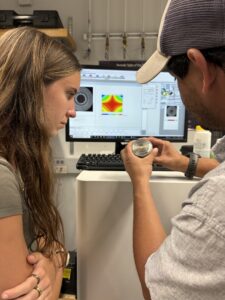
Preparing the samples, however, turned out to be much harder than we expected. Each test required the rocks in a different form. The XRF needed the rocks ground into an extremely fine powder, while the XRD required perfectly flat, dry samples. Before we could even begin either test, Kaitlyn and I had to break the large rocks into much smaller pieces, which meant spending a surprising amount of time outside with hammers, literally smashing rocks.
One of my favorite parts was discovering all the tiny marine organisms hiding inside the cracks and crevices of the rocks. It was like opening a miniature ecosystem every time one split apart.
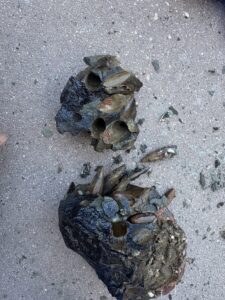
Not every rock cooperated, though. Some were so hard that we could barely chip off a usable sample, while others were so fragile that they crumbled apart before we could remove the clams. On top of that, our samples couldn’t contain any shell fragments or remains of the animals living inside, so carefully separating the rock from the clams became a challenge of its own.

Once we finally had our samples prepared, we placed them into our very scientific easy bake oven, aka the drying oven. Every day we weighed each sample to determine how much water remained inside the rock. The samples were only considered completely dry once their weight changed by less than 0.5 grams between measurements.
After running our tests, we started putting together a few hypotheses. Our results suggested that burrowing clams seem to prefer softer sedimentary rocks, particularly sandstone, which honestly wasn’t too surprising considering many of the rocks with clams practically fell apart like cheese when we cracked them open. The XRD data showed that these softer rocks contained higher amounts of calcium carbonate, while the XRF revealed greater concentrations of silicon and aluminum compared to the rocks without clams.
It was really exciting to work through almost the entire scientific process, from asking questions and preparing samples to collecting data and interpreting results. Of course, every answer seemed to create a few more questions. One thing I’ve been wondering is whether these rocks were naturally softer to begin with or if generations of burrowing clams somehow changed the rocks over time by increasing the amount of calcium carbonate within them. There’s still so much left to learn.
Outside of the lab, I continued exploring Santa Barbara and found a few new favorite spots. I discovered the most amazing caramel latte at Caje, which has quickly become my go to study cafe. I also visited two farmers markets this week and tried a delicious nectarine hybrid. Of course, I’ve been taking full advantage of all the incredible seafood here, and I even squeezed in a little vintage shopping, where I found some surprisingly cute tops.
To wrap up the week, I visited the Santa Barbara Museum of Art. I loved wandering through the galleries, but what fascinated me most was learning the stories behind each piece. Understanding the artists’ motivations and the history behind their work made me appreciate the artwork so much more.

Every week here seems to teach me something completely new, both inside and outside the lab. I’m excited to see where the rest of this internship takes me!
No Comments