
27 Jun Zoe Schiffer – Chemistry at TSRI – Engle Lab – Week 2
Just a reminder: I have the amazing opportunity to spend six weeks in San Diego interning at the Scripps Research Institute in the Engle Lab. The lab is run by Keary Engle, and I have been working with Madison Wagner, a fourth-year Ph.D. candidate, as my mentor. This week looked significantly different from last week. Since Madison was out of town, I spent the week shadowing Wenji He, another fourth-year Ph.D. candidate. We had a busy week with a combination of work inside and outside the lab.
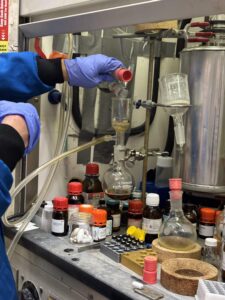
Wenji is filtering out the palladium
Wenji was finishing a reaction involving toluene (methylbenzene) and ethanol when I began shadowing him. The solution was filtered through Celite to remove any remaining palladium catalyst from the product. The filtered product contained crystals that had become stuck to the walls of the flask, so it was placed in a sonicator. The sonicator uses sound waves to help homogenize the solution and dislodge anything stuck to the glass. The product was then transferred to another flask.
One thing I learned was that the first portion of the solution collected is the most concentrated. When the sides of the flask are rinsed with solvent, the remaining product becomes more diluted. It seems like common sense now, but it wasn’t something I had really thought about until it was pointed out.
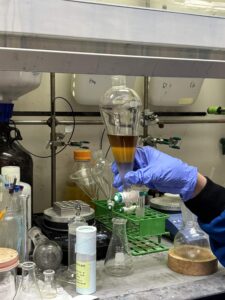
In the middle of the extraction, separating
The solution was then extracted to isolate the desired product. An extraction involves mixing the solution with another solvent that has a different density, allowing the product to separate from the other components. As the mixture settled, two distinct layers formed, making it possible to separate the product.
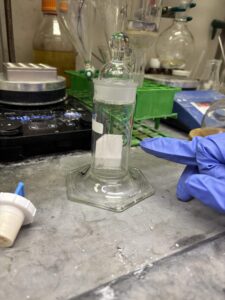
TLC
Next, Wenji performed a TLC (Thin Layer Chromatography) to determine whether the main product could be separated from any side products based on polarity. A TLC is prepared by placing a tiny spot of the product onto a silica plate. The plate is then placed into a solvent mixture—in this case, ethanol and hexane. I don’t fully understand the process yet, but the solvent travels up the silica plate, carrying the compounds with it. Under UV light, the compounds appear as spots. The farther a spot travels from the starting point, the less polar it is. Since the separation looked good, Wenji moved on to running a column.
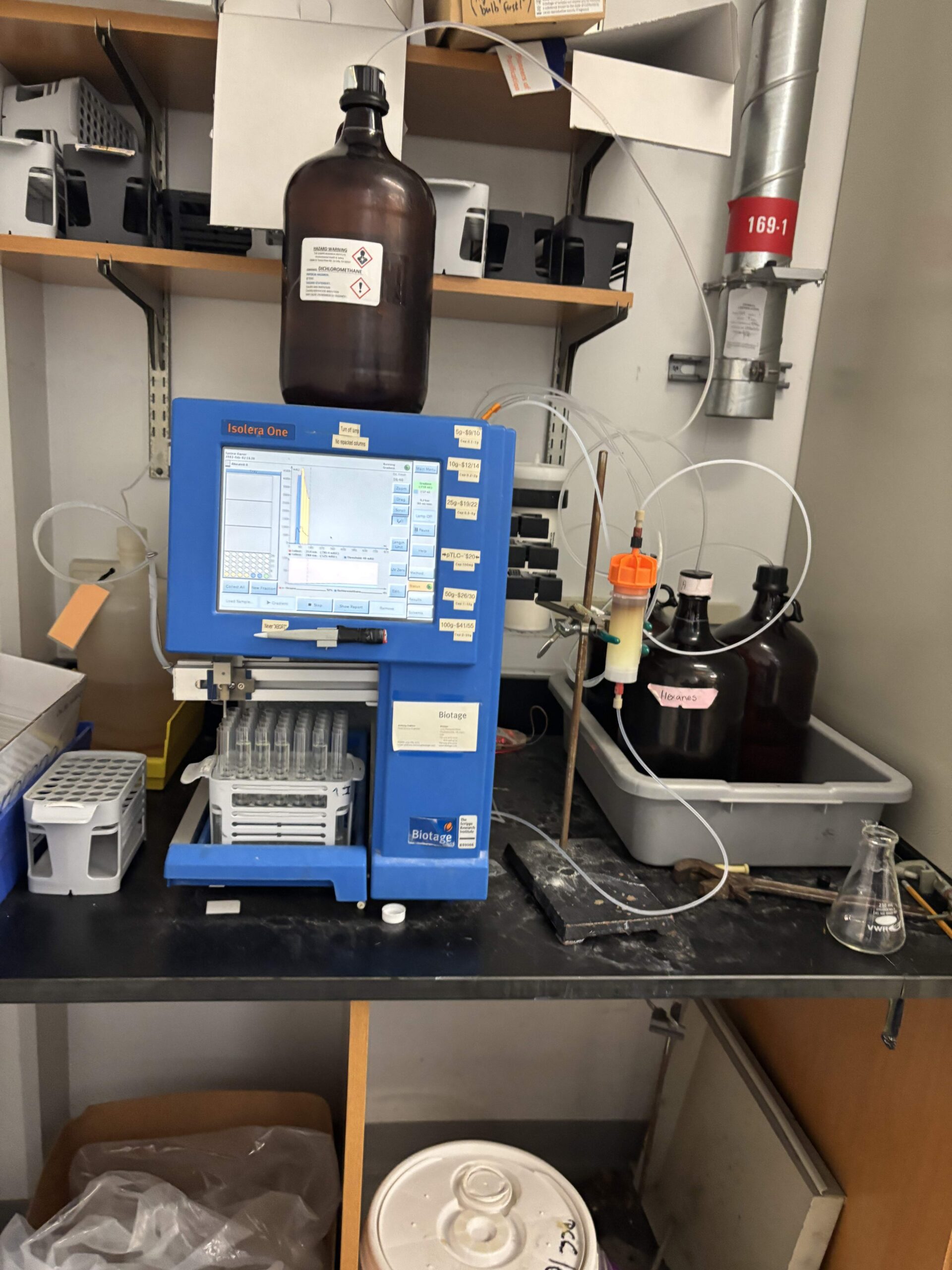
A column separates compounds using different solvent mixtures while monitoring UV absorption. The machine only collects fractions when the UV absorption reaches a certain threshold, indicating that the concentration of the product is high enough. Preparing the column involves filling a tube with silica and priming it with solvent to compact it. From there, the sample can be loaded in one of two ways, and I had the opportunity to observe both.
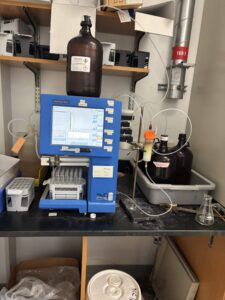
Running a column
The first method is wet loading, where the product solution is simply poured onto the compacted silica before running the column. The second method is dry loading, which is a bit more involved. A small amount of silica is mixed directly with the product, and the mixture is rotovaped until mostly dry, leaving the product adsorbed onto the silica. That powder is then added to the column, with a layer of sand placed on top to keep everything in place. The column then separates the product from impurities. Another TLC is performed afterward to confirm which collected fractions contain the desired product. Those fractions are combined and rotovaped.
The purified product was then reacted with another solution that Wenji had prepared the night before. For this step, we needed “dry” DCM (dichloromethane), which is stored in the glovebox. “Dry” means the solvent has not been exposed to moisture, so it is kept in the glovebox, where it is protected from air and water. I also learned that after using DCM, the glovebox needs to be purged. This replaces the nitrogen atmosphere because DCM vapors can interfere with the glovebox system. After the DCM was added, the reaction mixture was cooled while stirring, and another column was run using the dry-loading method.
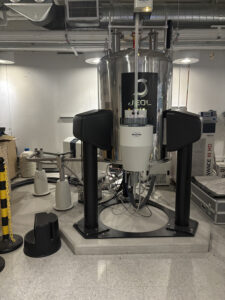
NMR Machine
After each step of the reaction, an NMR (nuclear magnetic resonance) spectrum was collected. The best description I’ve heard is that an NMR is the “fingerprint” of a molecule. It provides information about where hydrogen and carbon atoms are located within the molecule. I don’t yet understand how to interpret the data, but I expect to have plenty of opportunities to practice since NMR seems to be used constantly in research.
Along with all of the experiments this week, I was also able to attend a class that Wenji is TAing called Analytical and Computational Tools for Chemistry. I attended two classes and found them pretty confusing from a chemistry standpoint, but I could follow bits and pieces. The first class covered software used alongside HPLC (High-Performance Liquid Chromatography) to analyze data in real time. I didn’t fully understand the material, but I took notes from the slides and practiced drawing molecular structures. I also attended the final class, where the students presented videos about tools commonly used in chemistry labs. Much of the information was beyond my current understanding, but I recognized some of the equipment, including the mass spectrometer.
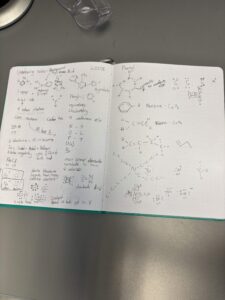
The prettiest note page
While we were waiting for reactions to finish, Wenji also took the time to review some fundamental chemistry concepts with me, including drawing molecules, understanding chemical bonds, and discussing orbitals. I was incredibly grateful because it served as both a refresher and an opportunity to learn the material more deeply. One concept we discussed was the phenyl group, the six-membered ring made up of alternating single and double bonds. Now I notice phenyl groups all over the lab and in presentations. It’s exciting to recognize something familiar, even if it’s something relatively simple.
I also had the opportunity to attend a couple of dissertation defenses. On Tuesday, I watched one from a student in a neighboring lab focused on synthesis. Then, on Thursday, someone from my own lab defended his work on discovering a new crystalline structure of a molecule that researchers previously thought was impossible to isolate. I was definitely confused during both presentations, but both students successfully earned their Ph.D.s. Even though much of the material was over my head, I still found both talks fascinating.
As I mentioned last week, the gap in my knowledge has narrowed a little, but it is still enormous. There is so much more to learn, and I want to absorb as much as I can during the six weeks that I’m here.
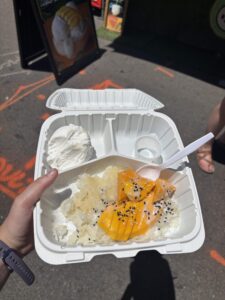
Mango Sticky Rice
Outside of the lab has been just as fun. The house is finally full with all six girls, and there has been so much laughter. It’s been nice coming home each evening to a house full of people where we can talk about our days and spend time together after long hours in the lab. We’ve gone to the beach a couple of times, visited a farmers’ market, and I discovered mango sticky rice. I honestly think it changed my life; it’s so good. And after going to our second farmers’ market, I have realized that I am really only there for the food.
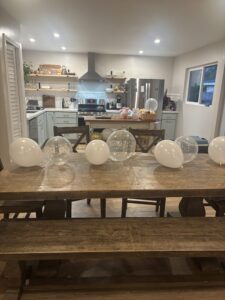
The decorations that we did
This week was also Liliana’s birthday, so we made brownies and decorated the house a little. We tried to surprise her, although I’m not sure how successful we actually were. Regardless, I think everyone had a great time “surprising” her, and it brought us even closer together.
I’ve also become more comfortable with climbing. I’ve found a few routes at the gym that I’m confident I can complete—I just

I’ve been enjoying the green route
haven’t managed them yet. I also reminded myself that I’m still breaking in a new pair of climbing shoes, which has made things a bit more difficult. That realization made me feel a little less discouraged and helped shift my mindset.
There are still plenty of early nights, usually ending with a movie. I’m pretty sure we’ve watched something every night since everyone arrived. I’ve had so much fun this week, and I can’t wait to see what the rest of the summer has in store.
No Comments