
21 Jun Izzy Giroir – Neuroscience at Ye Lab, TSRI – Week 1
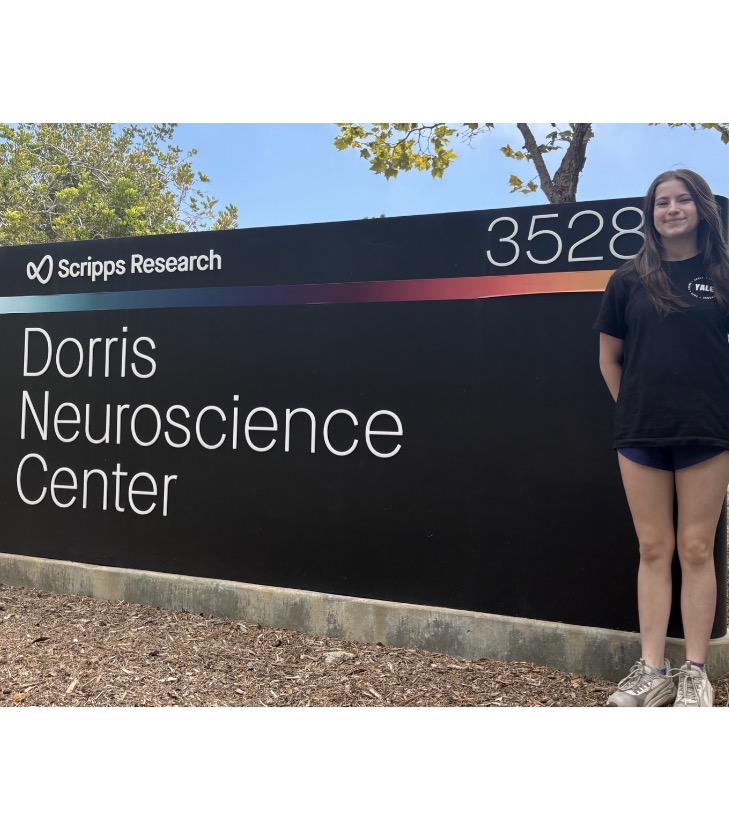
Hello again! My name is Izzy Giroir, and I have the amazing opportunity to be working at the Scripps Research Institute (TSRI) this summer! More specifically, I’ll working in the field of neuroscience at the Ye Lab, located in the Dorris Neuroscience Center (DNC). The particular group that I’m working with is currently looking into how glucose is metabolized during various learning processes, and how different genetic variations can influence such metabolism. To determine all of this, the Ye Lab primarily works with mice.
Monday (June 15th) –
My first day at my internship was – coincidentally – my birthday, and was a very exciting day overall. The first part of my morning was spent at HR, where I get to meet at least 20 other incoming interns. Most of these interns were from California, but I also got to meet Zoe Schiffer, a Pintern also working at TSRI! During this time, we listened to multiple different presentations about onboarding, went on a brief tour of the campus, and set up our accounts. After our initial onboarding was completed, I walked over to the Ye Lab to meet my mentors – Kaili Xue, Leyao Shen, and for the first week, Zimu Gao. After completing some safety training, Kaili and Leyao explained their projects to me. As mentioned before, they are looking at the metabolism of glucose as it consumed during learning. In particular, they are looking at how mutant pyruvate dehydrogenase (PDH – an enzyme that fuels the Krebs Cycle) can change the metabolism of glucose and therefore its metabolism during learning. We then went down to the sublevel of the DNC where the mice are located. The main set of mice that I will be working with are water deprived, meaning that they do not have regular access to water. This allows us to give the mice water as a reward as they learn. Before they could start learning, however, they needed to be habituated the the hydrogel (water in the form of jelly) that we will be using. To do that, we would put one mouse in a chamber with a glob of hydrogel for 20 minutes. Once the 20 minutes were up, we’d put the mouse back into its cage and put the next one in the chamber. Zimu and I did this for the six mice we’ll be working with, which took us up until the end of our work day.
Tuesday (June 16th) –
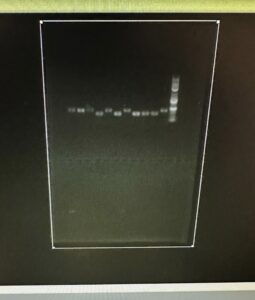
The end result of the genotyping.
I started my second morning with habituating the mice to the hydrogel again. During the duration of each mouse being habituated, however, Zimu and I started to do some genotyping on a different batch of mice. In order to differentiate the mice, the lab marks them by cutting off different toes, each one corresponding with a different number. We used the cut off toes of these mice for the genotyping. The process is split into two halves – PCR and electrophoresis. During PCR, you mix primers with a sample of DNA in order to replicate the DNA many times over. Then, during electrophoresis, you put the sample into little wells imbedded within gel in a chamber. Electricity is then applied, and as DNA is negative, it will move from the negative to the positive side of the chamber. Whichever sample moves the least carries the largest/longest DNA. You then take the gel and put it under a UV light, which allows us to generate an image with distinct bands based on the length of the DNA. After the genotyping and the habituation of the mice, I then helped Zimu create the hydrogel pellets we’ll be using for the mice to learn and train. We did this by heating up the hydrogel and then using pipettes to add small droplets of gel onto aluminum foil sitting over dry ice.
Wednesday (June 17th) –
Instead of habituating the mice this morning, Zimu and I switched over to training them. We did this by putting one mouse
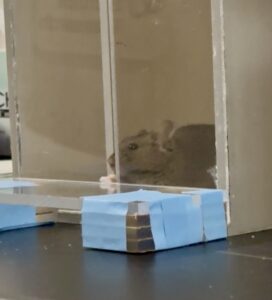
One of the mice picking up a pellet.
into the chamber, similar to previous days. But, instead of putting a glob of hydrogel in the chamber with them, we put a hydrogel pellet on a small platform just outside of the chamber. The mouse then had to learn how to pick up the pellet through a small slit in the chamber and the eat it without dropping it. Within the same 20 minute period, we recorded how many attempts the mouse made, with which paw, and how many of them were successful. After repeating this process with all six mice, we headed back upstairs to look at some confocal brain imaging. Using a confocal machine, we inserted slides of mouse brain slices dyed with different phosphorescent dyes. This dye helps us looks at different proteins or compounds within the brain. I helped to focus the imaging so Zimu could take images from the slide. We had to move on fairly quickly though, as we had to make some more hydrogel pallets for the next day.
Thursday (June 18th) –
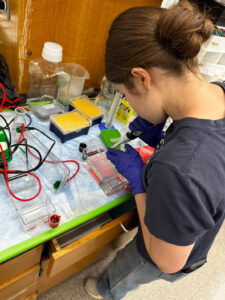
Me filling up wells for electrophoresis.
In the morning, we completed another training session with our six mice, though we gave them more time as Leyao was concerned they weren’t eating enough of the pellets to be hydrated. After the training, we did some more confocal imaging, this time with a more specialized machine that let us take more close up images. While Zimu did this imaging, I was tasked with completing another set of genotyping, this time on my own! Though I was a bit scared to mess something up, I was able to run it all without any issues. However, Leyao accidentally set it to run the electricity a bit too long, so the samples ran off the gel and we had to complete another round of genotyping.
Friday, Saturday, Sunday (19th – 21st) –
As the 19th was Juneteenth, I had the day off from work. My aunt and uncle took me to Seaworld, which was interesting, because I have never been there before. We spent most of our day there, and at night, stayed to watch their drone show. During Saturday, and now today, I have mostly stayed at home to rest and complete some more of my onboarding tasks.
This has been such a fun week, and as it has only been my first, I’m very excited to see how the rest of my internship plays out. I’m extremely grateful to both Pinhead and the Ye Lab for giving me such an amazing opportunity!
No Comments