26 Jul Harper Lapp, Frazier Rehabilitation Institute, Week 6
It didn’t hit me that my internship had come to an end until I caught a glimpse of my ID badge while packing my work clothes into my bags the night before my departure home. The whole day hadn’t felt like a finale. Sure, there had been a rush to get my 3D case printed before I left, but other than that it appeared to me like any other Friday. I felt just about ready to walk back into the lab on Monday morning to begin my second prototype. It wasn’t until that evening, when I dug my bags out of the back of the closet where they had remained untouched for the past six weeks, that I had the realization that there would be no Monday. Looking back, this overwhelming feeling speaks louder than anything else. It wasn’t that I had completely forgotten that this was my last day, but rather how my attention had never been focused on how much time I had left, but rather on what I was to experience next. Each time I looked ahead during my internship, every upcoming week was another opportunity, and this final week was no different.
Outpatient Rehabilitation:
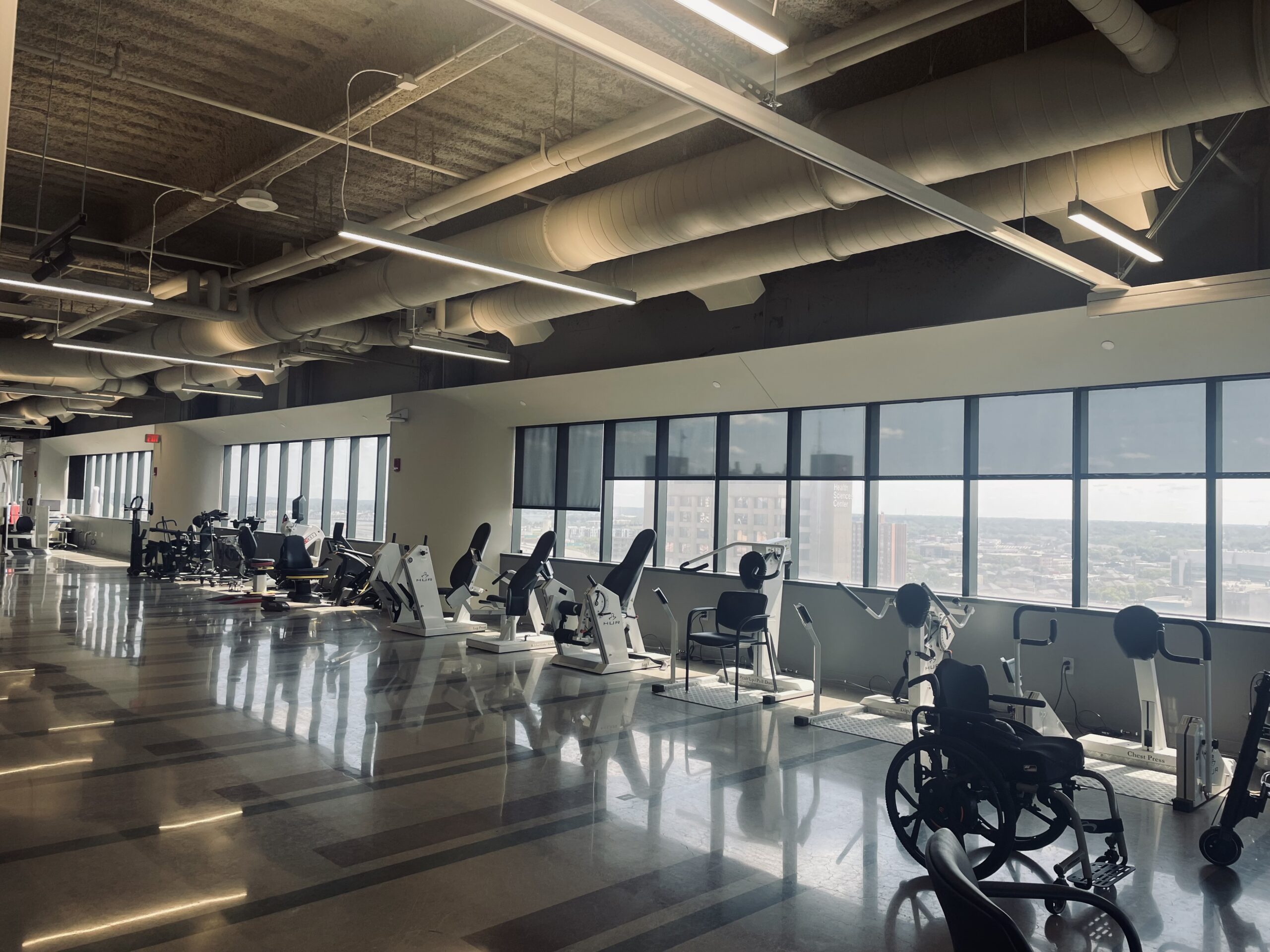
6th Floor Outpatient Center (12th Floor is on blog cover)
Considering my interest in nursing, my days in the outpatient clinic were one of the most valuable experiences that I had been measurably looking forward to. Rather than focusing on a direct research treatment or test, I observed therapists tailoring every session of theirs to the patient’s individual goals and needs. Therapy on the outpatient floor varied from physical, occupational, recreational, and speech therapies. Examining how each discipline approached every individual in their recovery process was an invaluable experience. Frazier Neurological Institute’s outpatient center is sectioned into two floors: floor six is designated for neurological injury, such as traumatic brain injury or stroke victims, while floor twelve is designated for spinal cord injury, which occurs mainly due to trauma to the spinal cord. In the neurological clinic, I observed a variety of sessions from functional movement to cognitive therapy. Many of the functional movement sessions consisted of walking exercises. The physical therapists prompted the patients to perform multitasking exercises, comprised of simultaneous exercises with arms and legs. Balance can also be severely affected by a stroke, so instruction for a walking sobriety test-like exercise was prompted in addition. The majority of the stroke victims appeared to have been affected more severely on one side of their body, so I could watch people lined up on the resistance trainers focusing specifically on one limb or side of their body. I was also able to sit in on a physical and occupational therapy session with a traumatic brain injury patient who was between level 2 and 3 on the RLAS 10 levels of cognitive function scale. His level consisted of generalized and localized responses, with inconsistent reactions to stimuli, and sporadic following of simple instructions in between inconsistent function. The physical therapist attempted to receive as many reactions and movement responses as she could from him, but he appeared very worn out. He had to wake up, though, because he had a whole session ahead of him with the occupational therapists, where we set up an eye-tracking device to see his reactions to questions and his ability to say simple responses. We prompted him to focus on the buttons to make a yes or no selection, but I think he was just about ready to wrap it up for the day. Not only did I observe and assist in session set-ups, but I was also offered the chance to participate in a group cognitive therapy session. I collaborated with a group of stroke victims in memory retrieval practice, word recognition, and language exercises. One of them made his belief about the unfairness of my “young/fresh-minded” participation especially clear. Apart from the fun and games of the group session, the takeaways focused on the effects of a stroke on language recognition were very valuable to my experience. My final session on the sixth floor was with a stroke victim working through her hand movement rehabilitation. We tested her functional movement and improvement after her stroke by working through a series of sign language symbols with our hands and analysing movement parameters.
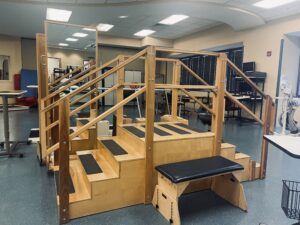
Stair set
What came across to me as the most distinct was how individualized each recovery path was. All the therapists collaborated across their disciplines to align each patient onto their optimal rehabilitation pathway, and my days observing and collaborating in each stage of the patients’ recovery, remaining so aligned and fitting to their needs, were especially useful for my future interests.
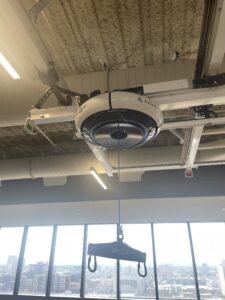
ZeroG!
The outpatient center additionally consisted of advanced rehabilitation technology. On the twelfth floor, I was introduced to a body-weight support and fall-protection system, the ZeroG. A simple ceiling-mounted support system, offering free rein (or at least inside the parameters of the track) for the patient to roam around, and ensuring safer gait training. To ensure safety and take some of the load off of the therapists were the distance and velocity safety settings. The distance setting locks the ceiling-mounted rope whenever the length of it from the disposal area is longer than a set amount, which locks the patient at a certain distance above the ground and prevents an occasional fall. The velocity setting locks the rope whenever the speed of the rope exiting the disposal area goes faster than a set amount, again preventing the patient from a fall. One patient who was affected by a spinal cord injury had a designated session on the ZeroG. After locking him into the safety straps, he roamed around the parameters and adjusted to the foreign way of movement. As I observed, a therapist suddenly tossed a soccer ball my way. I was startled for a moment, but caught on as she assisted in lining him up in front of me. As we began passing the ball back and forth, he looked up at me quickly and mentioned how he hadn’t kicked around a soccer ball like this, or any ball for that matter, since before his accident. I paused for a second as I caught the ball beneath my feet, and took a second to appreciate this moment I was able to spend with him. Though kicking a ball around may not seem like much to many, I know I cherished this moment just as much as he did.
Another advanced device I was able to work with was an orthotic leg support (sort of like an exoskeleton around the legs). This specific patient led us to an outdoor session, walking along the ramps and the uneven driveways around downtown, immersed in a real-world environment. Although he was completely paralysed below the hips, he stood up and slid himself into his forearm crutches or supported himself with his walker and took his standing steps along the sidewalk, kissing that wheelchair goodbye.
I can not include many pictures inside of the outpatient center nor the patients themselves due to HIPAA. Thus explaining my lack of patient photos these past six weeks.
I appreciate the time each therapist and patient granted to me to chime into their sessions. Thank you for the experience you have given me.
Clinical Assessment:
Earlier in the week, I watched an ASIA examination, which served as a nice break between my engineering sessions. An ASIA examination determines the level of a spinal cord injury through a series of cotton swab, pinprick, and motor function. Light touch was tested with a brush stroke of a Q-tip across the skin and a verbal measurement of sensation. Sharp and dull pinprick testing used the two sides of a safety pin, pricking on specific spots and with verbal distinction measurement between whether the prick was dull or sharp. Motor function tested the extent of consistent and conscious movement of body parts, as well as rectal functioning. This sensory and motor evaluation is vital for the accurate determination of neurological function and will help determine the individualized mapping session routes in future research projects.
Behind the Scenes:
I was also invited to sit in on a meeting, which was a brief discussion on the plans for the new Frazier neurological database and its user interface. Ideas were thrown around on the improvement of usability and accessibility…while also tangling with the idea of database confidentiality while the programmers accessed the outdated server.
Engineering Project:
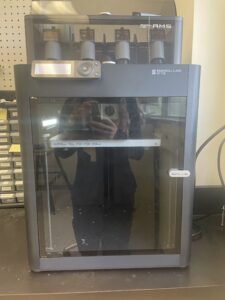
Hello there!
This was it. I was really bringing my design to life. And yes, I was extremely nervous as we opened up that 3D printer door.
I finished my SolidWorks 3D case prototype on Tuesday and began working with an intern named Amr (who was extremely familiar with SolidWorks, I will say…I have no idea what buttons he was pressing and what exactly they did as he examined my digital prototype; it was like some sort of sorcery). After he observed my design, I was just about ready for him to tell me to clear the file and restart, but he said all I needed to clean up were the 90-degree edges of the case (phew). He told me that 3D printers and 90-degree angles don’t get along very well, so I was prompted to fillet (round off) the edges to ease the printer’s nerves. Not only do I need to ensure user interface compatibility of my design, but printer compatibility in addition. Those picky printers!
I also discussed whether the case required a bottom enclosure with Andi, who then mentioned how there was a clip on the back of the X-Step to clip onto the wheelchair or whatever is preferred. Less struggle for me then…haha.
After finally returning the repaired and faulty electrodes to Ines, I headed over to the Engineering Services Lab to meet up with Aaron and Amr in the printer room. Amr used his sorcery to calibrate the 3D printer for my design, and all three of us crossed our fingers in hopes that my design wouldn’t turn into PLA filament spaghetti. Now all we could do was wait…
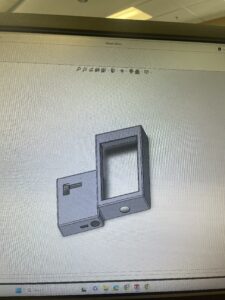
Digital version
Fun fact while we wait: Chuck Hull, the inventor of 3D printing (first printer in 1984; stereolithography), went to high school in Grand Junction! Just a coincidental anecdote I discovered throughout my 3D printing research.
Thankfully, we were able to cut down the required printing time by about two hours by dropping the infill density, so the wait time was only a couple of hours. And voila! My case was not a clump of filament spaghetti! Amr had gotten my hopes a little down before we walked over to check out my finalized product when he told me that I should have chamfered (45-degree angle) the edges of the case that touched the platform of the printer since the rounded edges were renowned for sticking to the bottom. Fortunately, the printer didn’t wake up on the wrong side of the bed that morning.
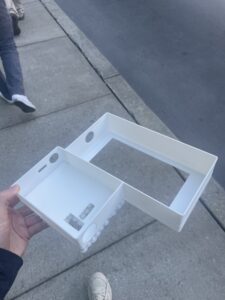
Physical version
After bringing my beloved prototype back to the office, I had a meeting with Andi, Aaron, and Matt. Andi made sure to keep reminding me that this was prototype one, so I wouldn’t let any of the inadequate findings hurt my feelings. We discussed the differences between me making my design more square-like instead of long (lined up). And the fact that the pause box didn’t even fit in the case…(I thought ⅛ of an inch was enough wiggle room–suppose not). After our meeting, Andi handed off the prototype to Amr, who would expand this project off of my design. Although my design wasn’t perfect, I kept in mind that not everything can be perfected on the first try. And the fact that I turned my own digital design into a tangible object that is being considered for future medical engineering growth is an accomplishment stronger than anything else.
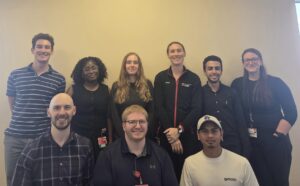
The team! Thank you all & anyone else not pictured!
I would like to extend each and every one of my thanks to Andi, Kristin, Ines, Aaron, Matt, my fellow interns, the entirety of the research team, and each research participant I was associated with. From trusting me with meaningful projects and equipment to your encouragement of my participation in research sessions, you all made me feel like more than just an intern. I never expected to be able to contribute in ways that I did.
Final Week @ Home:

I took my family out for Ethiopian food!
How grateful I am that I was able to spend my final week in Louisville with my entire host family. Although packing away my ID badge reminded me of the end of my internship, leaving my host family after my final week was just as difficult. My home away from home: Brigid, David, Graham, Angus, you offered me so much more than just a place to stay for the summer. Brigid and David, thank you for opening the doors into your home and introducing me to Louisville through your family’s eyes. Graham and Angus, thank you for the humorous and fun company that I walked into every day after work. I am extremely fortunate that this internship introduced me to your family.
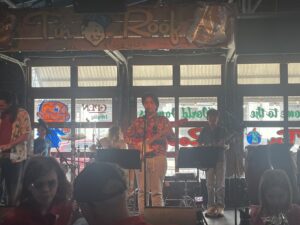
My host brother, Graham, singing at a Beatles show on my final night in Louisville!
I also want to thank the other Pintern, Louis, and his host family, Colleen, Mars, and Patrick, for offering me another place to always feel comfortable.
Special thanks go to Sarah Holbrooke and the entire Pinhead team for administering these experiences for prospective high schoolers each and every summer. Your commitment in the interviews, matching interns with institutions, organizing the logistics for each program, orchestrating the fundraising events, continuing to give helpful feedback to the Pinterns throughout the process to ensure their growth and success in future endeavors, and countless more I can’t even list. Thank you for giving me a chance to be a part of the Pinternship program.
No Comments