
19 Jul Liliana Almanza Mendez – Scripps Research @ Briney Lab, Week 4
Hello and welcome back to the blog!! It’s officially the fourth week of my internship, which means I sadly have to say goodbye next week. But to distract myself lets do a if you didn’t know, now you know, your welcome of the week…
#1 For those who are unknowledged in Colorado, we do not live in houses made of mud and sticks, nor do we have to fish for our food. (Your welcome Umair ”Nathan’s other high school intern”)
Monday, July 14th
As we came to find out last week both Mondays and Fridays are pretty slow. I was actually taking this downtime to set up the outline for the Pintern presentation this upcoming September. Nate asked if we would like to join them for a meeting with the Ward Lab, so we headed over. There were bagels and given I hadn’t had one in a while, there was just something about them that was extrodinary. The presentations today were very interesting especially the software and algorithms that the sequences are run through. It feels so rewarding to be able to understand more and more about what people present. I say this because the first presentation we listened to I had no idea what they were talking about. By attending meetings I have learned so much about public speaking and the Do’s and Don’ts.
For the rest of the day, we shadowed Dani one of our mentors, she was working on a sample of the Astro 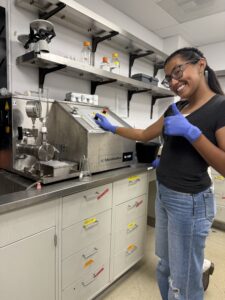 virus and needed to harvest it. The process began by having to resuspend the pellet with buffer, since it had been frozen. Then, we headed over to the chemistry building across the parking lot where the Microfluidizer is. The Microfluidizer is a machine that is a high-pressure fluid processor, when you insert cells inside it makes them burst open and the DNA or proteins inside burst open and remain in the supernatant, so then we can collect. To even insert our samples into the Microfluidizer we had to wash the pipes about 3-4 times with isopropanol and buffer, this is to ensure no other cells from past usage are stuck inside and we just collect our sample with no contamination. During these washes Dani let us help and the biggest ‘’make sure’’ was to not let there be air inside, so this meant to
  always leave extra fluid inside. We wrapped up and headed back to the Briney lab to centrifuge our sample for 15 minutes and 10,000g’s. I didn’t even know there was a bigger centrifuge until Dani showed us today, this centrifuge can reach about three times the speed of a countertop centrifuge. We picked up the sample and went inside the cell culture room where Dani harvested the cells (added media) so they could begin growing and replicating. This led us up till 5 pm, so we headed over to USCD Central Campus to get on the trolley back home.
Tuesday, July 15th
Instead of Nathan guiding us through harvesting the samples from last week, Morgan took over. We began  with setting up our hoods (Biological Safety Cabinet); this meant letting it run for a while then spraying everything inside with ethanol. Everything that goes inside also must be sprayed down with ethanol; the point is to provide safety for the user, environment and to keep sterility. We were working with bacteria, so we set up 10%
  bleach bucket solutions for our contaminated trash. Now that we were all set, Morgan assigned us each 12-13 samples, and we began by pouring them into new test tubes. This was to get rid of the bacteria growing on the tube’s walls. We then centrifuged for 10 minutes at 10,000g’s. This was to hopefully get all the cell derbies to precipitate to the bottom. Next step was to pour them over a filter that was connected to the vacuum; this was to have a fully clear uncontaminated supernatant. After doing so we added 500µl of protein ‘’A’’ to each of our samples. The last step was to place them inside the cold room on the spinning ferris wheel, which Morgan DIY extra attachments with tape, since we had to many samples. Honestly, if it works, it works so #StayCreative!
Wednesday, July 16th
If you recall, last Friday we shadowed Riza on the Transfection protocol for three samples that Terrance  was working on. Terrance assigned each of us a sample and I got to work with Nipah virus (NiV); a zoonotic pathogen, that evades the body’s innate immune response and because NiV affects early immune responses, the primary way the body successfully fights the virus is through the production of neutralizing antibodies, that targets the virus’s surface receptor-binding proteins. We started the harvesting protocol by transferring 500mL of the sample into 500 mL centrifuge tubes, and we repeated this step twice. Then we centrifuged for 3500g’s for 25 minutes at 4ºC. Now was the time to filter (picture on the right), the filters clogged as expected so we switched it out once. Terrance then added the beads and a deadly chemical that in studies, kills 99.99% of animals tested against it, so we
  observed as he added very little into each sample. We also had a meeting at 12 so we placed our samples in the cold room on the rollers, so tomorrow we can transfect. Nathan did a practice presentation for an update on his thesis, he even included us! I had never had Thai food, but the crispy chicken with lemon sauce that I ordered was so good. I will defiantly but ordering again next week, hopefully trying the Thai coffee too. We headed back and wrapped up the harvesting protocol by wrapping parafilm around each sample, this is to further prevent spills, the caps are old and don’t seal very well. There were 20 minutes left of the England vs, Argentina World Cup game so we headed over to a watch party across the campus. The host was giving out little flags and hand slapper toys for everyone, it was pretty packed inside the conference room, but that’s what made it funner to watch as everybody reacted. As we were heading out Terrance asked us for gum and I gave hime a piece, which honestly I thought he would have never asked.
Thursday, July 17th
Today was a very busy day. We were continuing the harvest protocol for Nathan’s samples. If you recall we  began the harvest protocol on Tuesday, giving the samples two days to spin on the Ferris wheel, in the cold room. We started by labeling new tube collectors with a filter inside of them, this was to catch all of the antibodies and discard the rest of the liquid. As you can see in the picture on the right, we were using columns, and the tub at the bottom was used to collect all the liquid. Before we could pour each sample into the columns, you had to invert the tube a couple of times so the bead would disassociate. Each time the tube went on the lower end we poured more in and waited because it filters droplets at a time. It was very crucial to not let the filters go dry, the antibodies would not be too happy in that environment. Once all of the sample went through we did a wash run with DPBS a buffer to make sure nothing but the antibodies were caught inside the filter. Next, we capped off the tubes and added 5mL of elution buffer to each, for 5 minutes. This buffer breaks the antibodies from the beads, it can do so because of its acidity (pH 3). This toke us all the way up to 1 pm ish so we capped off the tubes and stored them in the cold room, so we could go to lunch. Nathan had an event to go to, so we called it a day.
Friday, July 18th
Okay, I’d say this was the best day in the lab yet! It was full of new wet lab procedures and mini lessons.  We began by finishing our harvest procedure with Terrance. We transferred our four samples into 500mL centrifuge tubes and centrifuged for 10 minutes at 3500 g. They created huge pellets at the bottom I couldn’t even believe it! Next, we added them to the columns like yesterday’s procedure, except this time we hooked them up to the vacuum instead of letting gravity pull them through the filter. If we were to let gravity do the work it would take hours! Unfortunately, this full procedure had to be done in the cold room that’s set to 4ºC, Terrance suggested we utilize three gloves instead of one to keep our hands warm. After they went through the vacuums we did three washes of PBS to make sure everything was cleared through the filter. Very interestingly we were able to see the antibodies with our naked eye they looked like white
  specs and there were so many! That wrapped the harvesting procedure for Terrance, but began part two of harvesting Nathan’s, We collected all 38 of our samples from the cold room and began the process of doing three washes of PBS and centrifuging. This was to fully clear the filters and only leave the antibodies present. Lastly, we resuspended our antibodies with DPBS and transferred them into 1.5mL centrifuge tubes. Like always we checked our concentrations and labeled them onto our tubes. Some were good and others not so good, this time we were measuring in mg/µL. This took us all the way up to 5 pm..
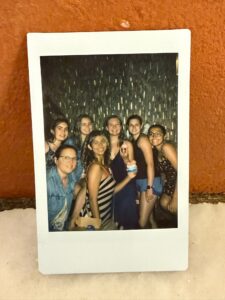
We ate dinner earlier than usual to go to Scripps Pier and watch the sunset, we sadly missed it, but luckily got so many cute pictures. Afterwards, we headed to the desert bar in town, where I got amazing tiramisu ice cream.
Saturday, July 19th
 Today was a very sad day. Stella and Kalia left 🙁 The house definitely feels empty with only five of us remaining. We had an early breakfast and said goodbye to them and headed out to drop off Belle, Zoe, and Ellie at Balboa Park. I wasn’t really feeling like being outside in the heat, so Jennie dropped me off at a Ross nearby. The Ross was so big there were racks upon racks of clothes, I got a couple of new shirts and some lunch containers. We headed home and sadly planned our activities for our last week in San Diego, it will definitely be a busy but fun one.
I’ll see everyone next week, for the grand week finale!!!
No Comments