28 Jun Gunnar Robinson, The Colorado School of Mines, Petroleum Engineering, Week 2
Hello everyone, this is Gunnar Robinson. I am excited to report that my second week at the Colorado School of Mines was another incredible experience, building on what I learned during my first week and deepening my knowledge of the petroleum engineering field. I continued learning and working alongside both Dr. Ashtiwi Bahri and Kenneth Bensching, while also taking on a new opportunity to assist Ph.D. candidate Aiman Laalam with his hydrogen bubble data collection project. It was a fantastic week that allowed me to expand my knowledge, gain new experiences, and meet more incredible people. I am excited to share what I learned and accomplished in this blog.

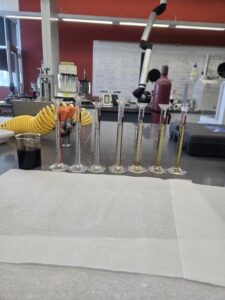
With Dr. Ash, I began conducting experiments on fluid properties in the Colorado School of Mines undergraduate laboratories and learned about the process of a flash separation test. During one experiment, Ash showed me a machine used to heat crude oil, (distillation) causing it to vaporize before entering a chamber where it was condensed back into liquid form. As each beaker filled, the oil became progressively darker because the lighter hydrocarbons were separated first, leaving behind the heavier components. This experiment helped me better understand the fluid properties of oil and the refining processes used to produce different petroleum products. It also gave me valuable experience with the type of laboratory work I may encounter as an undergraduate student.
In addition to the lab experiments, Ash taught me about flash separation tests, the relationship between reservoir pressure and pressure loss, various oil properties, API gravity, and the differences between laminar and turbulent flow. Each of these concepts plays an important role in understanding petroleum fluids and well systems. However, explaining all of them in detail would make this blog much longer than intended, so I will focus on the flash separation process.
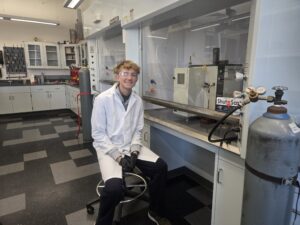
When fluids travel from the reservoir to the surface after hydraulic fracturing, they experience pressure losses due to factors such as friction, gravity, and acceleration. To better understand how the fluids behave under reservoir conditions, engineers use a flash separation test. In this process, the fluid is brought into a controlled chamber where the pressure is adjusted to a specific value, allowing engineers to observe how the oil, gas, and other components separate from one another. The results provide important information about fluid behavior and help engineers make decisions regarding production and processing operations. Dr Ash’s support has made a significant impact on my understanding of petroleum engineering concepts and laboratory work, and I truly appreciate the time he has taken to help me learn and grow in this field. I am very thankful for the opportunity to work with him and look forward to continuing to learn from him in the coming weeks.
With Ken, our experiment this week involving core flooding and pressure testing on different proppants unfortunately did not go as planned, as mineral oil leaked into the flood system and resulted in skewed data. Because of this, we shut down the equipment and began the initial cleaning process in preparation for the next test.
I also worked on permeability and porosity experiments with Ken; however, the machine configuration produced inconsistent results, so we ran several additional tests in an effort to troubleshoot and improve accuracy. In addition, we helped finalize a high-tech mining simulator that the Colorado School of Mines had set up, which was a great hands-on experience.
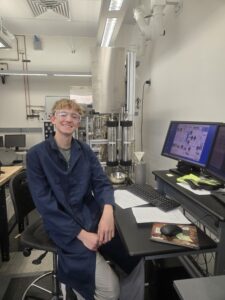
Although we had some experimental setbacks this week, I was still able to have many valuable conversations with Ken throughout the process, which made the experience very meaningful. I am sincerely grateful for his guidance, patience, and willingness to teach, and I truly appreciate the time he has taken to help me learn and grow in this field.
I also had the incredible opportunity to work with Ph.D. candidate Aiman Laalam on his hydrogen micro-bubble experiment, where he studied the diameter and behavior of hydrogen micro-bubbles formed in water under controlled conditions. The goal of the experiment was to better understand how these micro-bubbles interact with their surrounding environment and how their size and properties change under different conditions.
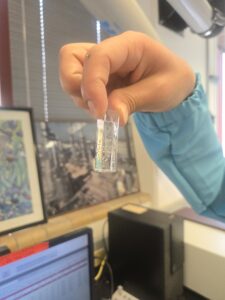
After generating the bubbles, the samples were analyzed using a high-resolution microscopic imaging system. This allowed us to closely observe the interactions between the hydrogen bubbles and the surrounding fluid at a very small scale. In a later stage of the experiment, oil droplets were introduced through a precision syringe system, and the same imaging setup was used to study how the oil droplets behaved in relation to the water and gas phases. The accompanying software then calculated various fluid properties and helped model the interactions occurring between the different phases.
Overall, it was extremely interesting to observe this experiment up close and take part in such a detailed and advanced laboratory process. I am very grateful to Aiman for including me in his work, taking the time to explain the experiment, and allowing me to contribute to such a unique and insightful research experience.
That was week 2, and I am incredibly grateful for this incredible opportunity!
Do Things Worth Doing!
~Gunnar Robinson
Marianne Robinson
Posted at 10:44h, 29 JuneThank you Gunnar, for sharing your blog with me..
Now I have a greater understanding of the work that is involved in the oil production. It is so impressive. What a wonderful opportunity to have to receive a headstart for your Freshman year. I am so proud of you, that you chose this field.