20 Jun Zoe Schiffer – Chemistry at TSRI – Engle Lab – Week 1
Hi everyone, my name is Zoe Schiffer, and I have been given the amazing opportunity to spend six weeks in San Diego interning at the Scripps Research Institute in the Engle Lab. The lab is run by Keary Engle. I have been working with Madison Wagner, a fourth-year PhD candidate, as my mentor. She gave me a tour of the lab, which solidified my feelings that I am now working in a real lab that does real research and produces results that are used in the real world.
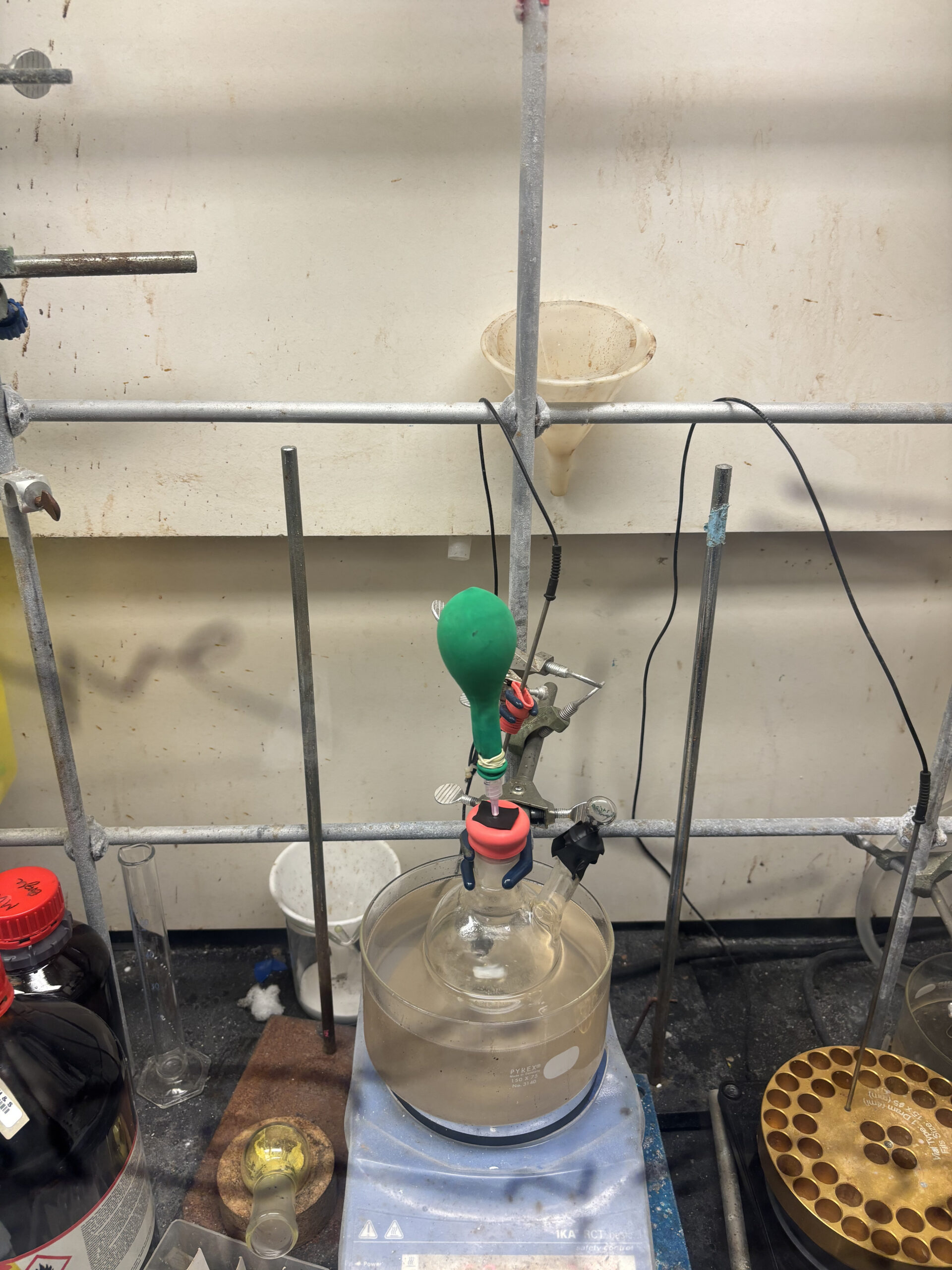
The first attempt to make an acyl chloride
The first reaction we did involved turning a carboxylic acid into an acyl chloride using thionyl chloride. This reaction took a couple  of tries to get right, but on the second attempt, we succeeded after leaving it overnight. We had to do this reaction in an inert atmosphere due to the toxicity of the thionyl chloride, which meant replacing the air with nitrogen. To do this, we used a Schlenk line. This involves putting a seal around the flask and inserting a needle into it. The needle is attached to a line that vacuums out the air and, with a turn of a valve, adds nitrogen into the system. By alternating between vacuuming out the air and adding nitrogen, an inert atmosphere can be reached, and the toxicity can be contained. We then put the solution into an oil bath so it could be heated uniformly. The directions said to wait an hour, which we did; however, it was not turning the pale yellow color we expected. We waited another hour, and it still wasn’t yellow, but we rotovaped it anyway.
The rotovap (Rotary Evaporator) is a piece of equipment that allows the solvent to be removed, or evaporated, from the product. This is done by attaching the flask to a vacuum system that includes a column filled with dry ice. The combination of the vacuum, which lowers the boiling point, and the dry ice, which condenses the solvent that boils out of the flask, leaves the product behind. The remaining material in the flask is either the final product or, in our case, something that will be used in later reactions.
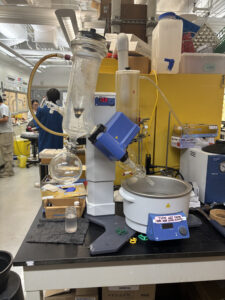
Rotary Evaporator
Rotovaping the first reaction didn’t give us a product; in fact, it gave us a reactant. We then repeated the reaction. This time, I got to do a little more than just watch. Don’t get me wrong, I learned a lot by observing, but actually doing things is really fun. I was able to measure out chemicals and add them to the flask. It doesn’t seem like much, but when someone hands you a chemical and says, “This can kill you,” it sparks a type of intrigue that I have really enjoyed. We put the reaction together again and let it mix and heat in the oil bath. This reaction was left overnight because it still wasn’t looking yellow when we left.
The next morning, we came in and found the yellow color we had been looking for. We then rotovaped it and obtained the gummy yellow solid we wanted. From there, we used the acyl chloride to perform amide coupling, which is useful for pharmaceutical testing. During this time in the lab, we also used a process called extraction to remove the product from the reaction solution. This works by separating the product from any solvents left in the reaction mixture and using density differences to separate the layers. This process is generally repeated several times so that the maximum amount of product can be collected. We also used a similar concept when filtering.
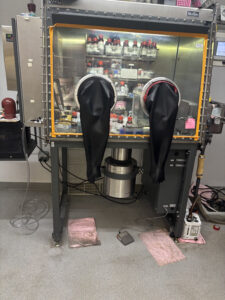
The Glove Box
We also got to use the glove box, which houses chemicals in an environment without air. This allows chemicals to remain dry, meaning they are not exposed to water, which is required for some reactions. We had to measure some materials in the glove box, which meant putting items into it. To do this, there is a small antechamber that vacuums out the air so that none is introduced into the box. There are also large gloves attached to the box that allow us to work inside from the outside. I watched Madison do it and thought it looked easy. At this point, that has been the general theme, and I have learned to expect that things won’t actually be that simple. I then tried to put a chemical away, which seemed easy enough. I felt like I was trying to grab the bottle while wearing a space suit. To add to the challenge, I could barely reach the spot where the chemical belonged, so I had to carefully nudge it into place.
Though most of my time is spent in the lab, I’ve done a couple of other things at Scripps as well. I got to attend some SURF presentations. SURF, or Summer Undergraduate Research Fellows, is a program at Scripps, and I was able to attend their Week 3 presentations, where students explained the goals of their projects, what they would be doing, and received feedback. Though I understood only a small portion of what was discussed, the projects all sounded interesting, and I enjoyed myself.
I also happened to be here during the anniversary of the Engle Lab, which is celebrated on June 15. In honor of the occasion, the entire lab went out for Korean barbecue, which was really fun. I got to meet more of the people who work in the Engle Lab and see everyone outside of the lab environment, which was interesting.
Up to this point, the only chemistry experience I have had is a single chemistry class in high school and the first week of my internship. I feel like there is a massive gap in my knowledge, but it closed ever so slightly this week. I hope that it continues to close as the weeks progress.
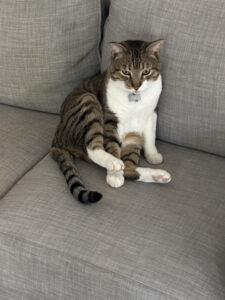
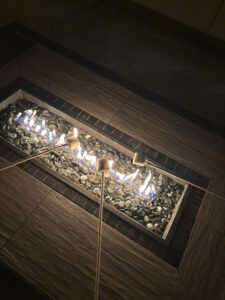 Outside of the lab, life has been busy as well. I’ve spent some time with my roommates, Stella and Kaila, at the beach and around the house. We have gone on a couple of walks that generally end with some sort of treat. There has also been a fair amount of time spent annoying Goose, Jennie’s cat, though he somehow hasn’t decided that we are terrible yet (Jennie is our host mom). We have also determined that the table on our back patio doubles as a great place to roast marshmallows.
I’ve also spent some of my afternoons after work at a climbing gym. It’s definitely a different vibe than I’m used to, but it will suffice for the time that I am here. Other than that, there have been a lot of early nights because this experience is both exhausting and incredibly fun.
From exhausting myself trying to understand advanced chemistry to having laughing fits in the evenings because something got misheard, I have had an amazing time during my first week, and I can’t wait to see what’s to come! 


No Comments