
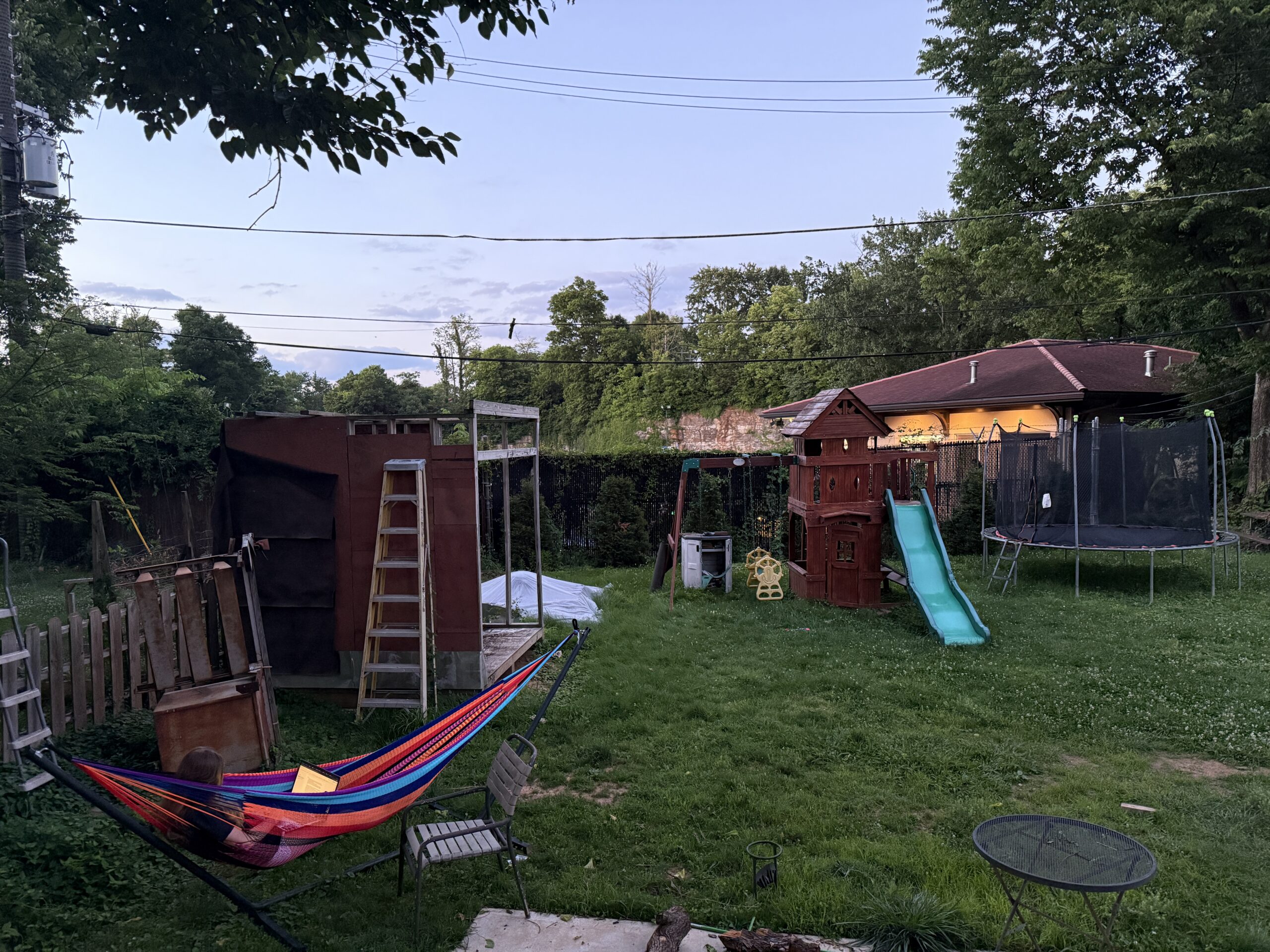
21 Jun Harper Lapp, Frazier Rehabilitation Institute, Week 1
Howdy! Let me tell you all, my first week working under Andrea Willhite at University of Louisville Health – Frazier Rehabilitation Institute has been anything but dull. Who would have thought that I would be eager to head to work in the morning–even after the 4 AM tornado sirens? Having arrived on the 13th, this past week has certainly taken its time. Whether you find me working throughout the hospital campus downtown, or along my countless evening walks around The Highlands neighborhood, you’ll never see me complaining about the time I have been granted to be thoughtfully educated by professionals, or exploring a new city with family and friends. My host family, neighbors, and coworkers offered me warm welcomes as I settled in, and they haven’t lost that southern hospitality since then.
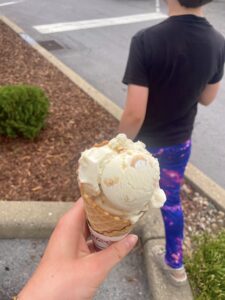
Ice cream outing with my host brother! Our innocent stroll got us caught in a torrential downpour…all of our ice cream melted in front of our very eyes…
To give everyone a briefing on what exactly I’ve gotten myself into: I’m working at the Kentucky Spinal Cord Injury Research Center (KSCIRC) in the Frazier Rehab Institute and Neurological Center in Louisville, Kentucky. KSCIRC conducts promising research in the development of spinal cord repair strategies. They perform research and testing in their laboratories in hopes of bringing these rehabilitation techniques to their outpatient clinic. I have been exposed to a wide variety of tests, exercises, sessions, and data collections while in the laboratory, and I hope to be able to watch them in action in the clinic next week–if my access ever gets approved.
Exploring Pulmonary Function
My first day was no slow start. Promptly after receiving my necessary tours of the floors I would have to familiarize myself with for the upcoming weeks, I was directed right into a session with a participant (not exactly a patient per se, as these people have offered to consent and contribute their data to research). Kristin, my mentor, introduced me to my surroundings as I entered the lab. I found myself walking into a pulmonary function test (PFT), where a participant was using a specific device called a spirometer (spirometry being a specific type of PFT). After calibrating the spirometer’s pressure and flow sensors, researchers collected measurements that helped determine how well the participant’s lungs were functioning. Observing the screens above the spirometer, they displayed respiratory flow rate and volume data. Along with those data sets was the FEV1/FVC ratio: FEV1 being the amount of air you can exhale forcefully in one second, and FVC being the total air exhaled forcefully in a complete breath. In the following sessions, I was presented with the Airofit mobile respiratory training device. Whilst using the Airofit, participants could view their inspiratory and expiratory pressure on a tablet, with data being relayed directly from the device. One participant mentioned that he used his data to set goals for himself, actively managing his air flow through immediate feedback.
Some of you may be wondering why I’m writing about pulmonary training when my internship appears neurological-based. And no, I haven’t been going to the wrong building the entire week. Interestingly enough, pulmonary function can be immensely affected by spinal cord injuries (SCI). SCIs can trigger immense ventilatory changes (breathing processes) in tetraplegics (all four limbs) and paraplegics (lower half of the body) alike. Respiratory muscles may be affected by such injuries, such as the diaphragm and intercostal muscles (around the ribs). Muscle defects like this can cause breathing capacity and cough effectiveness to decrease substantially. People affected use PFT’s and training devices like the Airofit to track and aid respiratory recovery. Pulmonary training doesn’t seem so irrelevant now, does it?
Spinal Cord Injury Familiarization
Entering my very own cubicle, I was sure enough presented with material to familiarize myself with SCI’s. I viewed a series of ten or so slide shows to acquaint myself with spinal cord anatomy, secondary health effects, nutrition, therapy, and other aspects of SCI management.
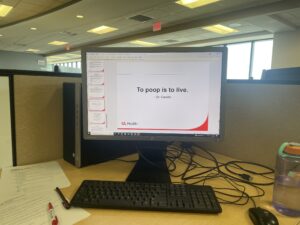
Quite inspiring words, Dr. Castillo….
What intrigued me the most was that these slideshows are typically observed by new SCI patients to give them a briefing on their situation. One of the slide shows even contained a pressure relief reminder slide, prompting the SCI-affected viewer to take a moment to relieve the pressure on their body. These affected people are mainly sitting the entirety of the day, so it is essential to develop a schedule where they will shift their weight and alter their position in their chair to relieve any constant pressure on their body to prevent skin breakdown and ulcers.
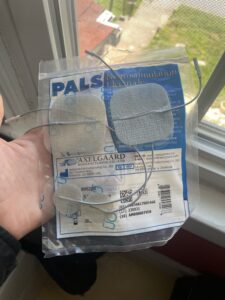
Who wouldn’t want their very own set of neurostimulation electrodes?
Additionally, I performed research, observed, and underwent tests involving noninvasive neuromodulation strategies, specifically spinal cord transcutaneous stimulation (scTS). scTS is a noninvasive technique to bypass epidural surgery, and is currently undergoing research at Frazier Rehab Institution. Placing neurostimulation electrodes directly onto the participant’s skin (specifically on the spine and lower abdomen), scTS releases electrical currents through the stimulation pads and targets sensory nerves throughout the body. This stimulation provokes dormant neurological networks and enhances the peripheral nerves (nervous system outside of the spinal cord and brain). And I’m not exaggerating when I say that it definitely provoked my peripheral nerves. After falling subject to this test, the stimulating electrodes tightened all the muscles throughout my neck and back. I don’t think I have ever stood as straight as I did with those stimulation pads…
Autonomic and Cardiovascular Trials
New participants came around, and the subject of blood pressure arose. SCI affected persons undergo immense blood pressure fluctations: from extremely low pressure when sitting and a lack of muscle movement moving blood up from the lower body through the veins, to instances of autonomic dysreflexia (AD) and muscle spasms spiking blood pressure. AD predominantly affects people with SCIs, and it is a response from the overreaction of your autonomic nervous system, which can be provoked by something as simple as a full bladder. Initially, a participant with hypotension (abnormally low blood pressure) was given a seated blood pressure evaluation. After moments of silence, as to not trigger a rise in blood pressure, he was then given a series of color and word recognition tests (low blood pressure can affect vision) whilst his blood pressure was measured throughout.
The seated blood pressure evaluation verified his eligibility for the tilt table test (to observe the body’s reaction to a change of position), and so we began. Aaron, another one of my mentors, began this test with the establishment of our number one…and now that I think about it…only rule: don’t pass out. After strapping the participant into a bed, he was then tilted up 70 degrees from the floor and remained suspended for multiple minutes. When lowering him back down from the suspension, he seemingly appeared to awaken. When unstrapping him from the bed and placing him back into his wheelchair, he mentioned he had an inkling that he had become unconscious while being raised in the air. And so it seemed, he had broken the number one (and only) rule. The participant had undergone orthostatic hypertension (OT), which is a sudden drop in blood pressure when standing up or lying down. As this participant was raised vertically, his blood pooled in his lower extremities. People who are not affected by an SCI compensate for this pooling by constricting their blood vessels. But since this patient had no muscular connection to his lower extremities, his body was unable to constrict such vessels, and his compensation was impaired, resulting in OT and his eventual loss of consciousness.
Gravity Neutral Device Exploration (GND)
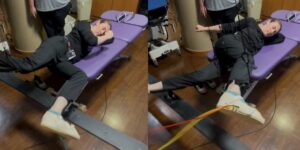
Kristin here demonstrating the GND. I gave it a go, but my performance wasn’t quite as successful! Hence why no photo of me is posted…
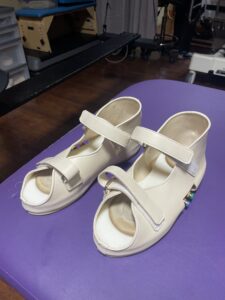
Russian Heel Boots! Funky feeling.
The GND creates the illusion of weightlessness and eliminates any gravitational forces. After laying the participant on their side and strapping their ankles into the holders (as shown in the photo), we place Russian Heel Boots onto their feet to additionally include the illusion of weight on the pads of feet and heels (balloons inflate and deflate inside shoes). The Russian Heel Boots aren’t entirely irrelevant to SCI participants, but they are more so directed to those affected with Parkinsons. Kristin mentioned the implementation of VR headsets into the GND device to allow participants to visually imagine standing upright instead of the awkward position they find themselves in as of now. This chance to explore the GND was great, and I hope to see more of it in the following weeks.
Rehabilitation Engineering
Circling back to my first day, I was additionally involved in biomedical engineering! I worked with Ines, yet another mentor, in the KSCIRC Engineering Service Lab (just across the street from the rehabilitation institution). We devoted a few hours of our time to fidgeting with Ambulatory Blood Pressure Monitors (ABPMs; portable devices that measure blood pressure). I tried to recall some soldering skills of mine (joining metal surfaces using a metal filler called solder; melting when it is heated up and hardening between surfaces to conjoin them), but it wasn’t going very well, to tell you the least…After soldering (or at least attempting to) a few flimsy, inconsistent wires and ABPM batteries, we used a heat-shrink gun to secure the wires with sleeves. Ines and I weren’t sure how unhealthy it was to inhale the soldered metals…oh well!
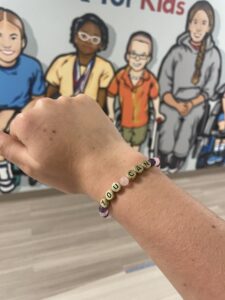
Bracelet made by one of the Kosair for Kids pediatrics patients!
One more thing! I was able to be present for the Kosair for Kids press conference, as well as the ribbon-cutting and tour for the remodeled pediatric rehabilitation floor!
Life @ Home
My host parents, Brigid and David, as well as my host brothers, are truly amazing. They will literally make other host families jealous. Card games have now become my favorite thing…hitting my host brothers with mini swords being my second. I haven’t been given work outside of the internship, so my afternoons and days off are open for time to explore! Lakeside, the pool that our house shares a fence with (although I’m unable to climb over it), is no joke. Established inside a quarry, Lakeside is one of, if not the best, places to lounge. It also serves as a great place to meet new people! This week was just the beginning, and I can not wait to continue my studies and free time over here in Louisville!
No Comments